Open Flying geese in the studio. The form on this page is that calculator.
Why there are two flying-geese methods
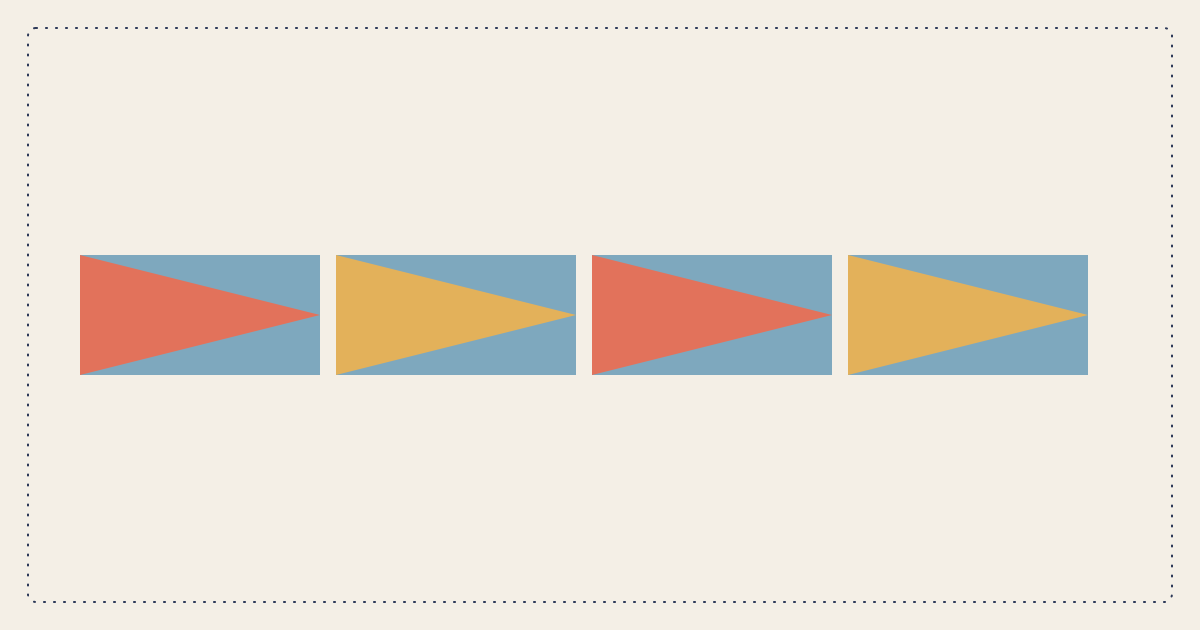
A flying goose is a wide unit: one large triangle pointing along, and two smaller triangles at the sides. Most patterns use geese that finish twice as wide as they are tall. The no-waste method makes four of those from one large square and four small ones. Leave the width blank and that is the shape you get.
A goose of some other proportion cannot be made that way. Stitch-and-flip makes any shape, one goose at a time: a rectangle of the goose fabric and two squares of the sky. Both methods are cut to be trimmed. A goose that is a sixteenth off will throw the next seam, and a flock of them will throw the whole block.
How the squares are calculated
No-waste, and only when the width is twice the height:
- Goose square = finished width + 1 1/4 inches. One square makes four geese.
- Sky square = finished height + 7/8 inch. Four sky squares per goose square.
- Trim to = finished width + 1/2 inch, by finished height + 1/2 inch.
Stitch-and-flip cuts the goose rectangle at that same unfinished size, and each sky square at the finished height plus 1/2 inch. You need one rectangle and two sky squares per goose. The flying geese block guide walks through the seams.
No-waste flying geese
Each row is one batch of four geese. Multiply the squares by the number of batches.
| Finished goose | Goose square | Sky square | Trim to |
|---|---|---|---|
| 2 × 4 in | 5 1/4 in | 2 7/8 in | 4 1/2 × 2 1/2 in |
| 2 1/2 × 5 in | 6 1/4 in | 3 3/8 in | 5 1/2 × 3 in |
| 3 × 6 in | 7 1/4 in | 3 7/8 in | 6 1/2 × 3 1/2 in |
How to use this calculator
- Enter the finished height. If the goose is twice as wide as it is tall, you can leave the width blank.
- Choose no-waste for that 1 by 2 shape. Choose stitch-and-flip for any other proportion. The card switches the cuts when you do.
- Enter how many geese you need. No-waste rounds up to the next four. Eight geese are two goose squares and eight sky squares.
- Trim every goose to the unfinished size on the card before you sew them into a block.
Tips for a flock of geese
- Check the point before you trim the whole batch. The sky should cross the goose a seam's width from the tip, so the point survives the next seam.
- Sky squares are smaller than they look. A 2 inch goose wants a 2 7/8 inch sky square, not a 3 inch one. The extra eighth is the difference between a point and a blunt tip.
- Directional sky fabric has to be watched in the no-waste method, because the four geese come off the square in different directions.
When the piece is part of a whole quilt. A sawtooth border is a long run of these units. Change the count and the card scales the squares. The fabric calculator counts every piece in a design, then adds binding, backing, and batting. These pages answer one question at a time.