Foundation paper piecing software should mean you leave with paper you can sew onto, not a pretty honeycomb on screen. Quiltler does that job. You design the layout in the browser studio — or on iPhone and iPad — and a subscription pack can include mirrored copies of every shaped piece. This page is that pipeline: grids, cuts, templates, and what we do not pretend to be. For the rest of the product see quilt design software. For a no-install session see the online quilt designer.
On this page
What Quiltler actually prints for FPP
In the pattern pack designer there is a toggle: Foundation piecing sheets. It adds mirrored copies of every shaped piece. The sheet heading says to sew on the dashed lines, then trim to the solid line. The shape is flipped so the finished piece reads the right way round once you tear the paper away — the usual reason FPP papers are printed in reverse.
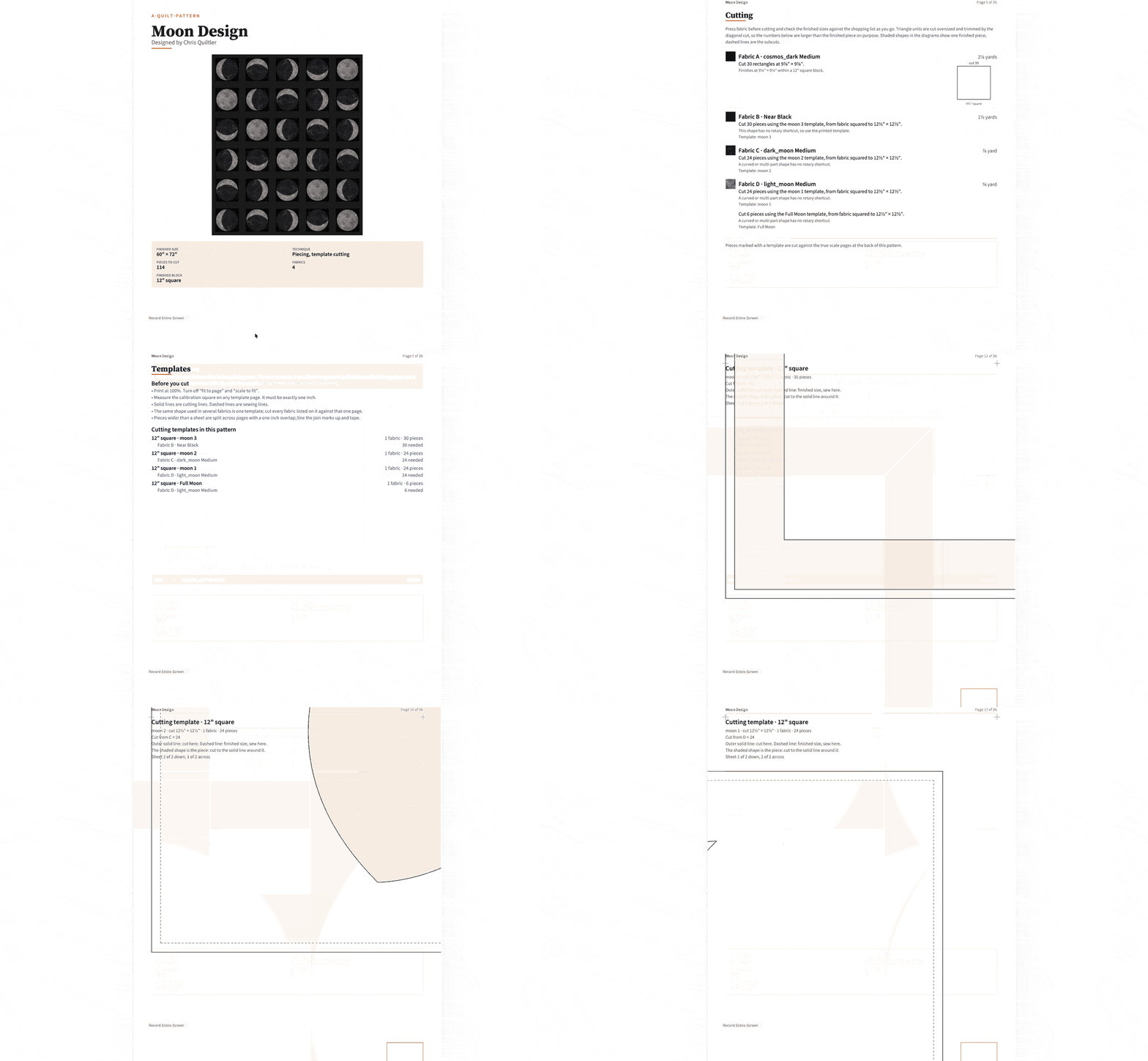
Those sheets are true scale. Pieces larger than a page are tiled with overlap and join marks. Every template page carries a one-inch calibration square, because browsers and printers love to quietly scale to fit. A free sample of a marketplace listing never includes the templates; that would be giving the pattern away.
Cut grids: the layouts that default to FPP
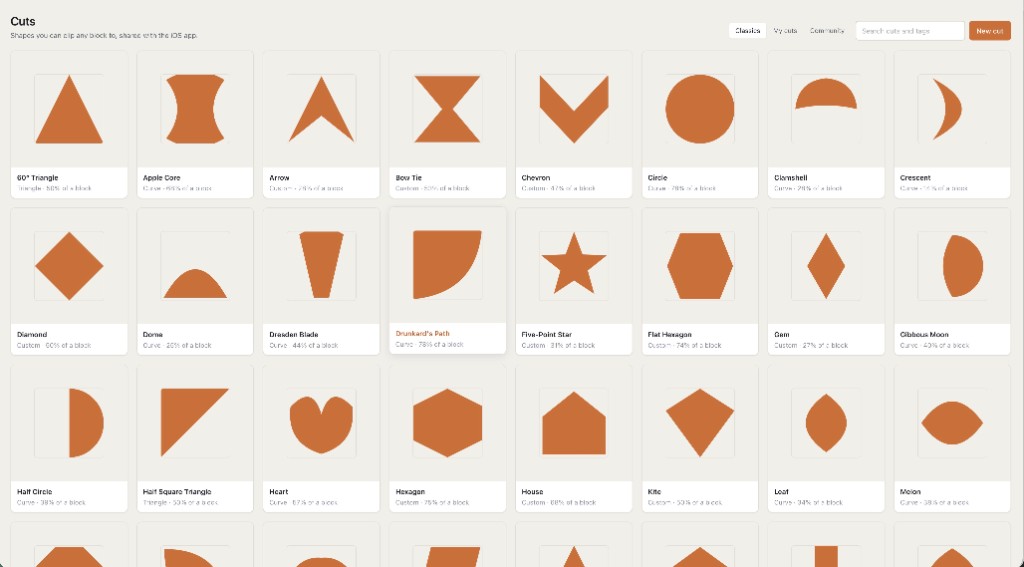
- Hexagons, 60° triangles, diamonds, tumblers, tumbling blocks. In the layout panel you can replace the square lattice with a tessellating cut. The canvas draws those cells; painting a cell places a piece. Hexagons sit on the lattice English paper piecers already know — that is how the geometry tiles — but the pack’s default technique for any cut grid is foundation paper piecing, not a separate EPP basting-paper export.
- Foundation sheets default on when the quilt uses one of those grids. You can turn them off. You can also turn them on for a square-grid quilt that uses custom cuts: any piece with a shape can get a mirrored sheet, not only hexagons.
- Cover and assembly copy follow the grid. A cut-grid quilt is labelled foundation paper piecing on the pack cover. Assembly text treats each printed foundation as a cell: sew fabric to the paper, trim, then join units in rows or from the centre out.
- Borders are honest about the edge. A honeycomb clipped to a rectangle can take a straight border. A whole-piece shaped edge cannot. The layout panel says so rather than drawing a border that cannot exist.
Templates and foundation sheets are two different things
True-scale templates are for pieces that have no rotary-cutting shortcut — curves, freeform shapes, holes. A half-square triangle does not get a tracing page; it is cut from an oversized square. Identical templates collapse to one sheet that lists every fabric it serves.
Foundation piecing sheets are the mirrored set. They can cover every shaped piece, including ones that also have a rotary recipe, because FPP is a sewing method, not a cutting emergency. You can print templates, foundations, both, or neither. The cut-and-fabric guide — a visual tile per fabric and shape — is a third toggle.
Yardage still comes from the pieces, not from a guess at quilt width. That is the same cuts vs fabrics math as a nine-patch. FPP does not get a second, looser calculator.
Quiltler is not a pictorial FPP numbering engine. It does not auto-sequence a photorealistic portrait into numbered sections the way some dedicated paper-piecing tools do. It prints mirrored foundations from the geometry you designed — cut grids and custom cuts — so you can sew that geometry onto paper.
What this is not
It is not Electric Quilt’s foundation library pasted into a tab. Quiltler does not open proprietary EQ8 projects. Recreate the layout; export Quiltler’s pack. EQ8 still has decades of desktop printing habits; if that install is already paid for and you never leave the desk, it can remain the better FPP printer for you. The Electric Quilt comparison is the rest of that split.
It is not English paper piecing software in the basting-paper sense. You can design a hexagon honeycomb, and the editor’s lattice matches classic EPP geometry, but the printable default is mirrored FPP sheets. If you need precut EPP papers with whipstitch diagrams, that is a different product.
It is not “FPP everywhere, including squares.” A straight-set nine-patch with rotary recipes does not become paper piecing unless you ask for foundation sheets on shaped cuts you actually used.
Designing the layout is free; the papers are not
You can build a cut-grid quilt and audition fabric without a card. Free accounts keep one saved quilt and ten fabric photos. Exact sizes, yardage, and the pattern pack — shopping list, cutting chart, templates, foundation sheets — for a design you make come with a $4.99 unlock of that layout or Quilter. Public calculator pages stay free. That is the same gate as the rest of Quiltler, not a special FPP paywall. Confirm prices at checkout; terms are the legal copy.
Choosing a designer for reasons other than paper piecing? Best quilt designer is the criteria page. If the computer is the constraint, use the quilt designer for web. If price is the search, free quilt design software states the library limit without repeating this FPP pipeline.
Who this page is for
Piecers who want hexagon, diamond, tumbler or triangle layouts with papers they can print at home. People who draft odd shapes in the Cut Designer and need the mirror. Teachers who would rather hand out calibrated sheets than graph the reverse by hand. It is a poor fit if you wanted software that ingests a photograph and emits a numbered pictorial FPP pattern, or if you only needed to recolour a JPEG of someone else’s honeycomb.
New to the craft? How to design quilts and the block pattern library sit beside this technique, not under it. The studio glossary defines foundation sheets in one paragraph if you opened this tab from a search and wanted the term first.
Around the papers
Quilt design software
The rest of the studio: blocks, layouts, stash, yardage, packs.
Online quilt designer
Design the layout in a browser tab, then print when you subscribe.
Best quilt designer
Sewable geometry is one of the tests; FPP papers are part of that.
Cuts vs fabrics
Why yardage follows pieces — including foundation-pieced cells.