Quilting history · Quilting bees

The History of Quilting Bees

Quilting together, from frolics to guilds

Neighbors around a frame, needles flying, and supper after: the quilting bee is one of America's favorite pictures of the past. Some of that picture is true, and some of it was invented a century later. Here is where the word came from, what really happened at a quilting, and how quilters have kept gathering, from a 1769 newspaper to today's guilds and virtual bees, with photographs from the Library of Congress, the National Archives and the National Gallery of Art.

  • 15 moments
  • 1769 to today
  • 15 museum photographs
  • Six smiling women of several generations quilting together around a pieced and appliquéd quilt
  • Couples square dancing in a small room while a quilt in its frame hangs from ropes just below the ceiling
  • Three Gee's Bend quilters hand-stitching a bright striped Housetop-style quilt stretched in a frame
  • A print of women in caps and powdered hair quilting around a frame in an elegant colonial parlor, with a toddler and kittens at play
  • Six women quilting a large Double Wedding Ring quilt together in a pine-paneled room
  • Young women and girls hand-sewing bright patchwork on a table set up on the grass of Central Park

What is a quilting bee?

A quilting bee is a gathering of neighbors or friends who quilt together, traditionally stitching the three layers of one quilt stretched in a large frame, with a meal and company afterward. The American word bee, for neighbors sharing a job, is in print by 1769, and "quilting bee" by 1808. Most quilt tops were pieced at home; the group's work was the slow quilting of the layers.

1769 – 1830s

Bees, quiltings and frolics

In early America, quilting was one of many jobs neighbors shared.

1769 – 1812

Why a "bee"? The word in print

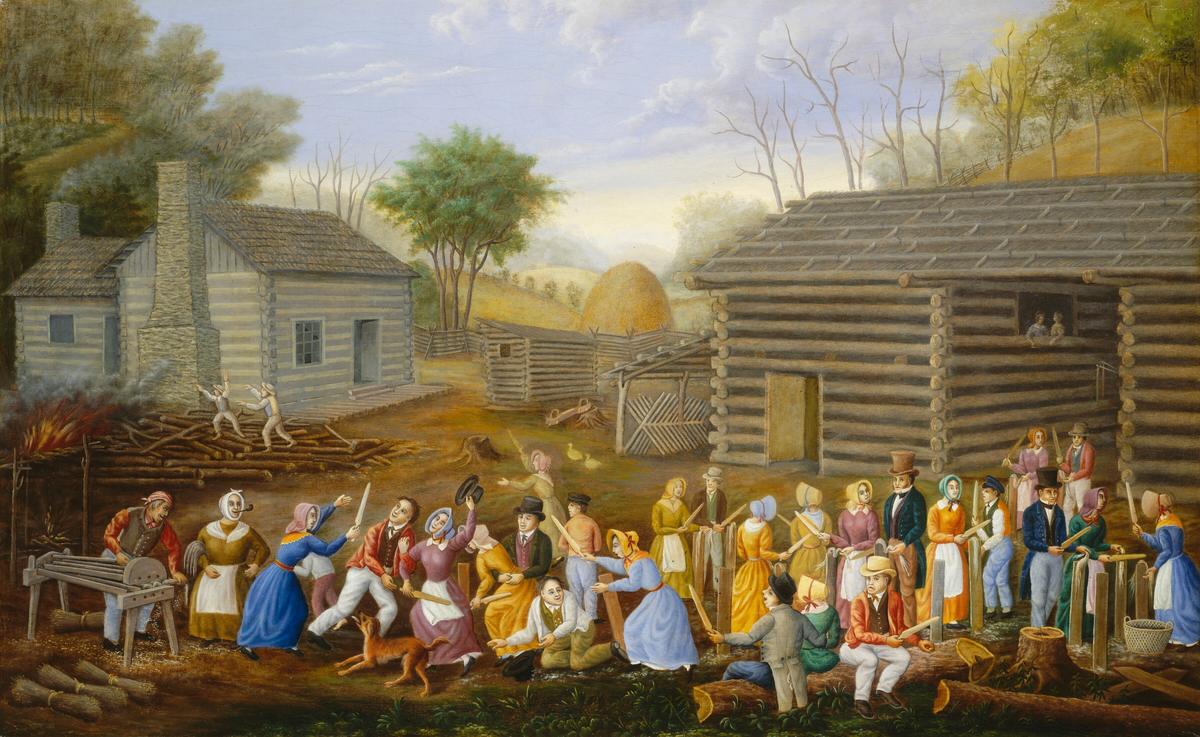
In American English a bee is a gathering of neighbors who work together on one job: spinning bees, husking bees, raising bees and quilting bees. Merriam-Webster dates this sense to 1769, and the earliest known example, in the Boston Gazette of October 16, 1769, describes a spinning match "or what is call'd in the Country a Bee."

The word probably doesn't come from busy insects. Merriam-Webster traces it, perhaps, to a dialect word "been," meaning help given by neighbors, from Old English bēn, "prayer" (the same root as boon). The insect may have shaped the spelling and the popular explanation. The phrase "quilting bee" is in print by 1808, in a runaway-apprentice notice in the Albany Gazette, and an 1812 Vermont newspaper lists "a spinning-bee, and a weaving-bee, and a quilting-bee."

A painting of neighbors in bright clothes beating flax together outside log cabins, with a hill and a haystack behind
Linton Park, Flax Scutching Bee, United States, 1885. National Gallery of Art · CC0

1790s

Quilting as one of many shared jobs

Diaries and household records show that 18th-century New England women did share quilting, but as one task among many: neighbors also helped with spinning, weaving, harvests, huskings and barn raisings. The midwife Martha Ballard of Hallowell, Maine, recorded quilting parties in 1790 and 1792 that helped prepare her daughters for marriage, as Laurel Thatcher Ulrich showed in A Midwife's Tale.

Piecing a top was usually done at home. The group's job was the slow quilting of the three layers in a large frame, and a quilting usually ended with a meal and company.

1813

Krimmel's Quilting Frolic

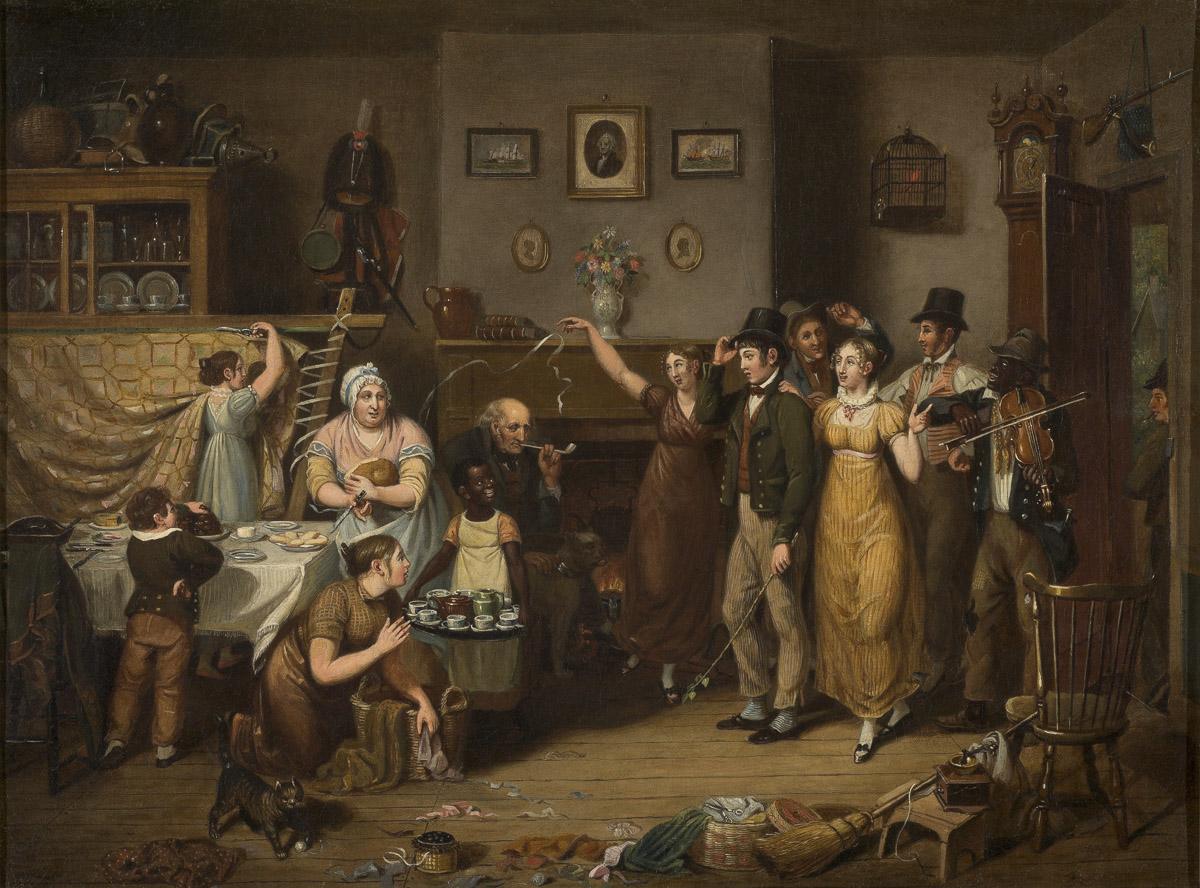
The best-known early picture of a quilting party is The Quilting Frolic, an oil painting by the German-born Philadelphia artist John Lewis Krimmel, signed and dated 1813 and shown that May at the Pennsylvania Academy of the Fine Arts. It shows a crowded parlor at the moment a finished quilt is being taken off its frame, as young men arrive, a Black fiddler plays and a Black girl serves refreshments.

Winterthur Museum, which bought it in 1953, notes that while the painting celebrates middle-class comfort, it also reinforces stereotypes of African Americans as contented servants. The word "frolic" was used, like "bee," for work parties that ended in food, music and dancing.

A painted parlor where a woman lifts a finished quilt off its frame as young men arrive, a Black fiddler plays and a Black girl carries a tray of refreshments
John Lewis Krimmel, The Quilting Frolic, Philadelphia, 1813. Winterthur Museum · Public domain

1834 – 1876

Causes, courting and the olden time

In the 19th century, women sewed together for causes, while prints and songs turned the quilting party into a joke and then a legend.

1834 – 1860s

Sewing circles for causes

Women's groups also sewed to raise money. The Boston Female Anti-Slavery Society held its first fair in 1834, selling needlework made by members and supporters. At its third fair, in December 1836, it sold a small cradle quilt, now at Historic New England and attributed to the writer Lydia Maria Child, inked with anti-slavery verse; Child wrote in January 1837 that her cradle quilt sold for $5.

Church sewing circles and ladies' aid societies used the same model for missions, ministers' families and, from 1861, soldiers. See Civil War quilts.

1861 – 1866

Courting at the quilting frame

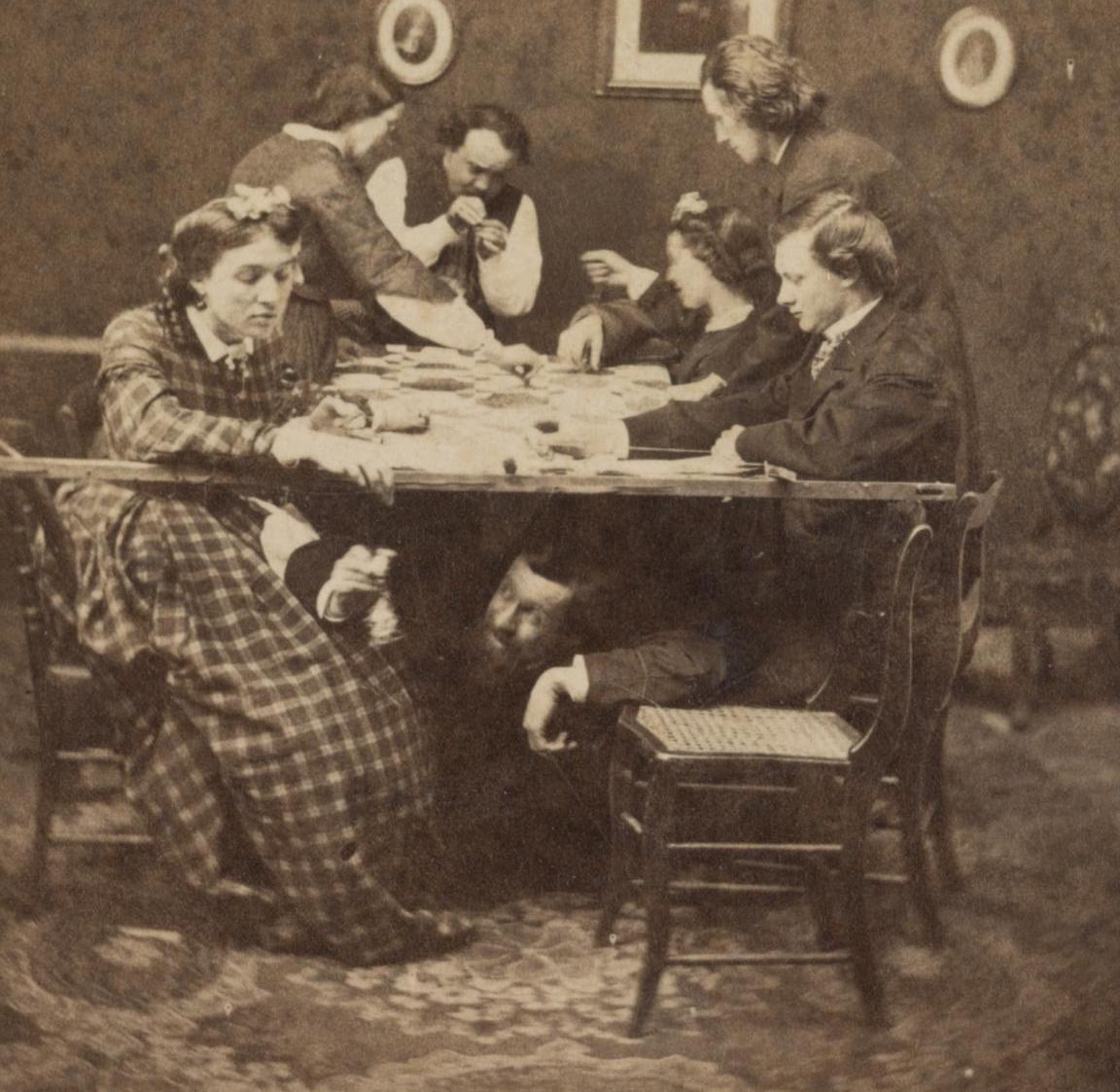
By the mid-1800s the quilting party had become a stock comic scene of courtship. A stereograph published in New York by George Stacy between 1861 and 1866, The Quilting Party, stages a party at a quilting frame with a young man crouched underneath it.

Songs, stories and prints of the period treated the evening party, when men joined after the quilting, as the real attraction. Historians caution that this playful picture grew over time and turned a working gathering into a matchmaking legend.

A staged photograph of a quilting party: men and women around a quilting frame while a young man crouches underneath it
The Quilting Party, stereograph published by George Stacy, New York, 1861–66 (one half of the card). Library of Congress · Public domain

1876

The Centennial invents the "olden time" bee

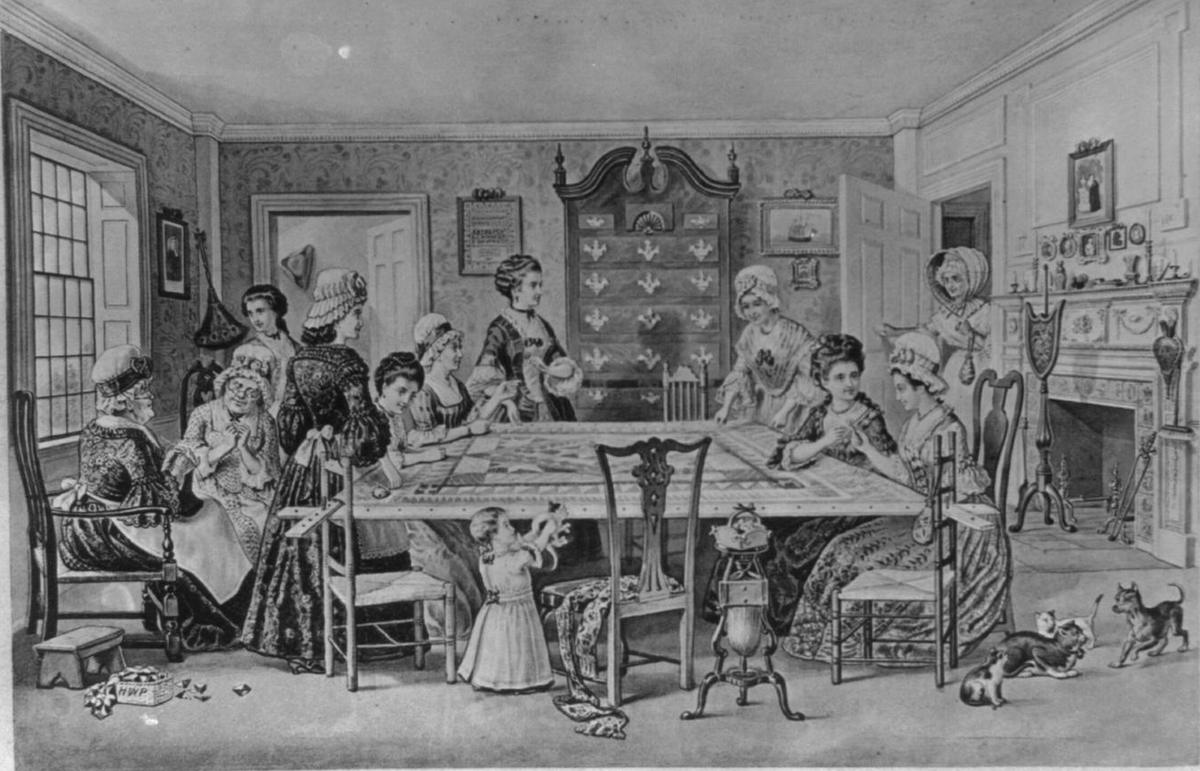
At the 1876 Centennial in Philadelphia, "colonial kitchen" exhibits staged quilting parties with women in costume, and quilting bees became a symbol of a cooperative, simpler past. A print registered that year by H. W. Pierce, A Quilting Bee in the Olden Time, shows women in powdered hair and caps around a frame in a Chippendale parlor, with a toddler and cats at play. (The same Centennial is often linked to the crazy quilt craze.)

As cities and factories grew, the quilting bee became a nostalgic emblem of community more than a record of how most quilts were made.

A print of women in caps and powdered hair quilting around a frame in an elegant colonial parlor, with a toddler and kittens at play
H. W. Pierce, A Quilting Bee in the Olden Time, 1876. Library of Congress · Public domain

1900 – 1941

Quilting together in hard times

In the countryside the real thing never stopped, and in the Depression government photographers recorded it.

1900 – 1915

The "old-fashioned quilting" carries on

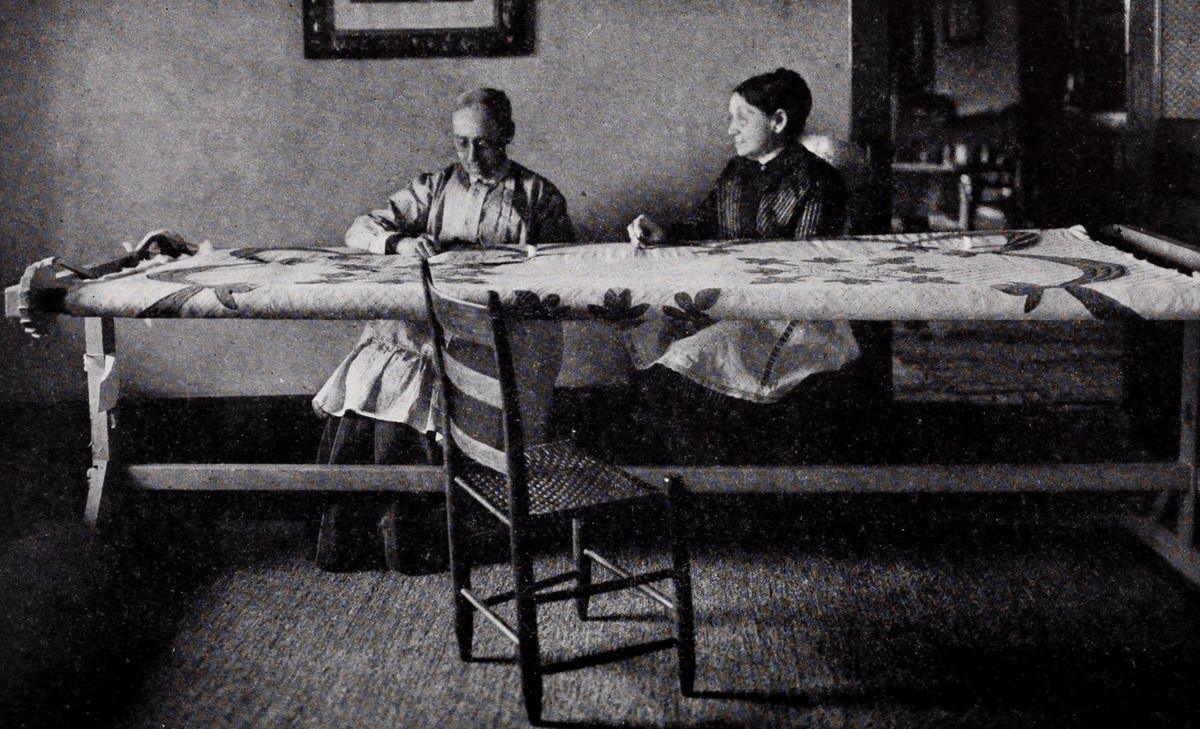
In rural places the custom continued. Laurel Horton documented an "old-fashioned quilting" held in 1910, and Marie Webster's 1915 book Quilts: Their Story and How to Make Them printed a photograph titled Old Ladies Quilting: two women at a long wooden frame with a chair pulled up for a third.

Webster also quoted an older frontier account that failing to invite a neighbor's family to a quilting was taken as an insult. Writers such as Eliza Calvert Hall (Aunt Jane of Kentucky, 1907) and later Ruth Finley wrote fond, idealized portraits of the custom.

Two older women stitching an appliqué quilt stretched on a long wooden frame, with an empty chair pulled up beside them
Old Ladies Quilting, from Marie D. Webster's Quilts: Their Story and How to Make Them, 1915. Internet Archive · Public domain

1917 – 1918

Quilting for the war effort

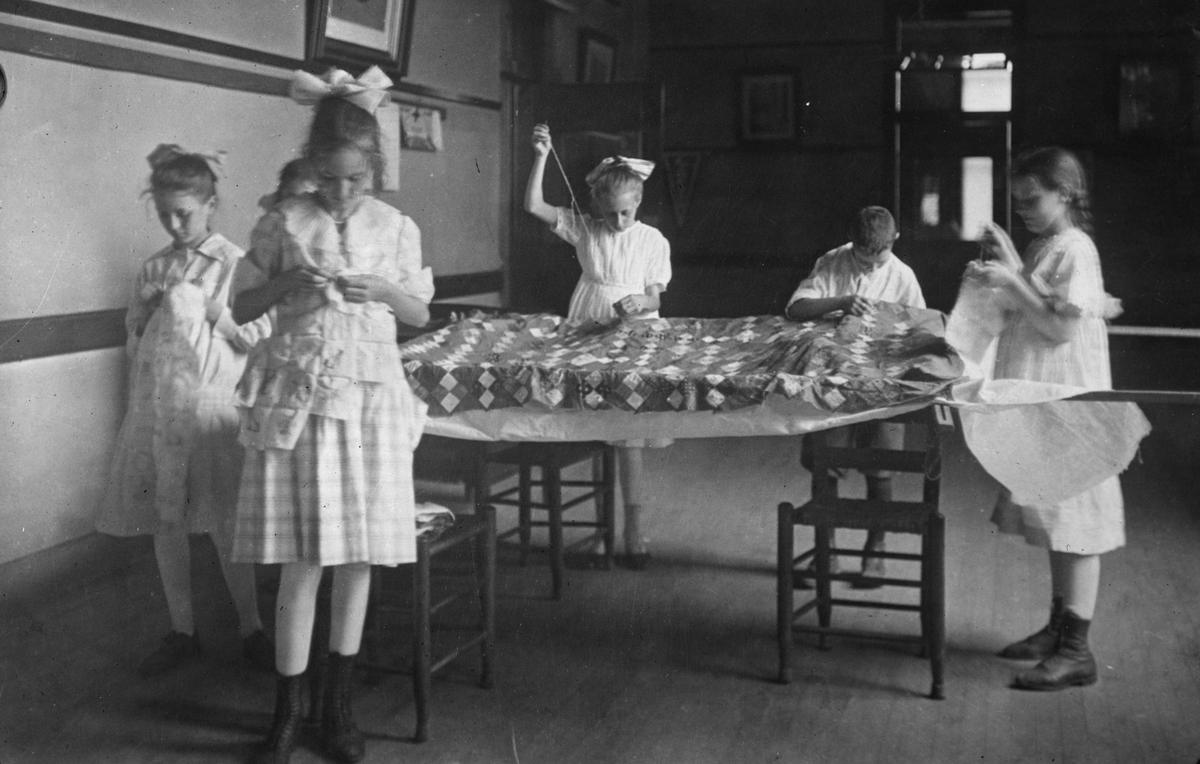
During the First World War, school groups, church societies and Red Cross chapters quilted for soldiers and hospitals. A 1918 American Red Cross photograph shows schoolgirls at the Cote Brilliante School in St. Louis quilting a quilt for a cantonment (army camp) hospital.

Group quilting had become a ready way to turn many hands toward one public need.

Schoolgirls in white dresses and hair bows sewing a patchwork quilt spread over a table in a classroom
Schoolgirls at the Cote Brilliante School quilting for an army camp hospital, St. Louis, Missouri, 1918. American National Red Cross collection, Library of Congress · Public domain

1933

From the bee to the contest

In 1933 Sears, Roebuck ran a national quilt contest tied to Chicago's Century of Progress world's fair, with regional judging at Sears stores and more than 24,000 entries, the most of any quilt contest. The grand prize was $1,000, with a $200 bonus offered for an original design on the fair's theme, though judges mostly chose traditional pieced and appliqué quilts.

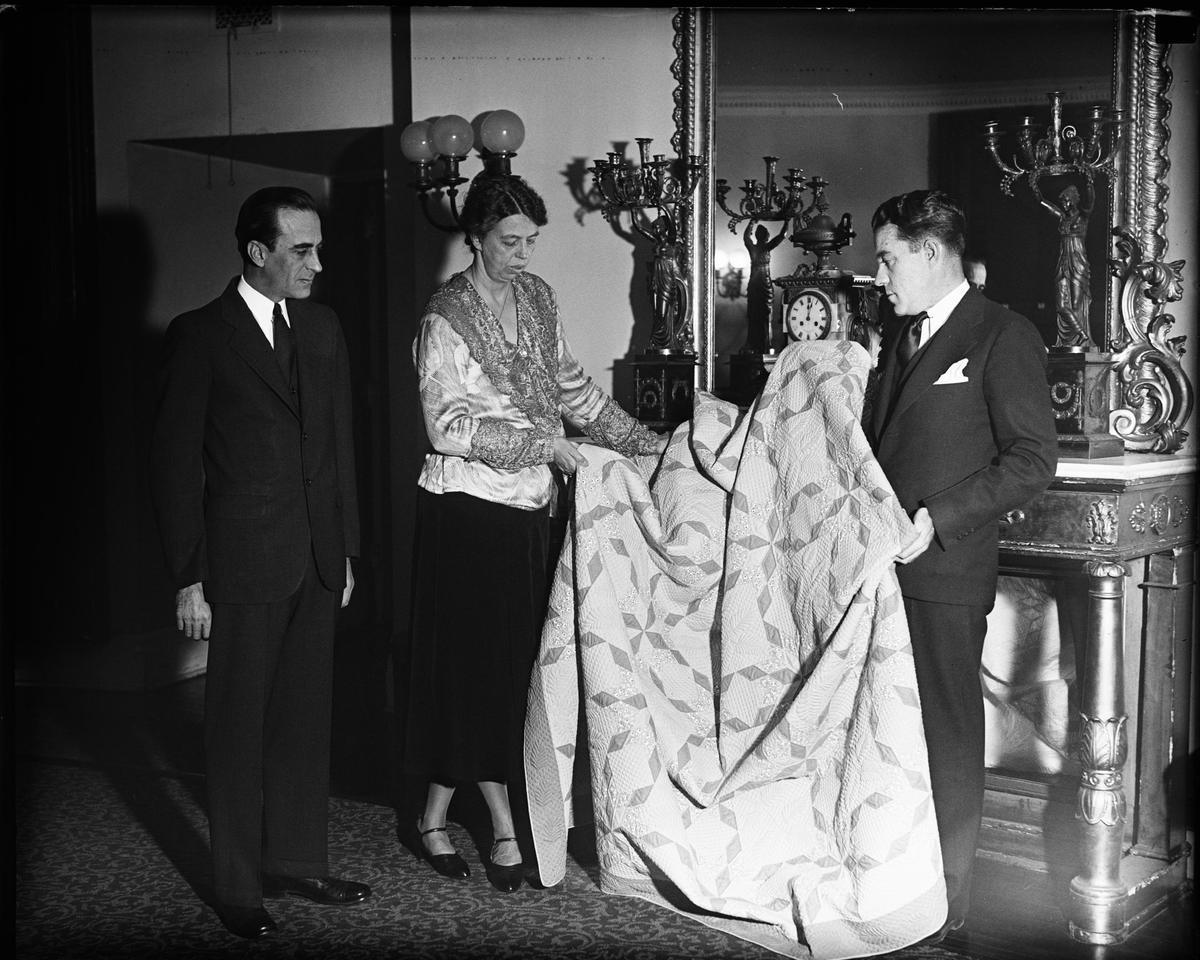
The winning star quilt, entered by Margaret Rogers Caden of Kentucky, was later found to have been made by other women she hired. A Harris & Ewing photograph shows a prize quilt from the fair being presented to Eleanor Roosevelt.

Eleanor Roosevelt holding up the corner of a large star quilt with two men in suits
Harris & Ewing, a prize quilt from the 1933 Chicago world's fair contest given to Eleanor Roosevelt, Washington, D.C., 1933. Library of Congress · Public domain

1938 – 1939

The Depression on camera

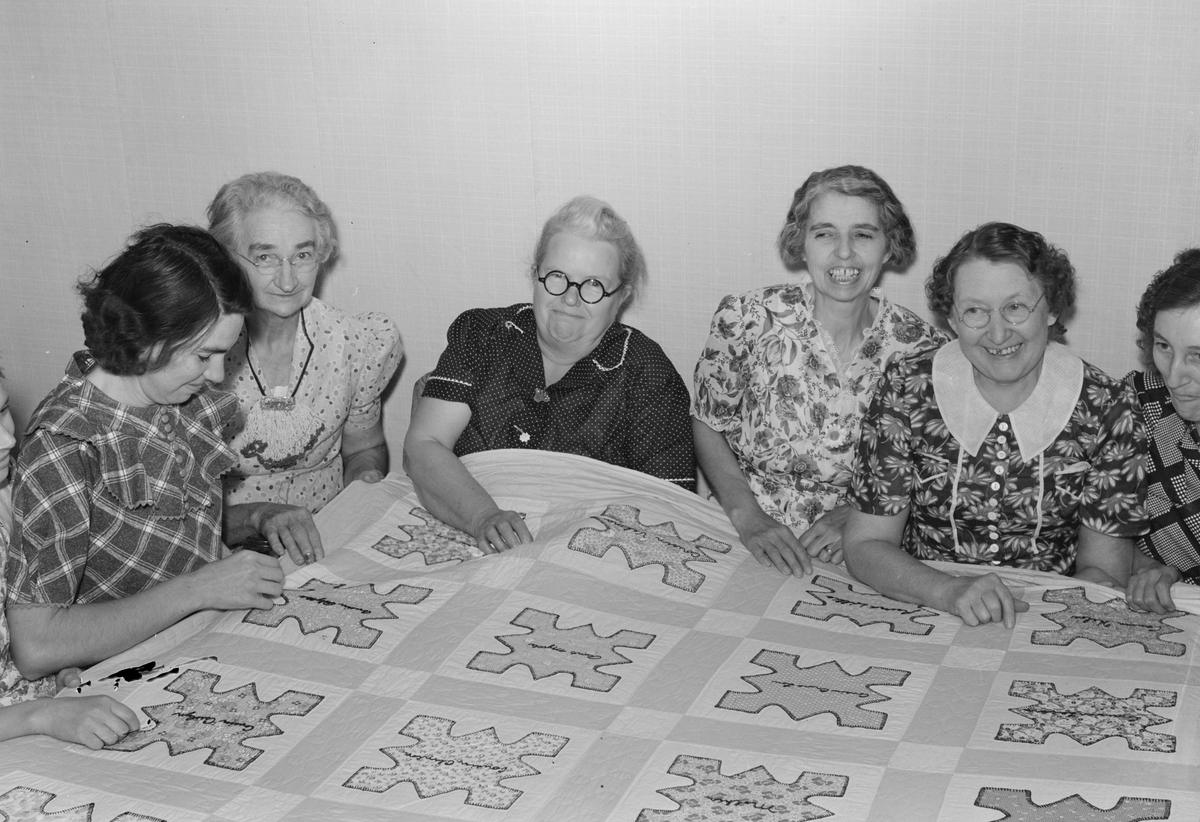
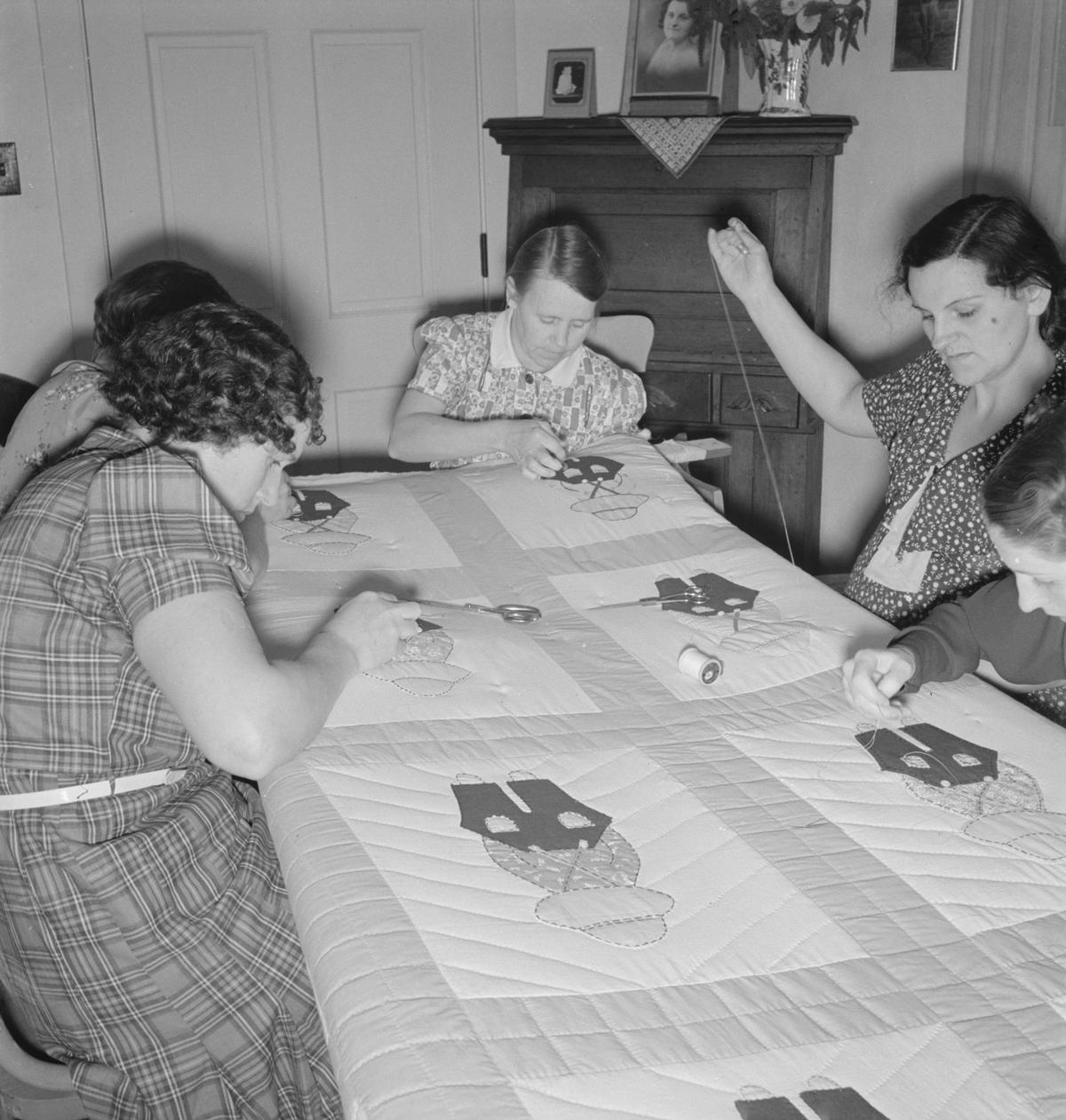
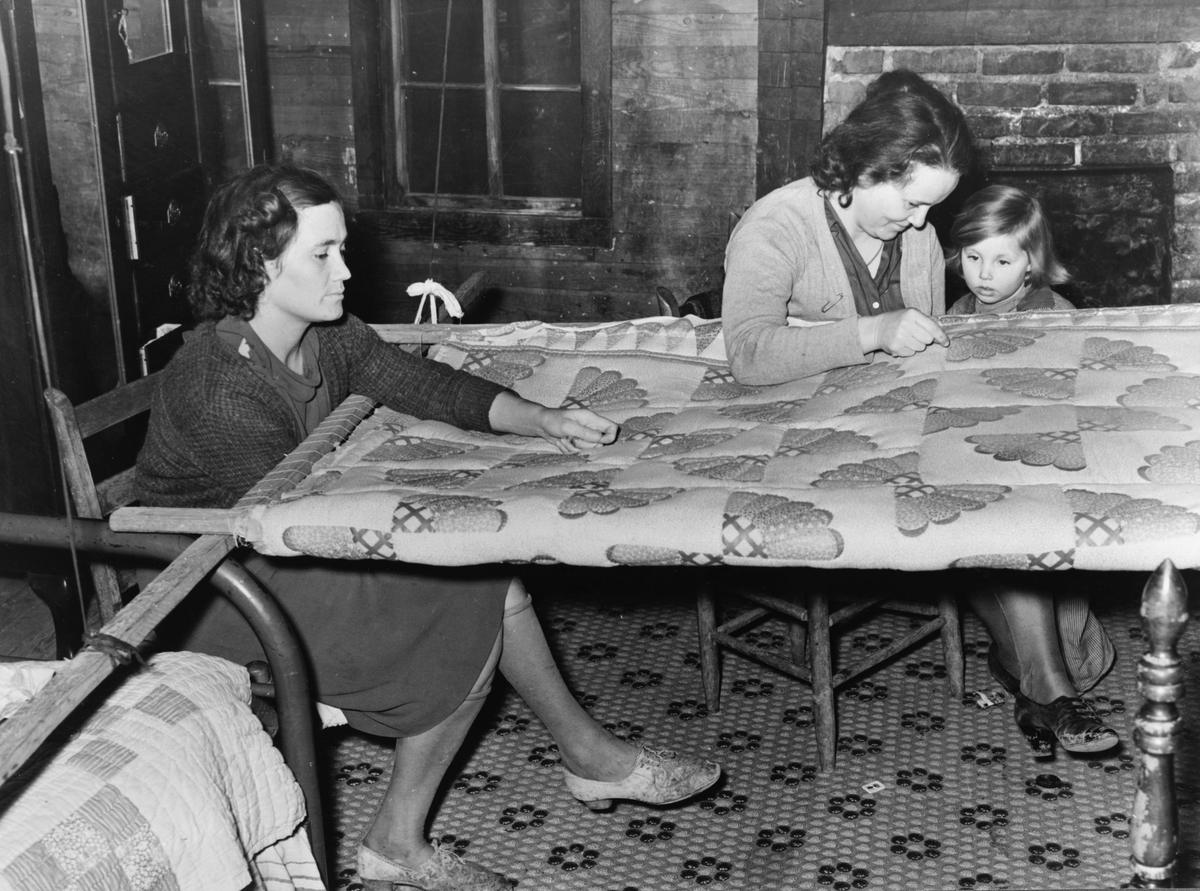
Photographers working for the Farm Security Administration recorded group quilting across rural America. John Vachon photographed the Ladies of the Helping Hand Society quilting in Gage County, Nebraska, in 1938; Dorothea Lange photographed farm women quilting near West Carlton, Oregon, in 1939; and Russell Lee photographed quilting in a sharecropper's home near Pace, Mississippi, the same year.

Lee's picture is one of the clearest views of a wooden quilting frame, which holds the layers taut so several quilters can stitch at once. Many of these quilters were making do in hard years; see how flour and feed sacks became quilts.

Six smiling women of several generations quilting together around a pieced and appliquéd quilt
John Vachon, Ladies of the Helping Hand Society working on a quilt, Gage County, Nebraska, 1938. Library of Congress, FSA/OWI · Public domain
Farm women bent over a quilted appliqué quilt spread across a table, one pulling her thread high
Dorothea Lange, Farm women working on a quilt, near West Carlton, Yamhill County, Oregon, 1939. Library of Congress, FSA/OWI · Public domain
Two women and a small girl at a wooden quilting frame holding a fan-patterned quilt in a farmhouse room
Russell Lee, Quilting in a sharecropper's home near Pace, Mississippi, 1939. Library of Congress, FSA/OWI · Public domain

1940 – 1941

Clubs, neighbors and quilts to give away

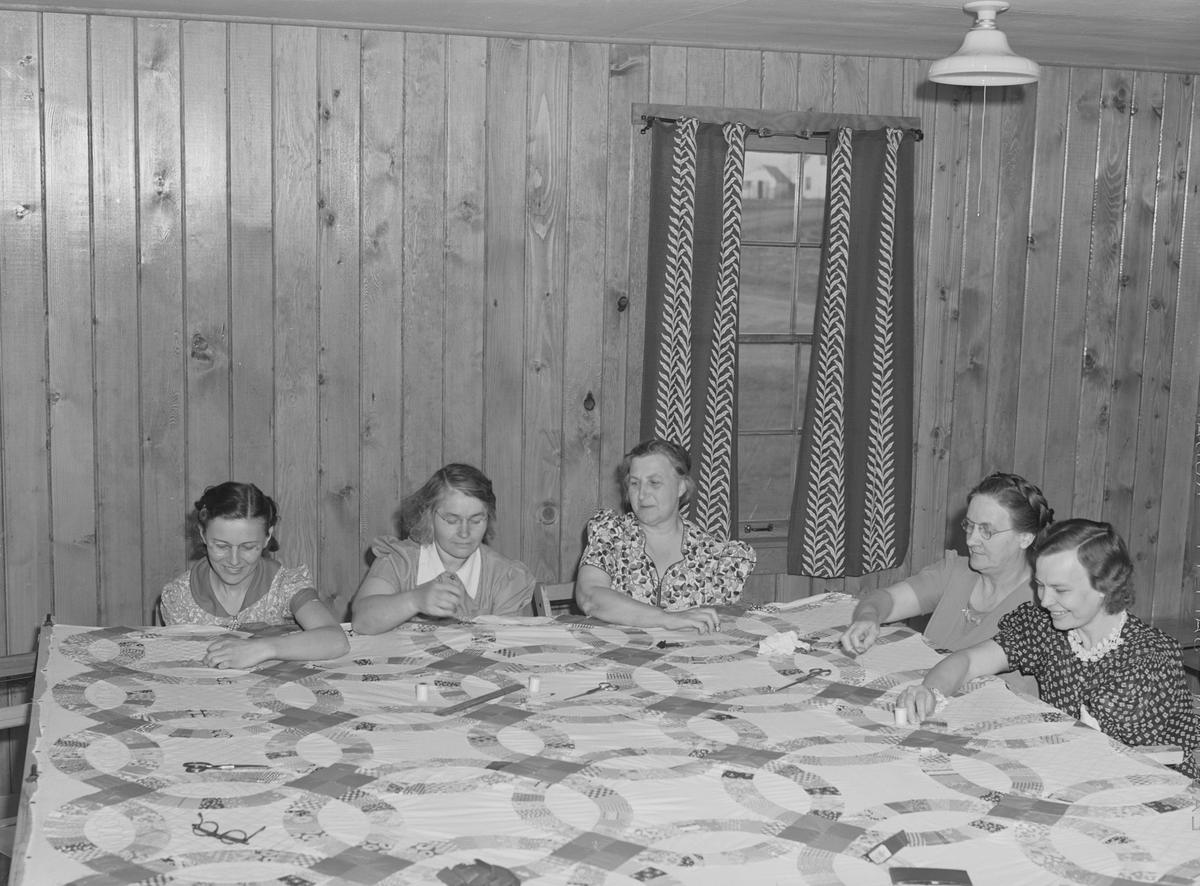
In 1940 Vachon photographed a women's club making a Double Wedding Ring at Granger Homesteads, Iowa. Many groups made quilts to give away, like the Scranton, Iowa, women who quilted for a needy family that year.

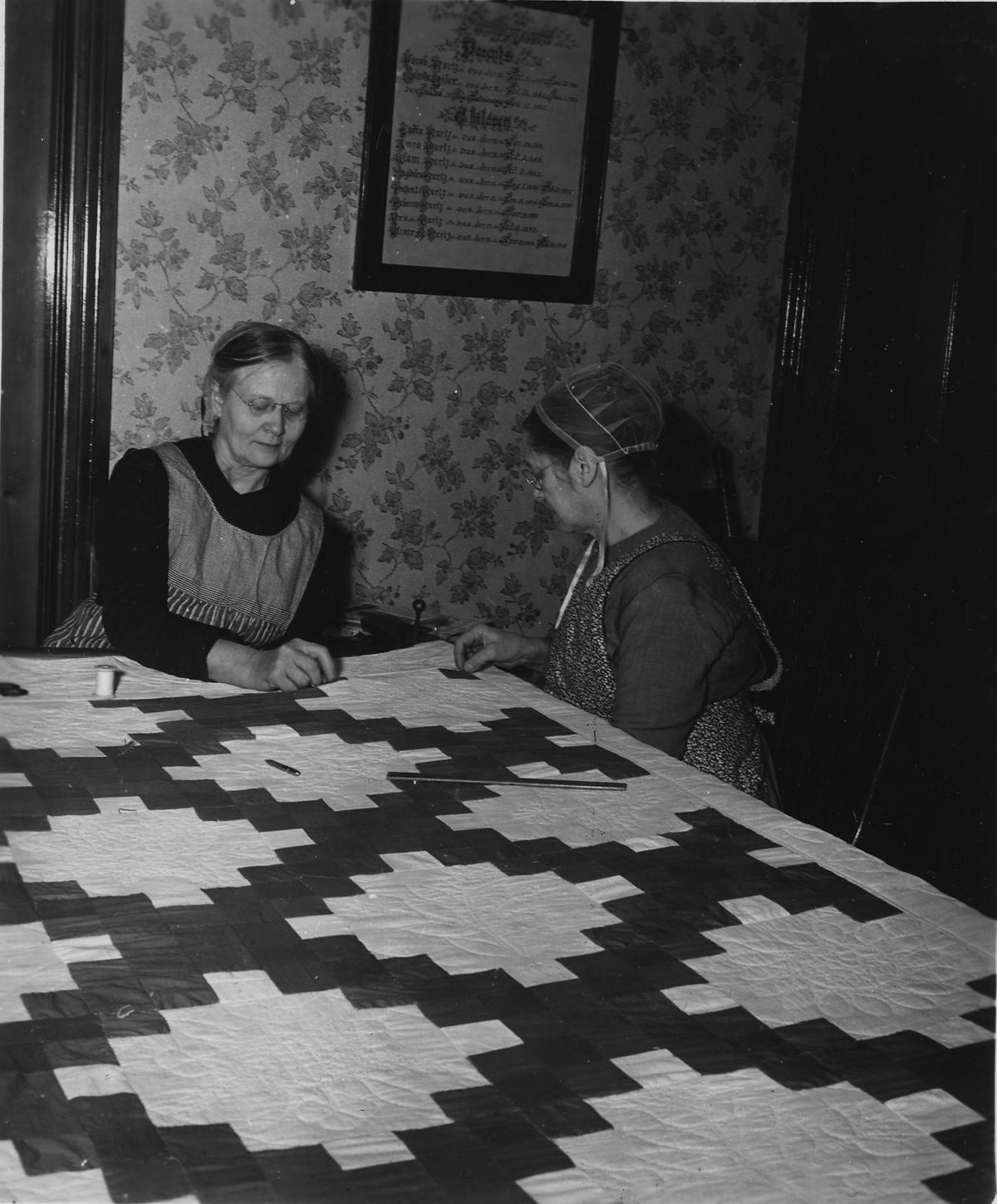
A 1941 Department of Agriculture photograph of two Amish women quilting in Lancaster County, Pennsylvania, notes in its caption that quilting bees were popular there. See Amish quilts.

Six women quilting a large Double Wedding Ring quilt together in a pine-paneled room
John Vachon, Members of the women's club making a Double Wedding Ring quilt, Granger Homesteads, Iowa, 1940. Library of Congress, FSA/OWI · Public domain
Two Amish women in caps and aprons quilting a bold dark and light pieced quilt on a table
Irving Rusinow, Two Amish women quilting, Lancaster County, Pennsylvania, 1941. National Archives · Public domain

1940

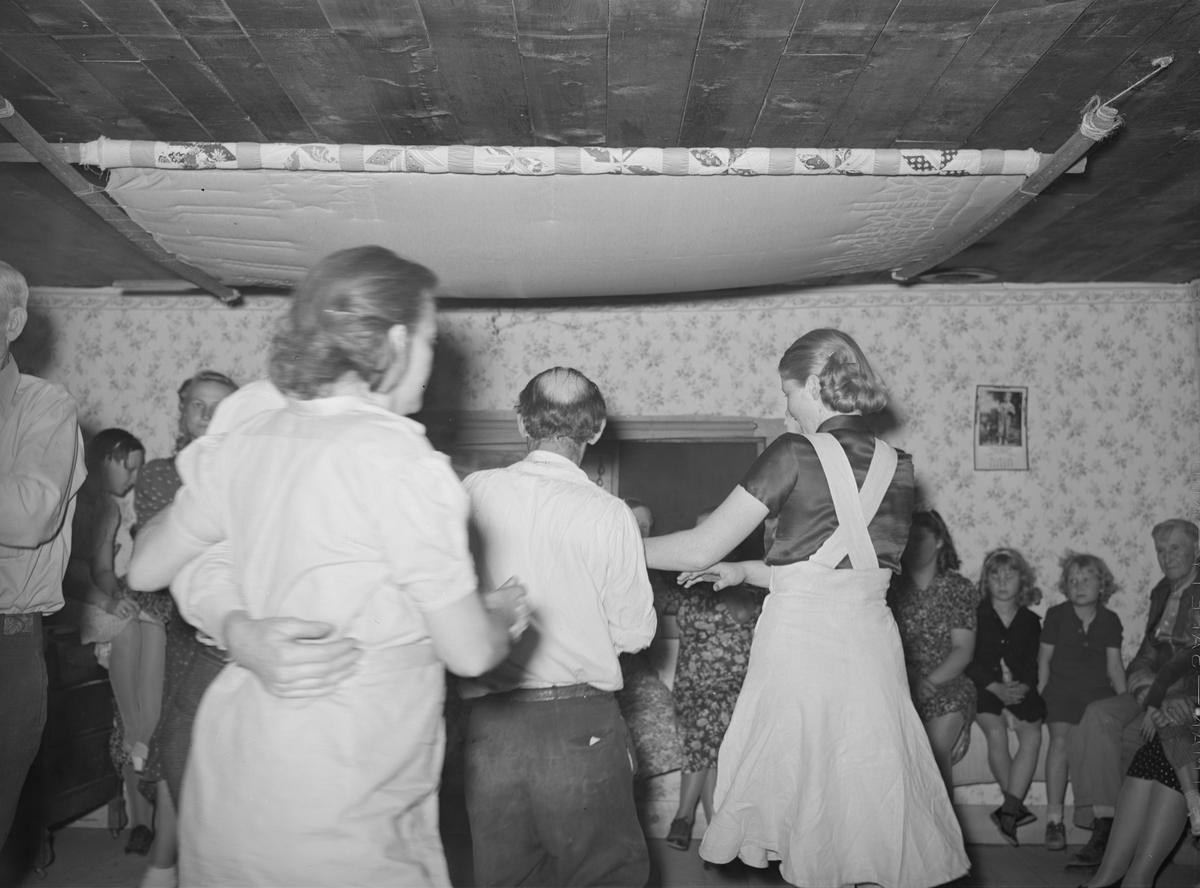
Pie Town: a frame over the dance floor

In 1940 Russell Lee photographed Pie Town, New Mexico, a homestead community settled by about 200 migrant Texas and Oklahoma farm families. His pictures include a square dance in a house where, as the caption says, the quilting frame is hoisted up to the ceiling overhead, and quilts made by the community, including a friendship quilt.

Raising the frame on ropes kept a quilt in progress safe while the room was used for living, eating and dancing.

Couples square dancing in a small room while a quilt in its frame hangs from ropes just below the ceiling
Russell Lee, Figure in a square dance, with the quilting frame raised overhead, Pie Town, New Mexico, 1940. Library of Congress, FSA/OWI · Public domain

1966 – today

Bees with a purpose, and bees today

The old word kept finding new work to do.

1937 – 1966

Gee's Bend and the Freedom Quilting Bee

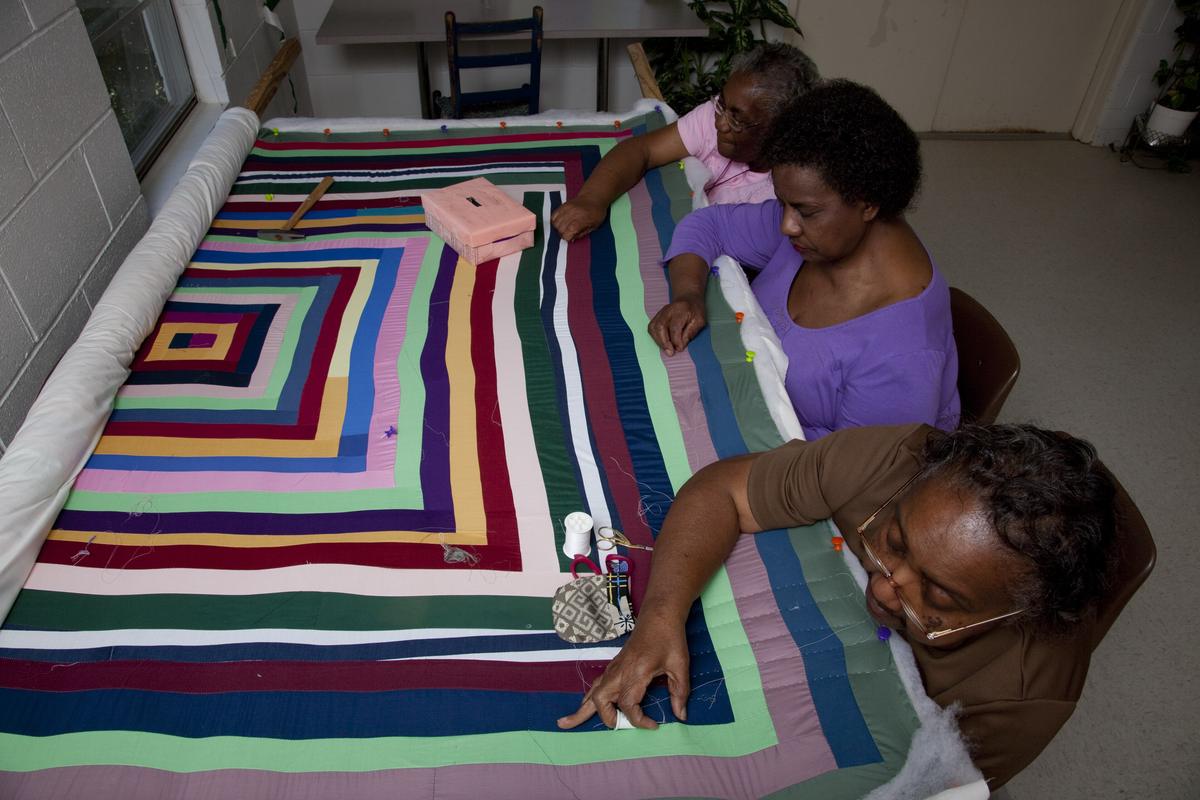
Arthur Rothstein photographed women sewing quilts in Gee's Bend, Alabama, in 1937. In 1966, during the civil rights movement, Black women in Wilcox County, Alabama, near Gee's Bend, founded the Freedom Quilting Bee, a cooperative that sold quilts to earn independent income; Estelle Witherspoon was its president. The cooperative won orders from buyers including Sears, Roebuck.

Its name turned the old word "bee" into a statement about economic freedom, and Gee's Bend quilters still quilt together today.

Three Gee's Bend quilters hand-stitching a bright striped Housetop-style quilt stretched in a frame
Carol M. Highsmith, Gee's Bend quilters at a quilting frame, Gee's Bend, Alabama, 2010. Library of Congress · Public domain

1970s

The quilt revival brings the bee back

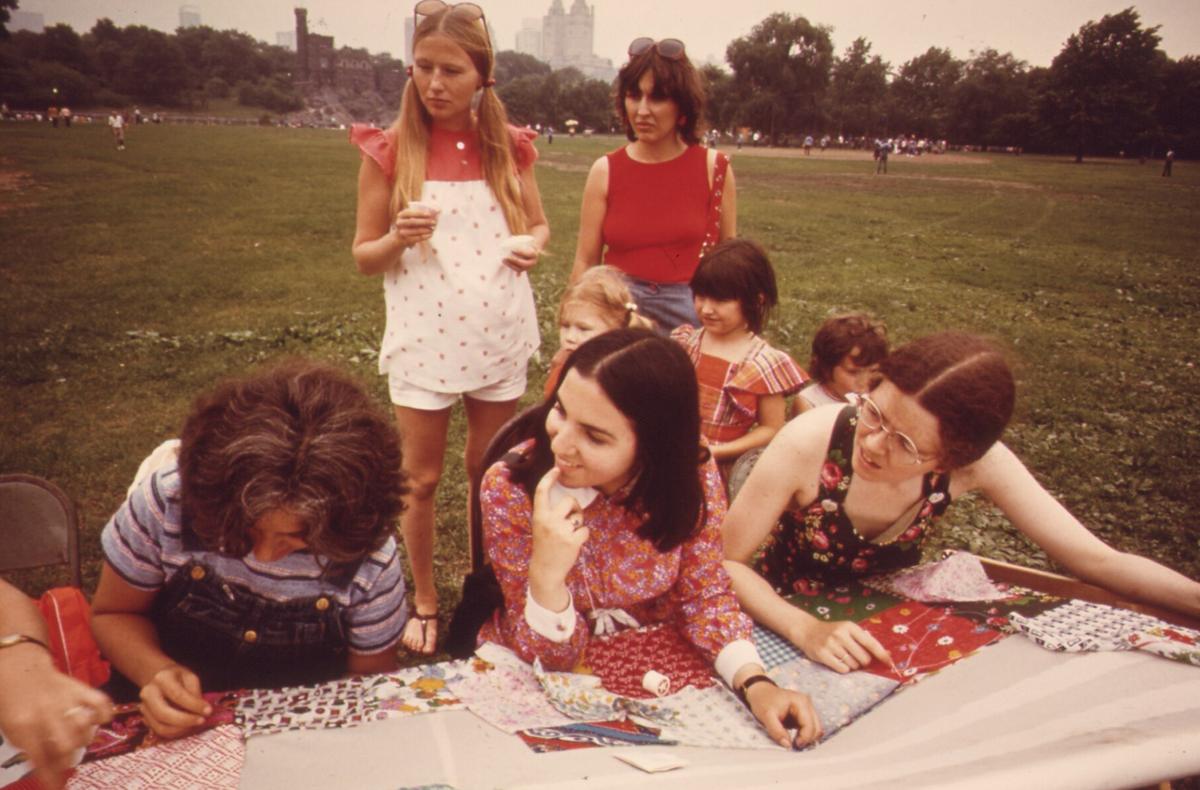
The quilt revival of the 1970s, fed by the women's movement and the 1976 Bicentennial, revived group quilting as a public event. In June 1973, New York's parks department sponsored a midsummer evening quilting bee in Central Park, photographed by Suzanne Szasz for the federal DOCUMERICA project.

The International Quilt Museum notes that bees served as the precedent for the quilt guilds that multiplied in these years.

Young women and girls hand-sewing bright patchwork on a table set up on the grass of Central Park
Suzanne Szasz, Midsummer evening quilting bee in Central Park, New York, June 1973. DOCUMERICA, National Archives · Public domain

2009 – today

Guilds, virtual bees and quilt-alongs

Many small groups still call themselves bees. Online communities run virtual bees, in which each member makes blocks for another's quilt, and quilt-alongs, where thousands sew the same pattern on a schedule. The Modern Quilt Guild began when Alissa Haight Carlton and Latifah Saafir organized an in-person meeting in Los Angeles in October 2009 for quilters who had met online; it has since grown into an international organization with local chapters.

The tools have changed, but the idea is the 1769 one: many hands making light work. A bee can even start on screen: in Quiltler you can send a block to another quilter, or invite them to work in your library with you.

Quilting bee myths

The quilting bee gathered stories as fast as it gathered quilters. Here is what diaries, museum records and quilt historians actually say.

Mostly myth

Early American women made their quilts at quilting bees.

Most tops were pieced at home by one woman or her family. Neighbors did gather to quilt the layers, but quilting parties were a small part of a wider pattern of shared work, and many quilts were quilted at home or by paid quilters.

Exaggerated

Quilting bees were mainly matchmaking parties.

Young men did join the evening meal and dancing, and 19th-century prints made a joke of courting at the frame, but historians say later writers turned a working gathering into a romantic legend.

Probably not

A quilting "bee" is named for busy honeybees.

Merriam-Webster suggests the word comes from a dialect word "been," help given by neighbors, from Old English bēn, "prayer." The insect likely influenced the spelling and the popular story.

A local game

At the end of a bee, girls shook a cat in the new quilt, and the one it ran toward would marry first.

A real folk game, not a universal rule. Ozark folklore collections describe young women "shaking the cat" in a finished quilt as lighthearted fortune-telling; it was local and playful, not a ritual every bee followed.

Folklore

Every bride went to her wedding with twelve quilts made at bees, plus a thirteenth bridal quilt.

Families who could afford it usually sent a daughter off with two or three quilts. The belief that the first person to sleep under a group-made quilt would dream of a future spouse is lore too.

Myth

Quilts made at bees carried coded messages for the Underground Railroad.

No 19th-century source mentions quilt codes; the story comes from a single family account published in 1999. See the quilt code.

Start a bee of your own

Quilters still make blocks for one another. Here are a few places to start.

Quilting bee questions

Why is it called a quilting bee?

In American English a "bee" is a gathering of neighbors who work together on one job, a sense in print since 1769. It probably isn't named for busy insects: Merriam-Webster suggests a dialect word "been," meaning help given by neighbors. The phrase "quilting bee" itself is in print by 1808.

What happened at a quilting bee?

Neighbors gathered around a large frame holding a pieced top, its batting and its backing, and quilted the three layers together, a slow job that went faster with many hands. A quilting usually ended with a meal and company, and sometimes, when young men joined in the evening, music and dancing.
Did colonial women make their quilts at quilting bees?

Mostly not. Most tops were pieced at home by one woman or her family, and many quilts were quilted at home or by paid quilters. Diaries like Martha Ballard's show that quilting parties did happen, but as one of many shared jobs, alongside spinning, husking and harvests.

What is "shaking the cat" at a quilting bee?

A folk game recorded in the Ozarks: young women put a cat in a finished quilt, shook it, and whoever the cat ran toward was said to marry first. It was a local, lighthearted custom, not something every bee did.

What was the Freedom Quilting Bee?

A cooperative founded in 1966, during the civil rights movement, by Black women in Wilcox County, Alabama, near Gee's Bend. Members sold quilts to earn independent income, with Estelle Witherspoon as president, and won orders from buyers including Sears, Roebuck.

What's the difference between a quilting bee and a sewing circle?

Historically, a bee was a gathering of neighbors to finish one job, like quilting a top, usually followed by a meal. Church sewing circles and ladies' aid societies were standing groups that sewed for a cause, such as missions or soldiers. Today the words overlap, and many small quilting groups simply call themselves bees.

What is a virtual quilting bee?

An online group in which each member makes blocks for another member's quilt, so one quilter's job is spread across many hands, as at the old bees. Quilt-alongs are related: thousands of quilters sew the same pattern on a shared schedule.

More quilt history

Sources and image credits

  1. Merriam-Webster: bee (noun 3), first known use 1769
  2. Pascal Tréguer, Word Histories: origin of 'bee' (communal work)
  3. Etymonline: bee
  4. International Quilt Museum, World Quilts: The Quilting Bee?
  5. International Quilt Museum, World Quilts: wedding quilt folklore
  6. Winterthur Museum, Bearing Witness: The Quilting Frolic
  7. Historic New England: Cradle quilt, 1836
  8. Boston Public Library: The Anti-slavery Fair
  9. Barbara Brackman: Abolitionist Crib Quilt
  10. Marie D. Webster, Quilts: Their Story and How to Make Them (1915)
  11. International Quilt Museum: A Century of Progress
  12. Barbara Brackman: Chicago's 1933 Quilt Contest
  13. Library of Congress: Making a quilt in Scranton, Iowa, home (Vachon, 1940)
  14. Library of Congress: Mrs. Bill Stagg with state quilt, Pie Town (Lee, 1940)
  15. Library of Congress: Sewing a quilt, Gee's Bend, Alabama (Rothstein, 1937)
  16. Encyclopedia of Alabama: Freedom Quilting Bee
  17. University of Arkansas Museum: Quilt Square (Ozark folklore)
  18. ASAE: How the Modern Quilt Guild Went Worldwide (2017)
  19. Modern Quilt Guild: Then & Now with co-founder Alissa Haight Carlton
  20. International Quilt Museum, World Quilts: Underground Railroad Quilts?

Every picture is in the public domain or released under CC0: photographs from the Library of Congress (Farm Security Administration, American Red Cross, Harris & Ewing and Carol M. Highsmith collections) and the National Archives, paintings and prints from the National Gallery of Art, Winterthur Museum and the Library of Congress, and a plate from Marie Webster's 1915 book. Each caption names the picture and links to its record.