Quilting history · Hawaiian quilts

The History of Hawaiian Quilts

Kapa kuiki: appliqué cut from folded cloth

One bold design cut from a single folded cloth, sewn onto a plain ground and quilted in ripples out to the edges: a Hawaiian quilt is easy to know. Here is how kapa kuiki grew from bark cloth and an 1820 sewing circle into a style Hawaiian women made their own, with quilts from the Honolulu Museum of Art and the stories, and the legends, behind them.

  • 15 moments
  • 1820 to today
  • 19 museum photographs
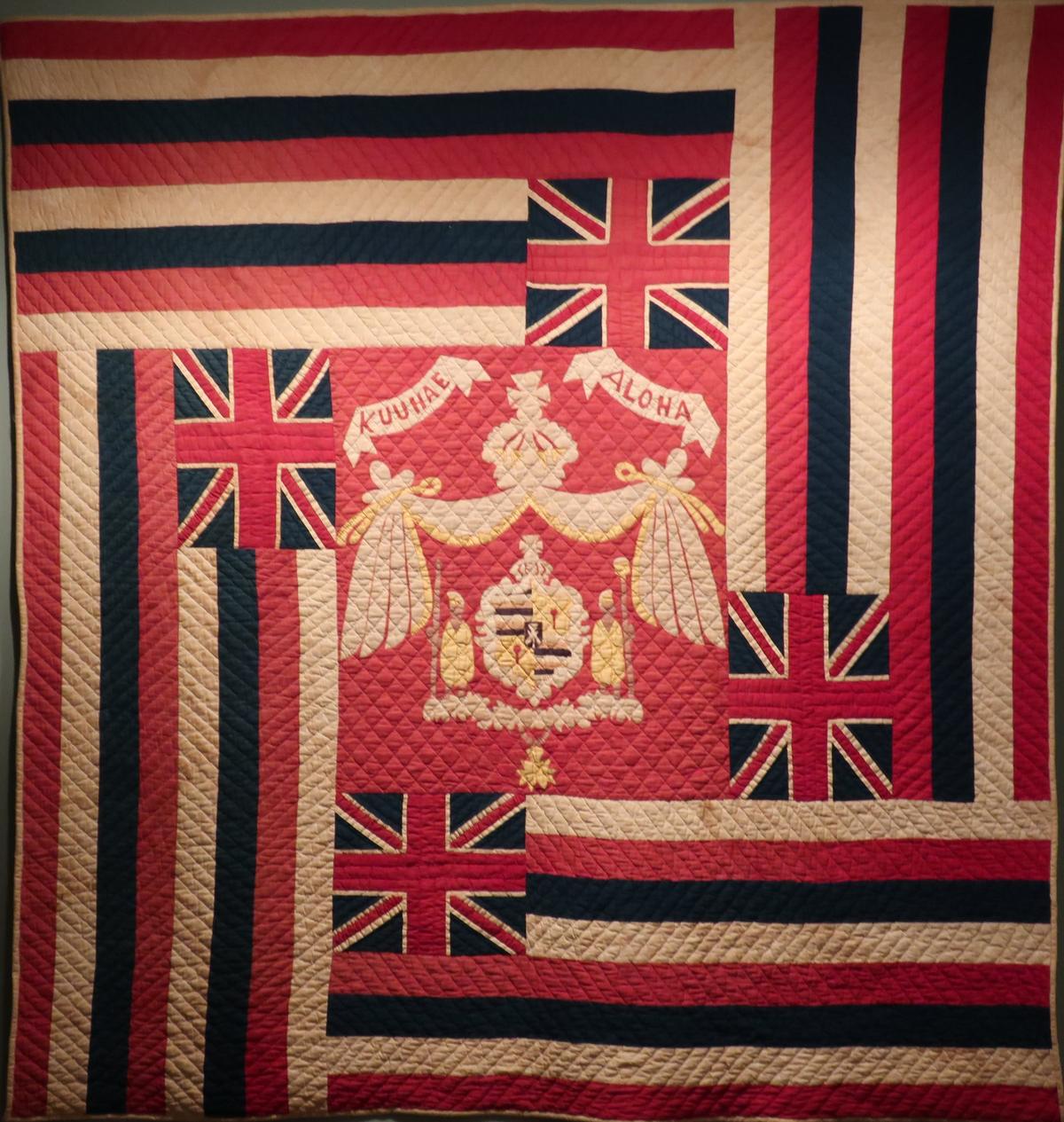
  • A flag quilt: four pieced Hawaiian flags with red, white and blue stripes around an appliquéd coat of arms under a crown, with the words KUU HAE ALOHA
  • A red-and-white Hawaiian appliqué quilt: four great feathered kāhili radiate from a central medallion, with crowns at the corners and echo quilting all over
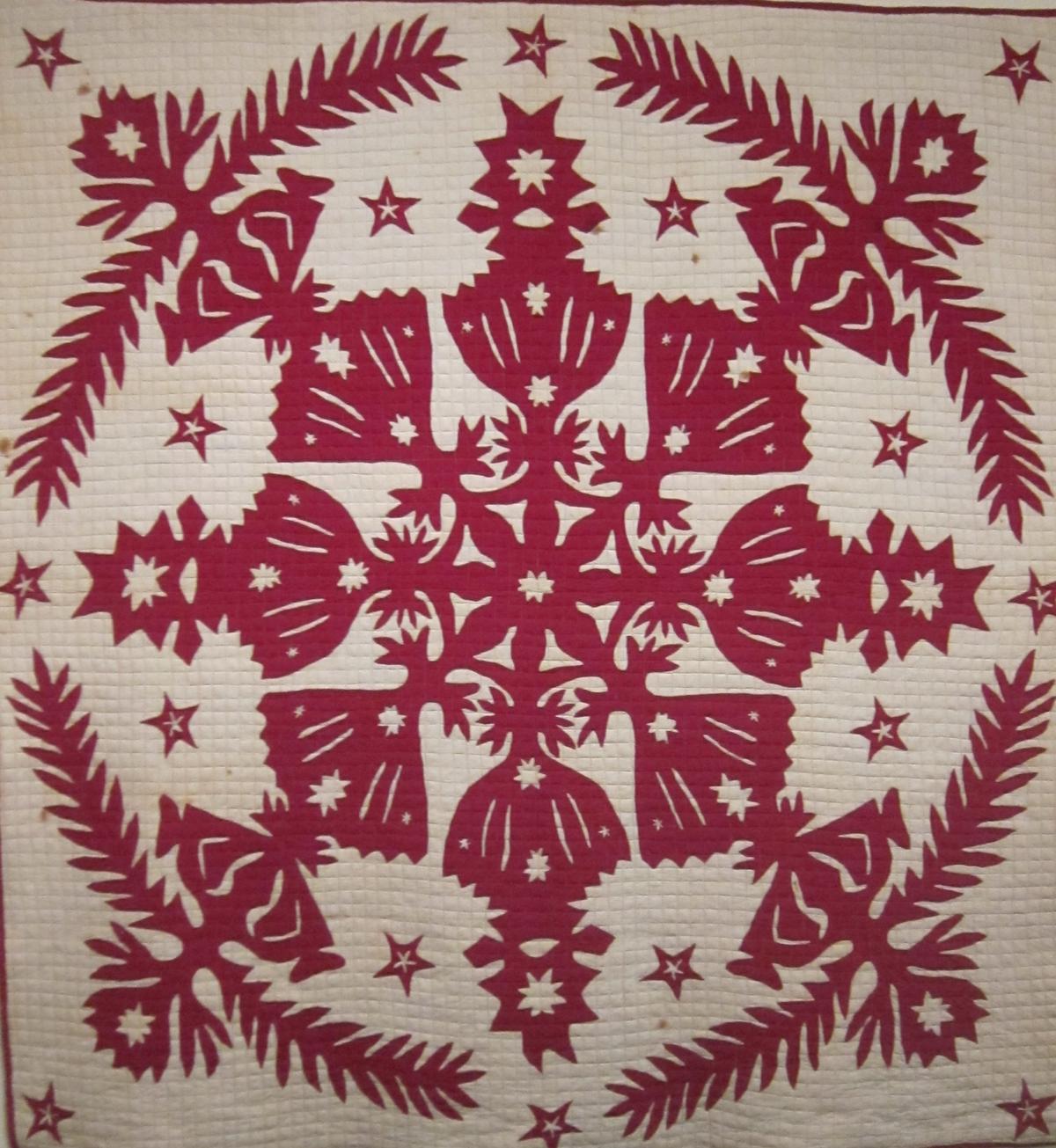
  • A crimson appliqué design cut from one folded cloth, repeating around the center like a snowflake, with stars and fern sprays on white
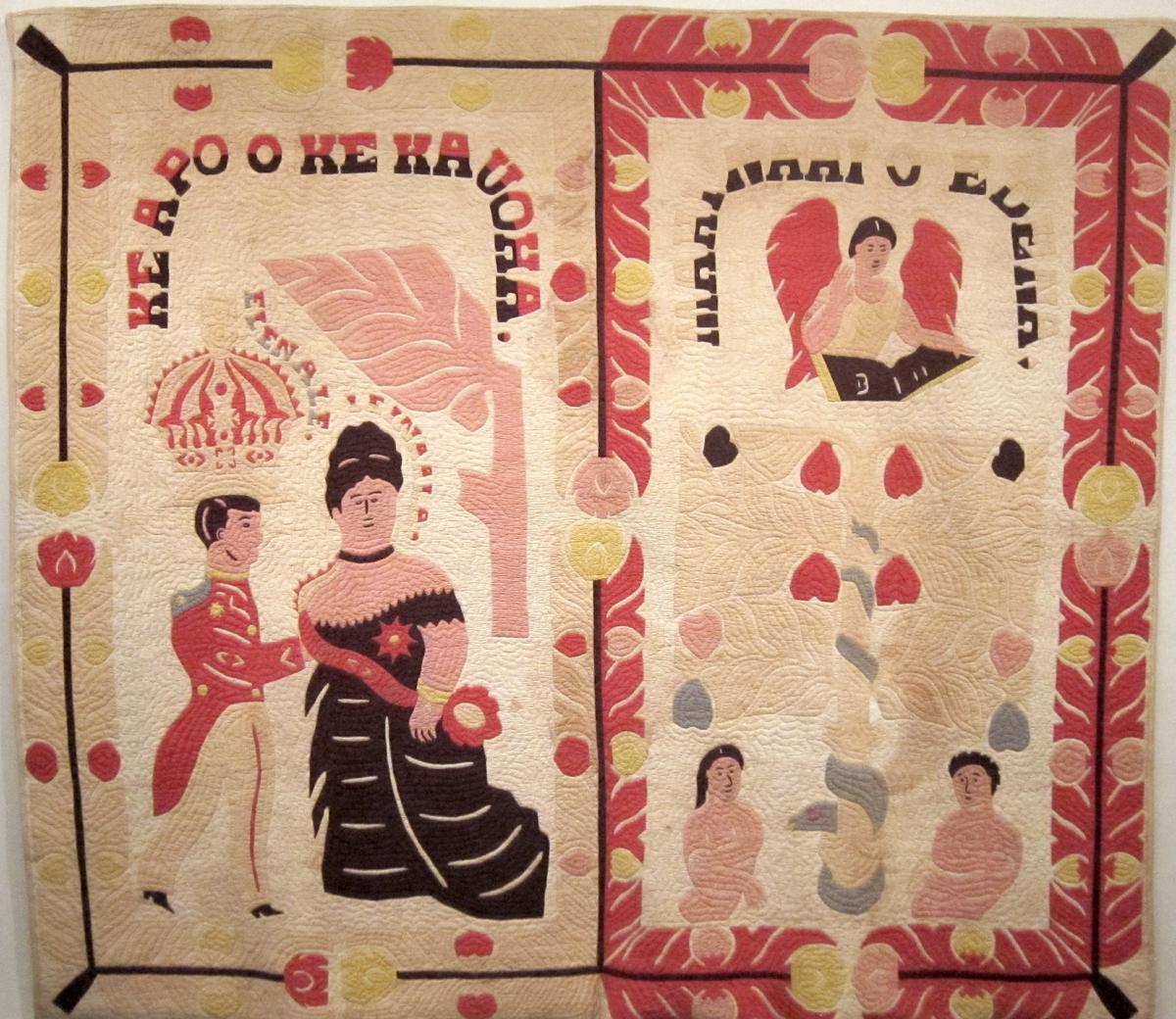
  • A two-panel pictorial quilt: at left a crown over a man in uniform and a woman in a gown, at right an angel with a book above two seated figures
  • A red quilt with a gold appliqué medallion in the center and four gold flowering sprays toward the corners
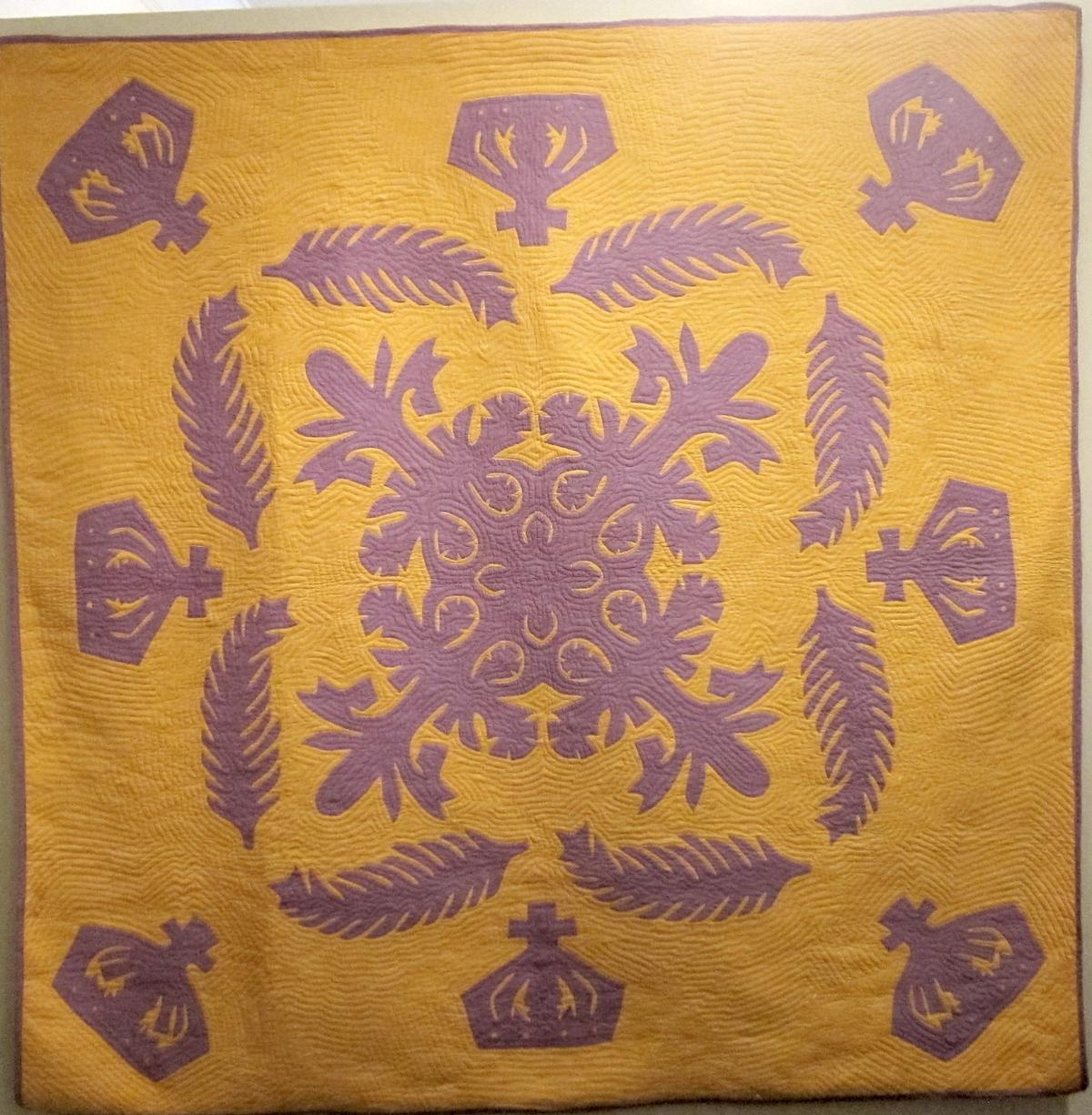
  • A gold quilt with purple appliqué crowns and leafy sprays around a central medallion, echo quilted in rippling lines

When did Hawaiians start quilting?

Hawaiian women first sewed patchwork on April 3, 1820, when the chiefess Kalākua gathered the newly arrived American missionary women on the deck of the brig Thaddeus for what Lucy Thurston called "the first sewing circle." The earliest Hawaiian quilts were pieced. The bold fold-and-cut appliqué that the world now knows as the Hawaiian quilt appears by the 1870s, and it was developed by Hawaiian women.

Before 1820 – 1860s

Bark cloth and a sewing circle

Hawaiians had a textile art long before cotton arrived. The needle and calico came in 1820. For the wider story, see The History of Quilting.

Before 1820

Kapa: Hawaiʻi's cloth before cotton

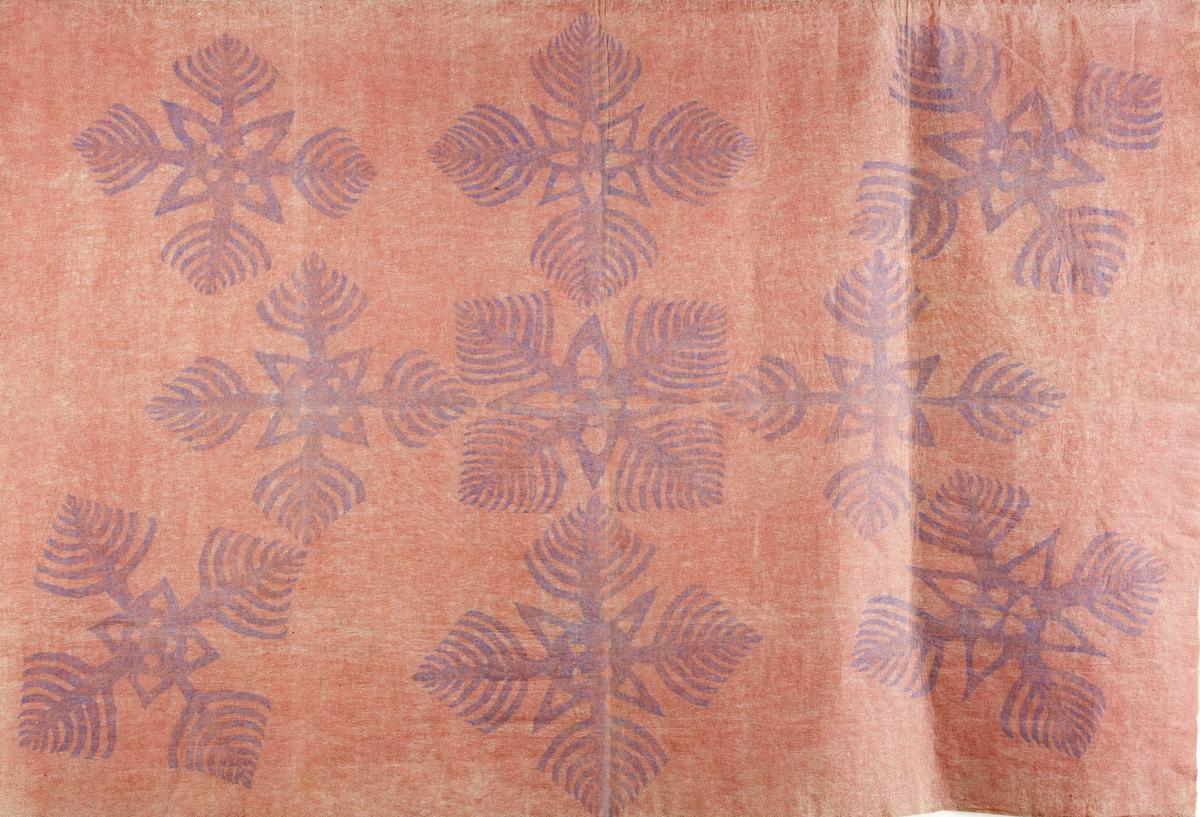
Before Western cloth arrived, Hawaiians made kapa, a cloth of beaten inner bark of the wauke (paper mulberry), printed and dyed with natural pigments. Bedding was kapa moe, which Pukui and Elbert's Hawaiian Dictionary defines as a blanket, bedspread or "sleeping tapa": layered bark-cloth covers, decorated but not pieced or appliquéd.

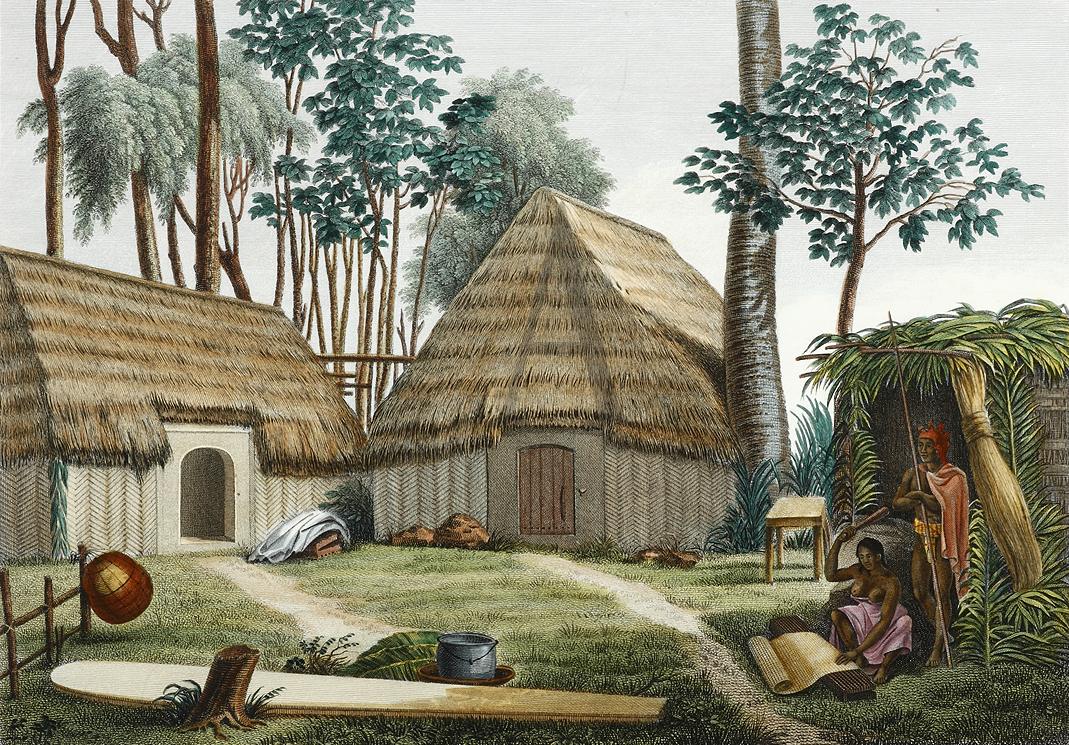
They weren't quilts in the Western sense, but the Hawaiian quilt grew out of this older textile art rather than out of nothing. About 1819, the year before the missionaries landed, an artist with a French expedition drew Likelike, wife of the chief Kalanimoku, beating kapa outside their houses.

A rose-colored bark-cloth bed cover stamped with repeated purple leaf motifs
Kapa moe, a bark-cloth bed cover, Hawaiian Islands, late 1800s. Los Angeles County Museum of Art · Public domain
A hand-colored print of thatched Hawaiian houses among palms, with a woman beating bark cloth on a log in the shade at right
J. Alphonse Pellion, the houses of the chief Kalanimoku, with kapa being made, about 1819 (published 1825). Freycinet expedition atlas · Public domain

April 3, 1820

The first sewing circle, on the deck of the Thaddeus

The first company of American Protestant missionaries sailed from Boston on the brig Thaddeus on October 23, 1819. As the ship came down the coast of Hawaiʻi Island from Kawaihae, the chiefess Kalākua (Kaheiheimālie), a widow of Kamehameha I, asked the missionary women to make her a dress of white cambric.

On Monday, April 3, 1820, she gathered the seven missionary women on mats on the deck. Lucy Thurston called it "the first sewing circle" in the Hawaiian realm. Mrs. Holman and Mrs. Ruggles cut the work, and four high-ranking Hawaiian women were given calico patchwork to sew, which Thurston called "a new employment to them." The next day, April 4, the Thaddeus anchored off Kailua, 163 days out of Boston.

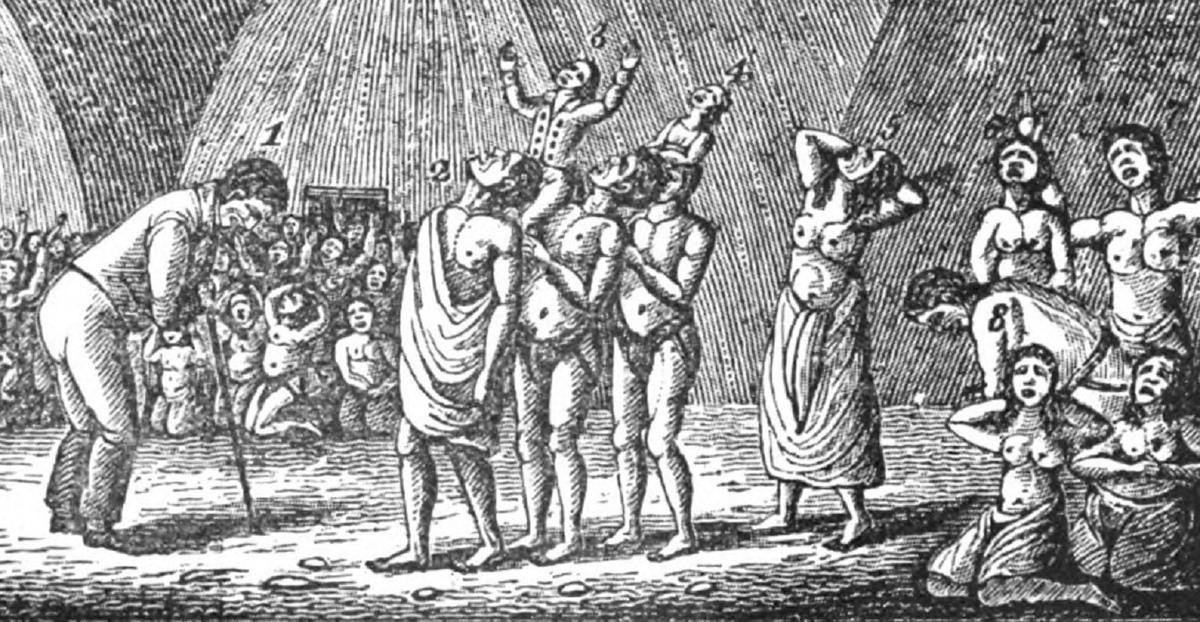
An engraving of Hawaiian chiefs standing and kneeling in mourning beneath a thatched roof
The royal family mourning Keōpūolani, Lahaina, 1823, engraving after William Ellis (1825). Kalākua, who led the 1820 sewing circle, is among the chiefs. Engraving after William Ellis · Public domain
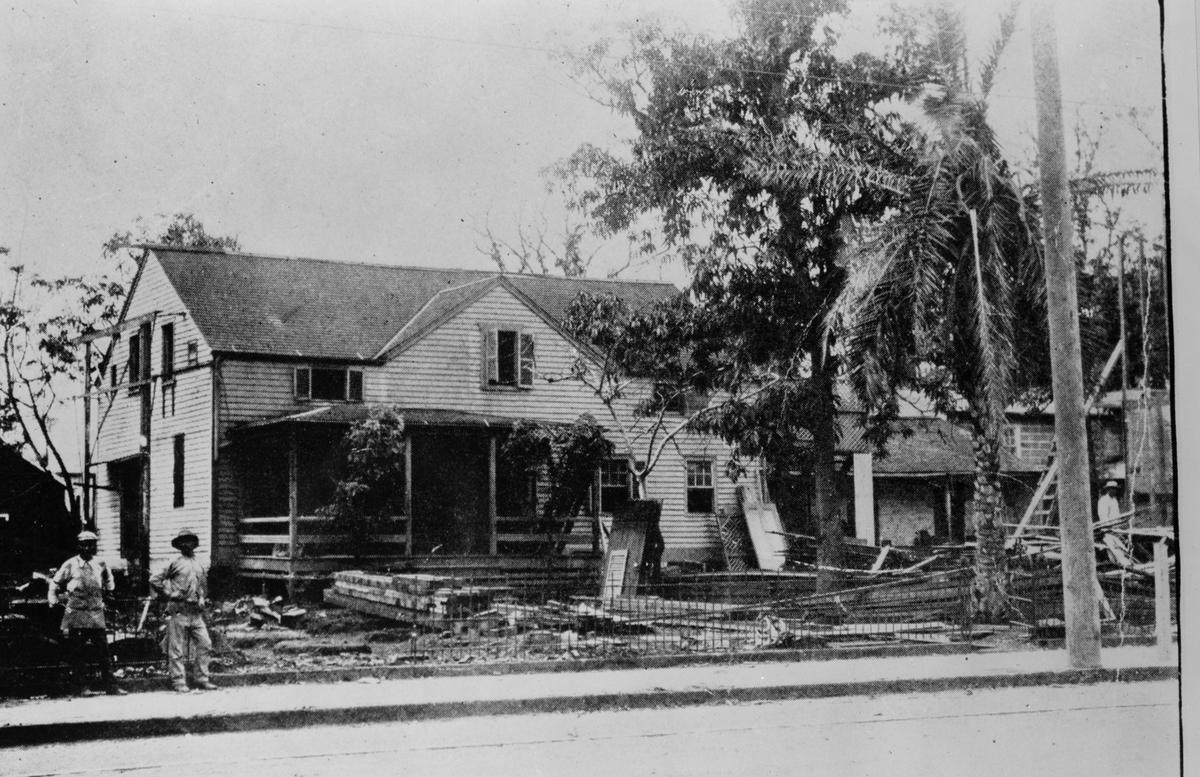
An old photograph of a two-story white frame house with a long porch behind trees, on a dirt street in Honolulu
The missionaries' frame house in Honolulu, now Hawaiian Mission Houses, photographed about 1907. Library of Congress, HABS · Public domain

1820s – 1860s

Patchwork first

Missionary women went on teaching sewing. Quilt historian Linda B. Arthur notes that they were teaching Hawaiians to sew in the 1830s and that patchwork was called kapa pohopoho. The earliest Hawaiian quilts were pieced rather than appliquéd, and all the cloth was imported, since cotton cloth was not made in the islands.

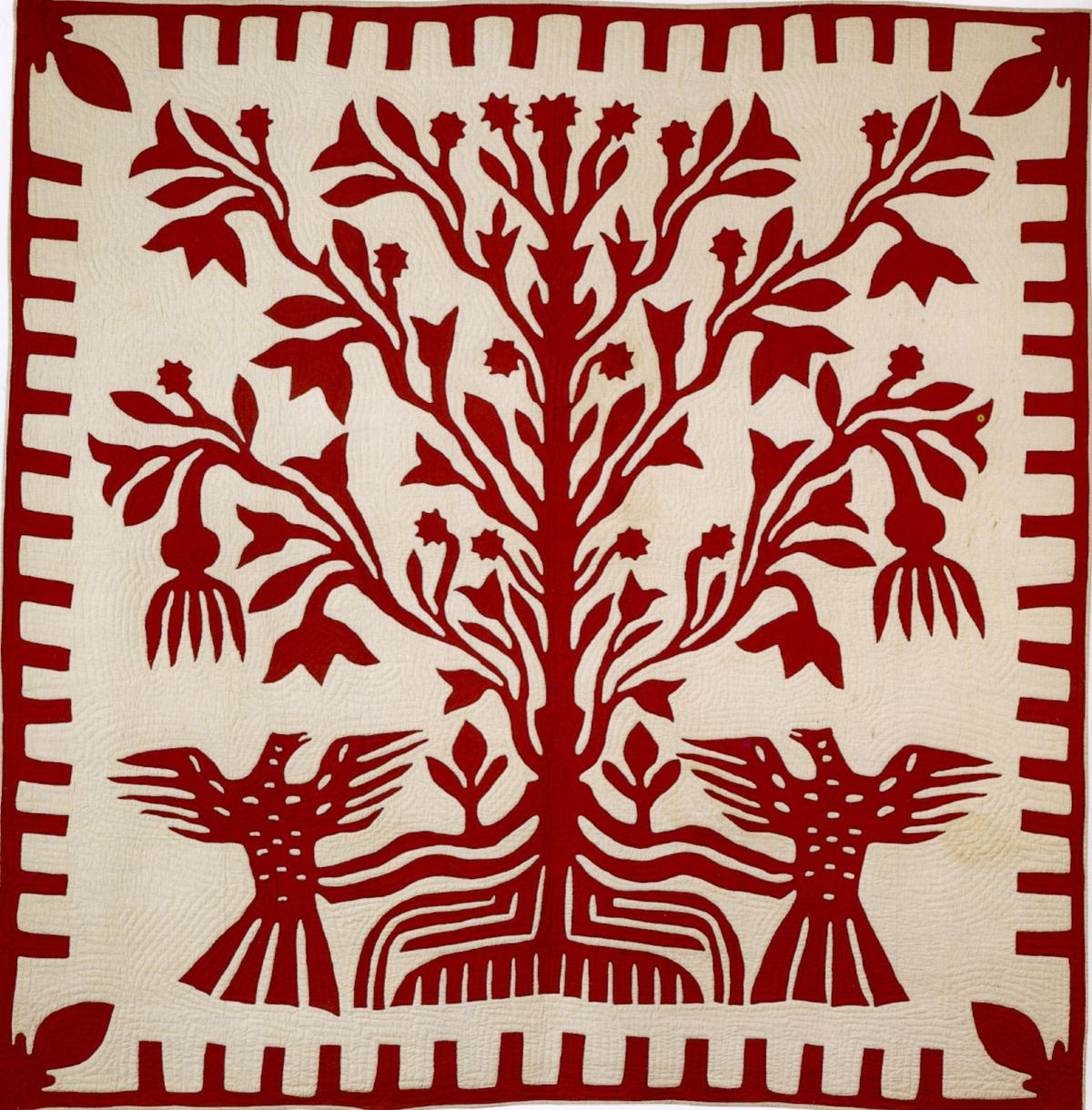
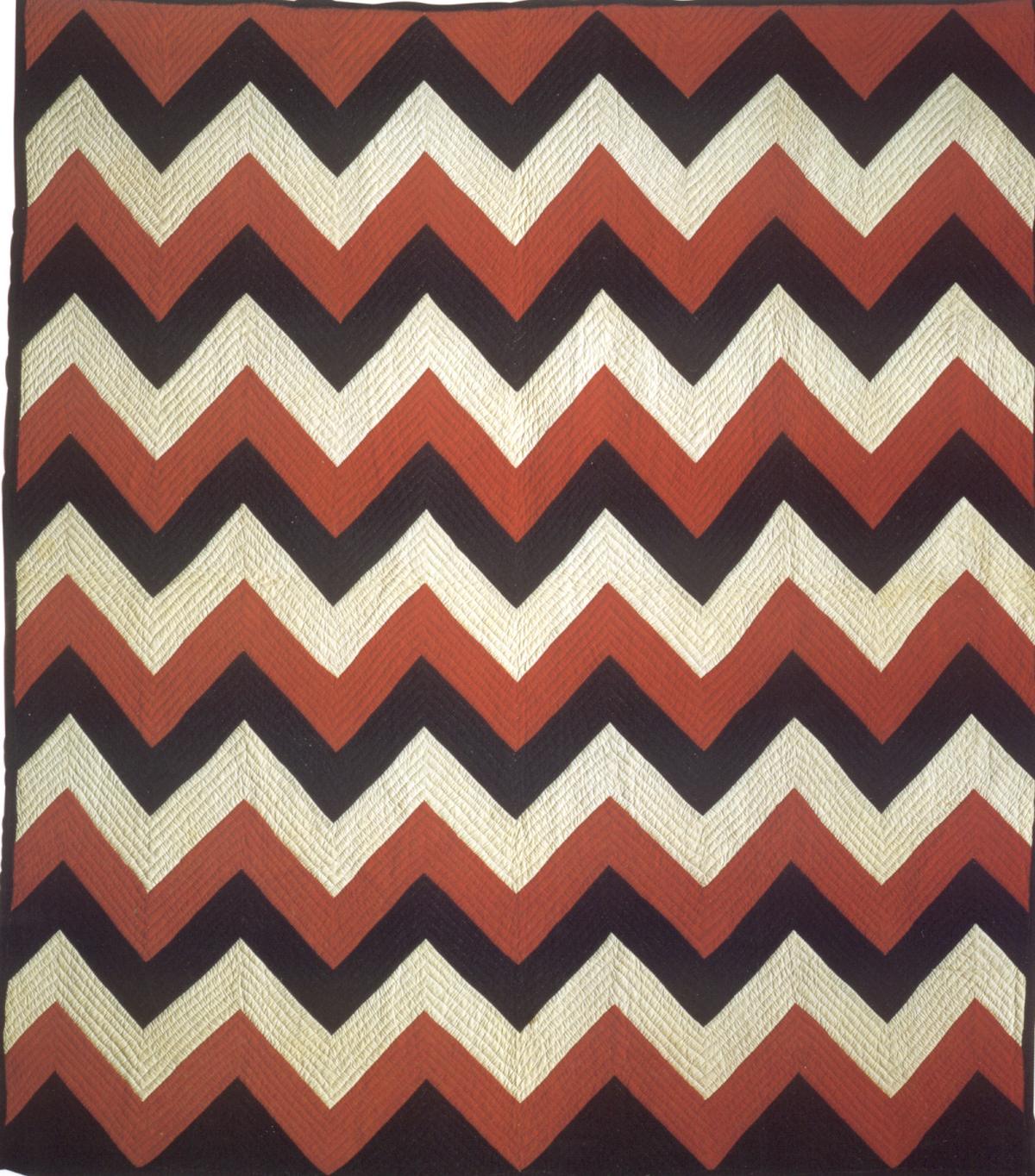
Piecing never disappeared: Kulipuʻu, a bold zigzag quilt from Kauaʻi made in the late 1800s or early 1900s, is pieced, not appliquéd. But a red-and-white presentation quilt from Oʻahu, dated only broadly to about 1855–1887, already shows a new look: a single symmetrical tree with two birds and a sawtooth border.

A red-on-white appliqué quilt of a single symmetrical flowering tree with two birds at its foot, inside a sawtooth border
Presentation quilt with a tree and two birds, Oʻahu, about 1855–1887. Honolulu Museum of Art · Public domain
A pieced quilt of bold zigzag bands in red, black and white, finely quilted
Kulipuʻu, a pieced quilt from Kauaʻi, late 1800s or early 1900s. Honolulu Museum of Art · Public domain

1870s – 1880s

A Hawaiian style

In the second half of the 1800s, Hawaiian women turned missionary patchwork into an art of their own.

1870s

Fold-and-cut appliqué: a Hawaiian invention

By the 1870s Hawaiian women were making fold-and-cut appliqué: one large piece of colored cloth, folded and cut like a paper snowflake so the design repeats symmetrically around the center, then sewn onto a plain ground. The International Quilt Museum dates this development to the 1870s, and Pukui and Elbert give kapa lau ("leaf quilt") for a quilt with appliquéd designs.

This is the heart of the story. The missionaries brought calico patchwork; the cut-cloth style was developed by Hawaiian women. Exactly how it emerged is not documented. The International Quilt Museum notes that missionaries may have introduced paper cutting, but no firm evidence of that has been found.

A crimson appliqué design cut from one folded cloth, repeating around the center like a snowflake, with stars and fern sprays on white
Ke Kahi O Kaʻiulani (The Comb of Kaʻiulani), Hawaiian quilt, before 1918. Honolulu Museum of Art · Photo by Hiart, CC0

1873

"Quite works of art"

The English traveler Isabella Bird spent the first half of 1873 in the islands, and her letters were published in 1875. In one Hawaiian home she saw a bed "covered with a beautiful quilt," with an arabesque border on a white ground and a wreath of green leaves in the center.

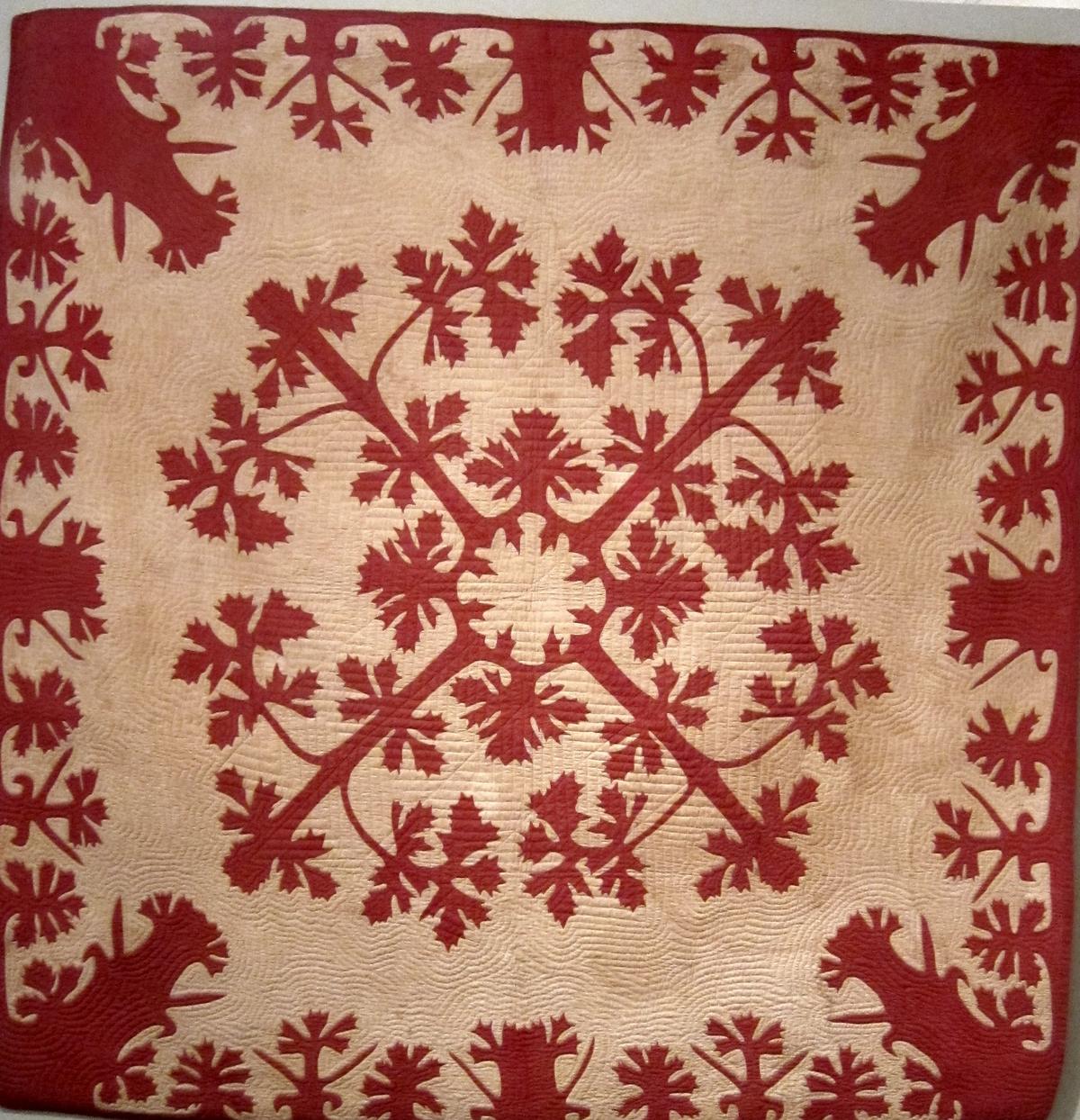
Hawaiian women, she wrote, used the utmost ingenuity in the patterns and colors of these quilts: "Some of them are quite works of art." The plain and printed cottons cost about $8, and a finished quilt was worth $18 to $50. Her central wreath and border match the appliqué quilts that survive from the late 1800s, such as Lei Mamo.

A red-and-white Hawaiian quilt with a wreath of leafy branches around the center and a leafy border, quilted in rippling lines
Lei Mamo, Hawaiian quilt, late 1800s. Honolulu Museum of Art · Photo by Hiart, CC0

1874

DAVIES, 28 September 1874

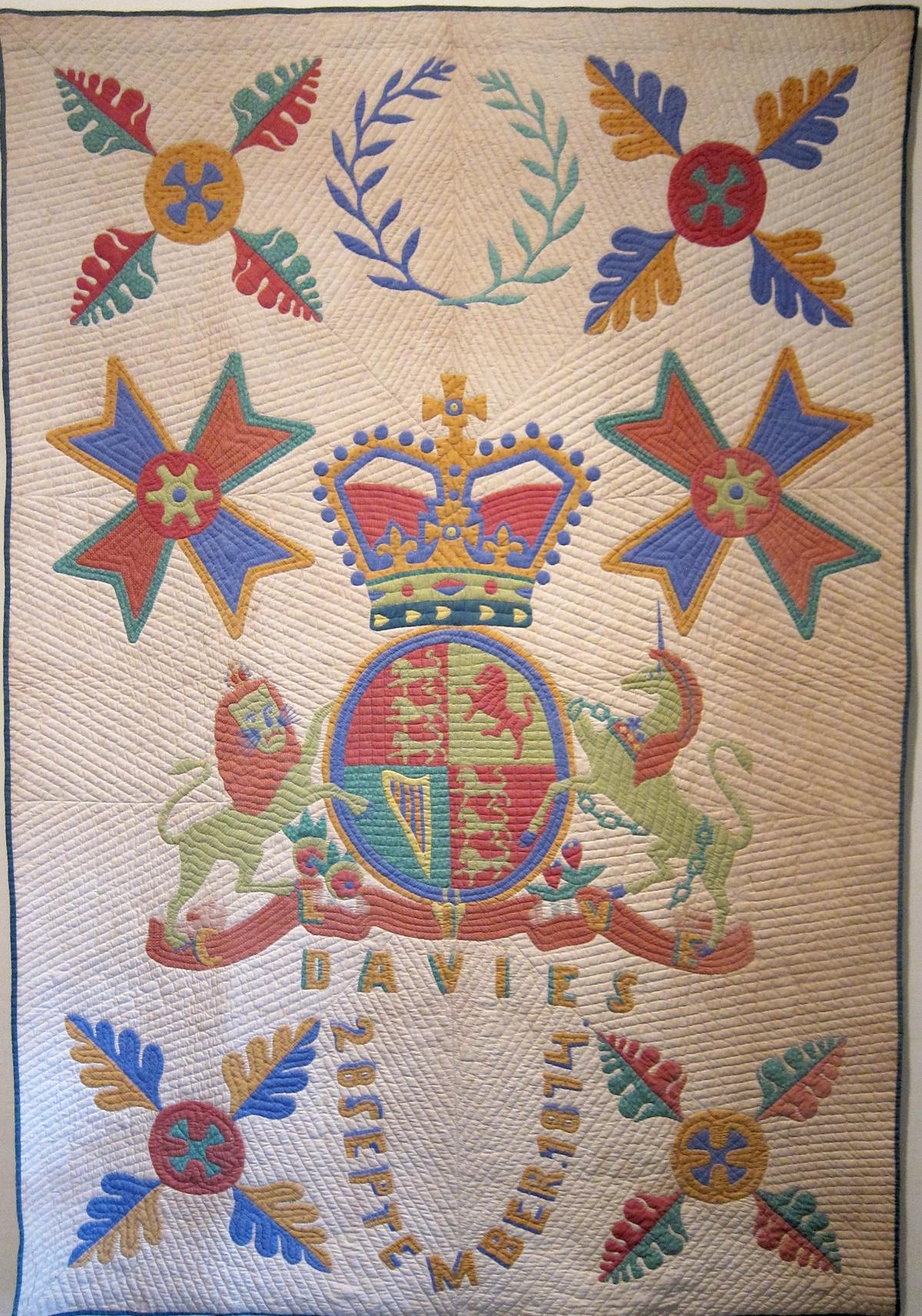
One securely dated quilt from these years, in the Honolulu Museum of Art, is inscribed DAVIES 28 SEPTEMBER 1874. In multicolored calico appliqué and reverse appliqué on cotton duck, it shows a crown over the British royal arms with the lion and the unicorn, framed by stars and a wreath.

It is a reminder that heraldry and lettering were part of Hawaiian quiltmaking from early on.

A multicolored appliqué quilt with a crown over the British royal arms, a lion and a unicorn, stars, a laurel wreath and the name DAVIES
Hawaiian appliqué quilt inscribed DAVIES 28 SEPTEMBER 1874. Honolulu Museum of Art · Photo by Hiart, CC0

Late 1800s

Echo quilting and named designs

The quilting on a Hawaiian appliqué quilt follows the outline of the design in row after row, so ripples spread across the whole surface. Pukui and Elbert name this kuiki lau, "a kind of quilting that follows the design"; the general word for quilting is kuiki, so a Hawaiian quilt is kapa kuiki. Many quilters today call it echo quilting.

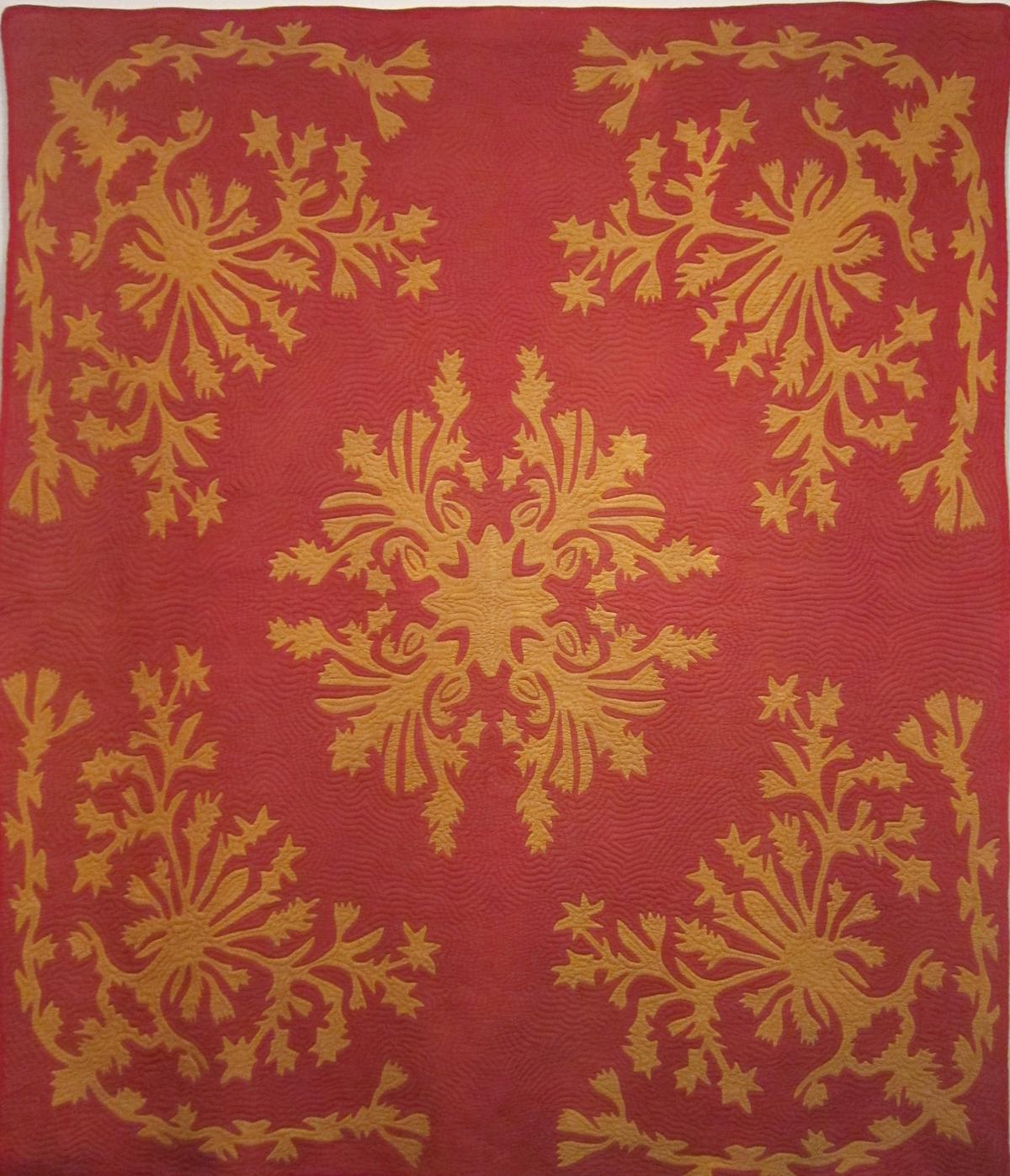
Each design was given a name, often from a place, a plant, a person or a poetic phrase, such as Ka Ua Kani Lehua, "The Rain that Rustles Lehua Blossoms."

A red quilt with a gold appliqué medallion in the center and four gold flowering sprays toward the corners
Ka Ua Kani Lehua (The Rain that Rustles Lehua Blossoms), Hawaiian quilt, late 1800s. Honolulu Museum of Art · Photo by Hiart, CC0

A tradition

Why the first quilt is an ʻulu

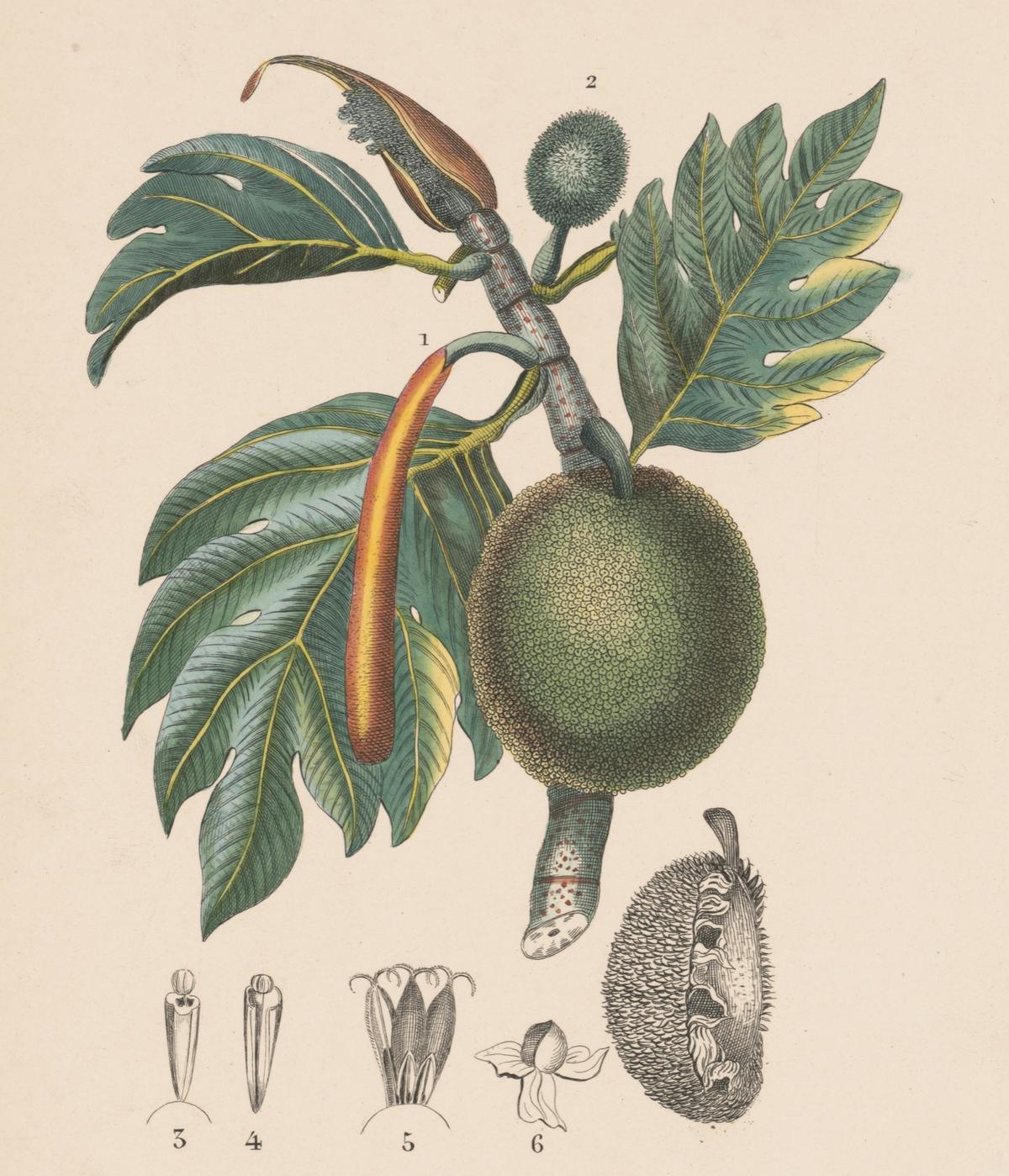
A widely told custom holds that a quilter's first quilt should be an ʻulu (breadfruit) design. University of Hawaiʻi curator Linda B. Arthur records the belief that a woman whose first quilt was an ʻulu would always have food in her household, and quotes the quilter Deborah U. Kakalia: "to make an ulu motif means that you will always make another."

A separate story says the first Hawaiian quilt design came from the shadow of an ʻulu tree falling on cloth laid out to dry. Hawaiian Mission Houses tells it as a legend from master quilter Patricia Lei Murray, not as documented history.

A hand-colored botanical print of a breadfruit branch with deeply lobed leaves and a round green fruit
ʻUlu, the breadfruit, in a hand-colored botanical print, France, 1800s. Library of Congress · Public domain

c. 1886

Crowns and kāhili: the kingdom in cloth

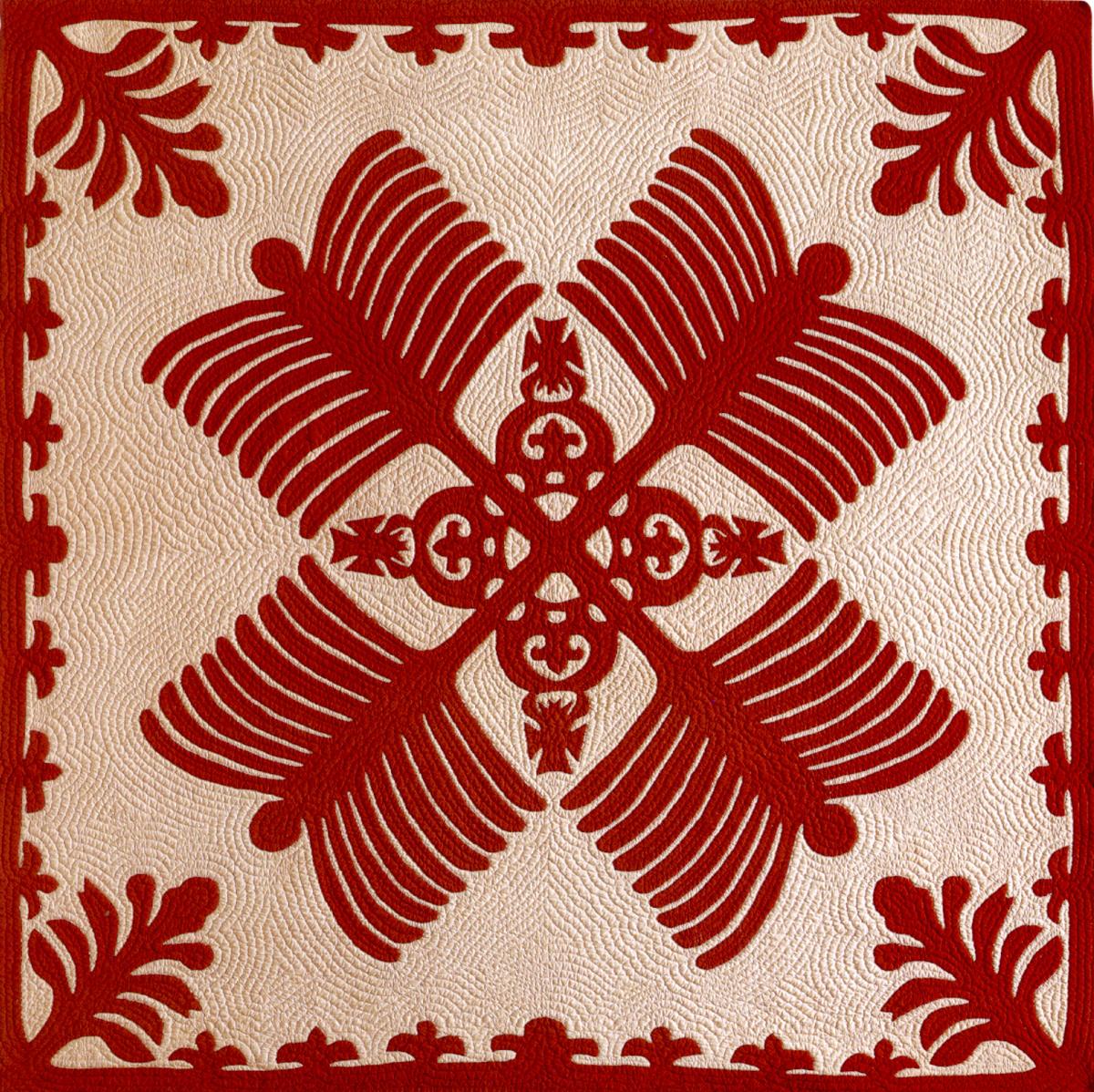
Royal symbols were favorite motifs while the Hawaiian Kingdom still stood. Na Kalaunu Me Na Kāhili ("The Crowns and the Kāhili"), attributed to Mary Sophia Rice and dated about 1886, sets crowns and kāhili, the feather standards carried for aliʻi (chiefs), around a central medallion.

Another quilt in the Honolulu Museum of Art, Na Kalaunu ("Crowns"), made before 1918, repeats crowns between leafy sprays. These designs honored the kingdom and its chiefs, and their meaning sharpened after the monarchy fell in 1893.

A red-and-white Hawaiian appliqué quilt: four great feathered kāhili radiate from a central medallion, with crowns at the corners and echo quilting all over
Na Kalaunu Me Na Kāhili (The Crowns and the Kāhili), attributed to Mary Sophia Rice, Hawaiʻi, about 1886. Honolulu Museum of Art · Public domain
A gold quilt with purple appliqué crowns and leafy sprays around a central medallion, echo quilted in rippling lines
Na Kalaunu (Crowns), Hawaiian quilt, before 1918. Honolulu Museum of Art · Photo by Hiart, CC0

1893 – 1898

The fall of the kingdom

The overthrow of the Hawaiian Kingdom gave flag quilts and royal motifs new weight.

1893 – 1898

Overthrow and annexation

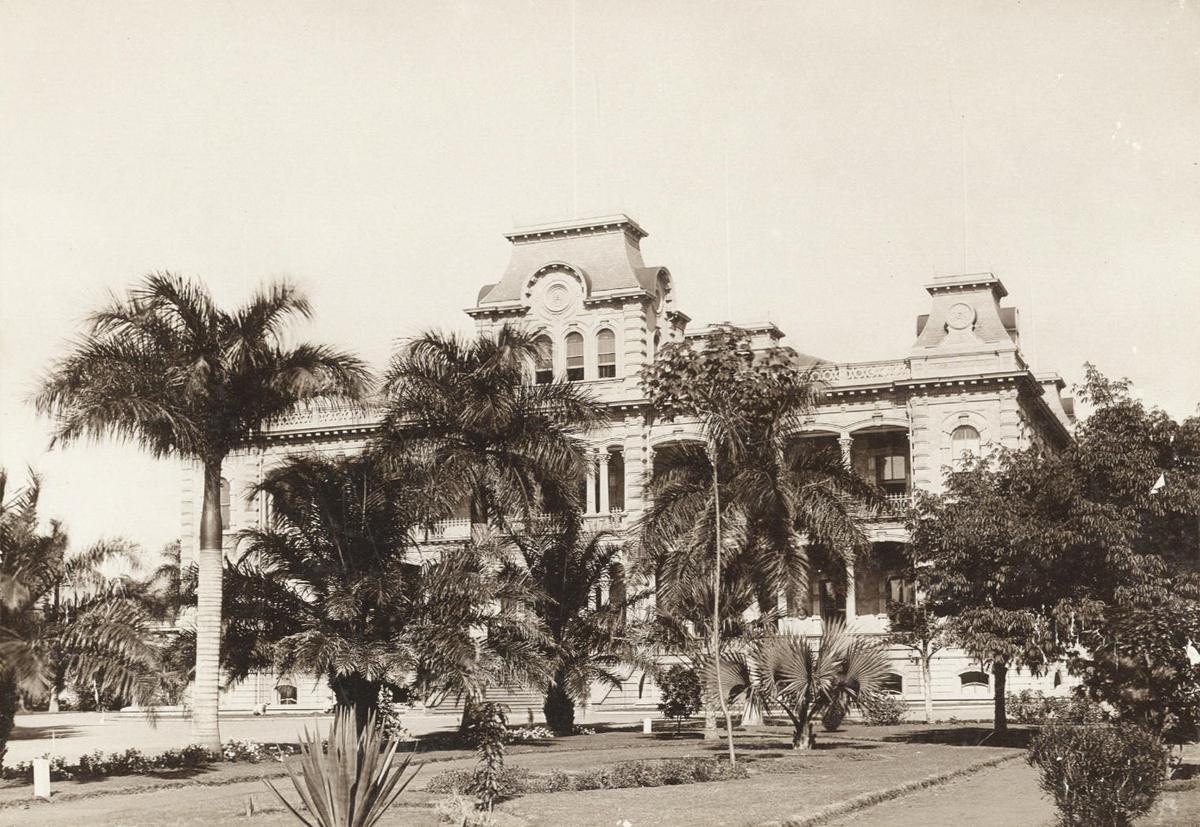
On January 17, 1893, a Committee of Safety backed by a landing force from the USS Boston overthrew Queen Liliʻuokalani. The United States annexed the islands by a joint resolution signed on July 7, 1898, and the Hawaiian flag was lowered at ʻIolani Palace on August 12, 1898.

An old photograph of ʻIolani Palace, with its towers rising behind palm trees
ʻIolani Palace, Honolulu, about 1890. F. G. Eyton-Walker · Public domain

Before 1870 – today

Kuʻu Hae Aloha: My Beloved Flag

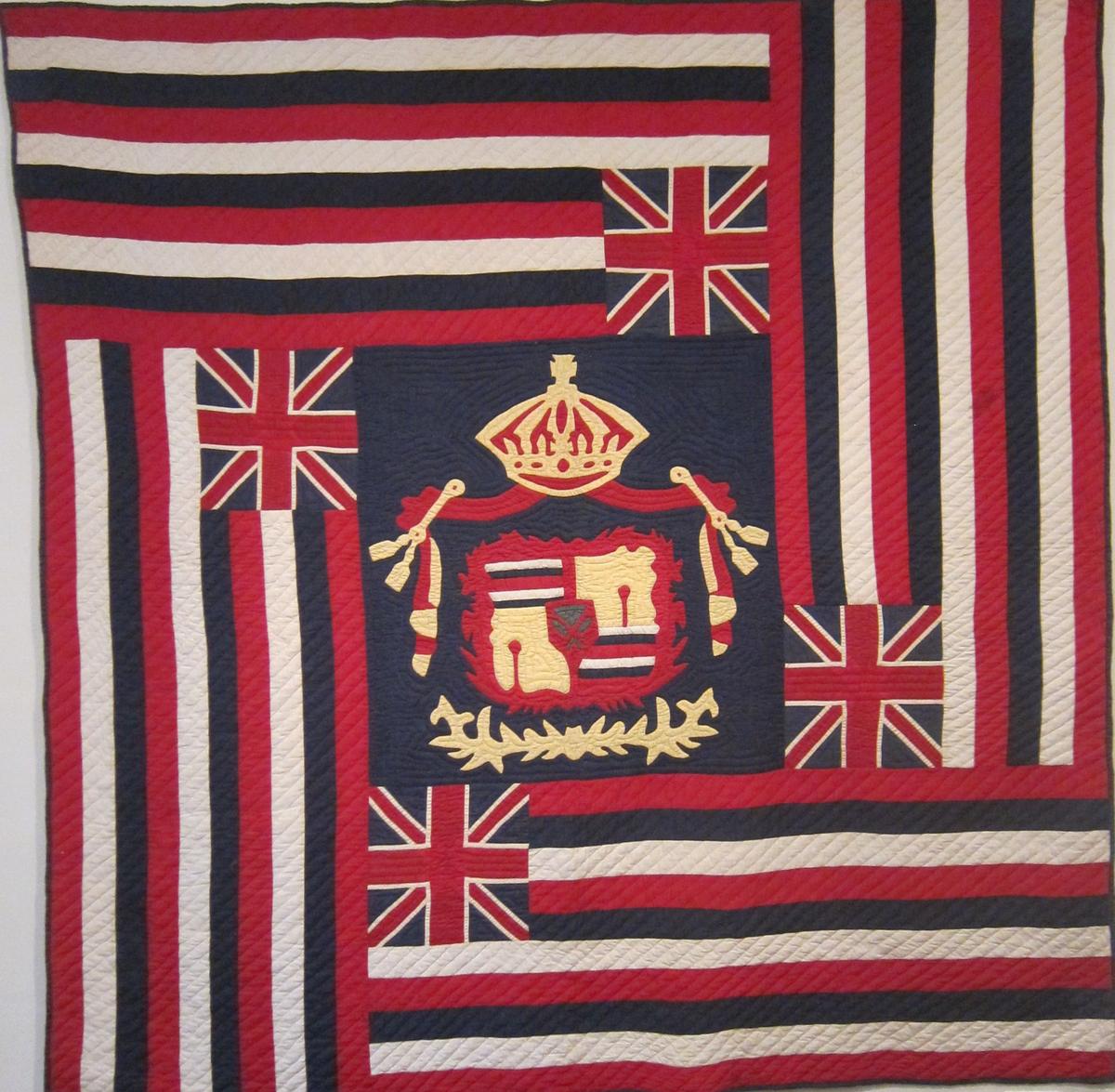
Flag quilts, called Kuʻu Hae Aloha ("My Beloved Flag"), combine four pieced Hawaiian flags with an appliquéd coat of arms or crown. The Honolulu Museum of Art says the type originated sometime before 1870, and that demand increased after what it calls the illegal overthrow, during the Republic of Hawaiʻi (1893–1898), and continued after annexation.

Many were statements of love for the lost kingdom, but each quilt's meaning was its maker's own. A popular story dates the first flag quilt to 1843, when Lord George Paulet seized the islands, but no surviving flag quilt is securely dated to 1843.

A flag quilt: four pieced Hawaiian flags with red, white and blue stripes around an appliquéd coat of arms under a crown, with the words KUU HAE ALOHA
Kuʻu Hae Aloha (My Beloved Flag), Hawaiian flag quilt, 1890–1900. Honolulu Museum of Art · Photo by Hiart, CC0
A flag quilt with four striped Hawaiian flags around a navy center holding a gold crown and the kingdom's coat of arms
Kuʻu Hae Aloha (My Beloved Flag), a flag quilt from Waimea, before 1918. Honolulu Museum of Art · Photo by Hiart, CC0

1895

The Queen's quilt

After a failed attempt by royalists to restore her, Liliʻuokalani was arrested on January 16, 1895, signed a forced abdication on January 24, and was held in an upstairs room of ʻIolani Palace for nearly eight months. In her memoir she wrote that she was released on September 6, 1895. ʻIolani Palace notes that her days there included prayer, music, crochet work and quilting.

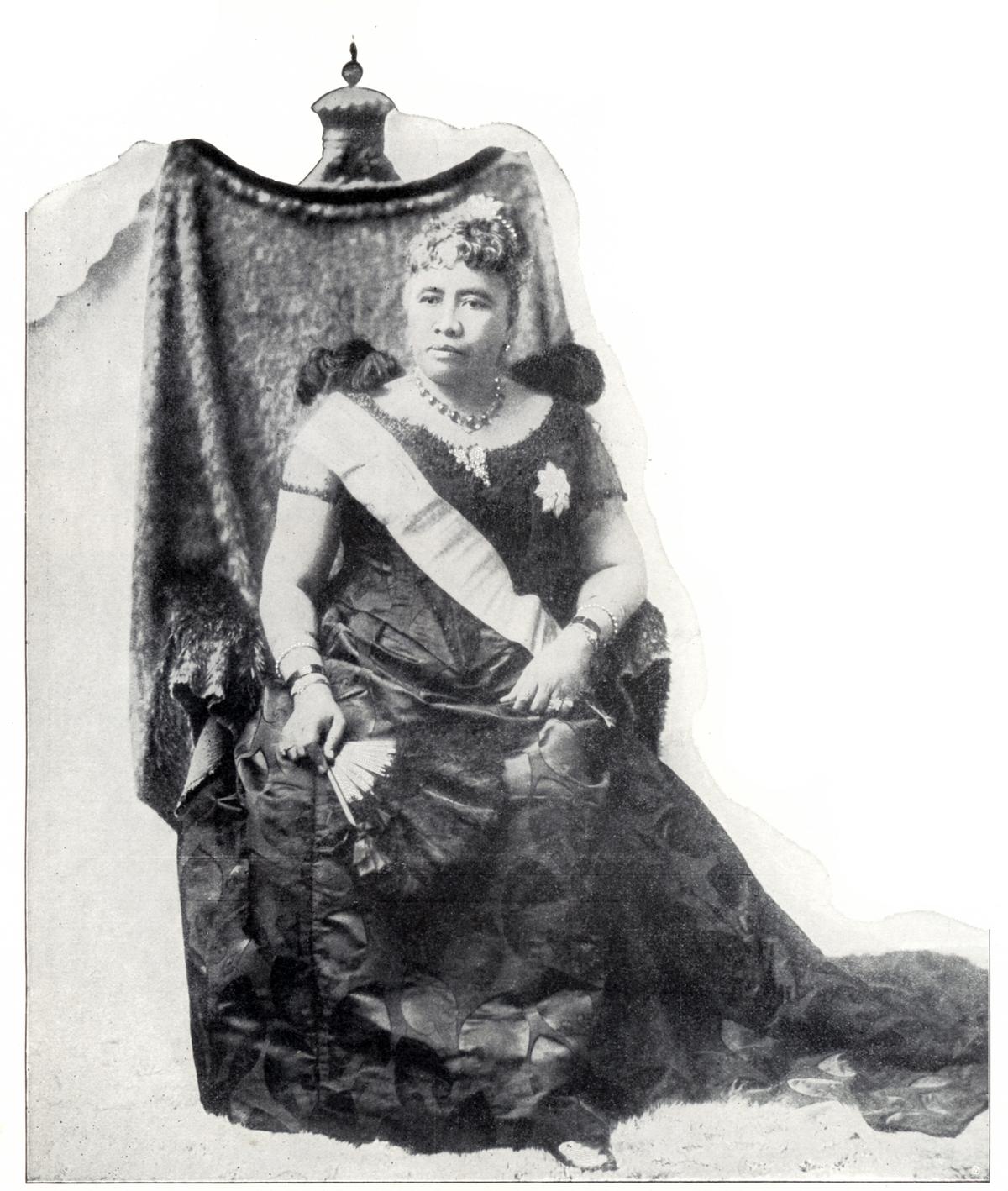
With her companions she made a quilt whose embroidered center block begins "Imprisoned at Iolani Palace ... We began the quilt here," and whose blocks carry dates and the names of supporters. It is crazy patchwork, not Hawaiian appliqué, and its embroidered dates show it was finished after her release. It is displayed today in the room where she was held. No public-domain photograph of it exists, so her portrait stands here instead.

A portrait of Queen Liliʻuokalani, seated, with a feather cloak draped over her chair
Liliʻuokalani, from a photograph of about 1891, published 1899. Our Islands and Their People, 1899 · Public domain

1900 – today

Given, not taken

Through the 1900s, patterns passed from hand to hand, and teachers kept kapa kuiki alive.

c. 1900 – 1930s

Patterns passed hand to hand

In the decades after annexation, Hawaiian women kept making appliqué quilts, and patterns were traced, traded, sold and collected; Loretta Woodard, co-author of Hawaiian Quilts: Tradition and Transition, has studied pattern collecting from 1900 to 1959. Quilts of this era honor people and places, such as Ke Kahi O Kaʻiulani ("The Comb of Kaʻiulani"), named for Princess Kaʻiulani, and the pictorial Na Kihapai Nani Lua ʻOle O Edena a Me Elenale ("The Beautiful Unequaled Gardens of Eden and of Elenale"), both made before 1918.

Some patterns were treated as private. By tradition, as Honolulu Museum of Art curator Tory Laitila has explained, a pattern was given to you, or you were allowed to copy it, before you made it, and copying another quilter's design without permission was frowned on.

A two-panel pictorial quilt: at left a crown over a man in uniform and a woman in a gown, at right an angel with a book above two seated figures
Na Kihapai Nani Lua ʻOle O Edena a Me Elenale (The Beautiful Unequaled Gardens of Eden and of Elenale), Hawaiian quilt, before 1918. Honolulu Museum of Art · Photo by Hiart, CC0

1940s – 1985

Teachers keep the art alive

Mealiʻi Kalama (born 1909) made an ʻulu quilt as a teenager that took a year and a half. She taught Hawaiian quilting for decades through Honolulu's parks department, at Papakōlea and at Kawaiahaʻo Church, where she was a lay minister. With church women she designed and made 30 quilts, each eight feet square, in 18 months for the Mauna Kea Beach Hotel.

In 1985 she received a National Heritage Fellowship from the National Endowment for the Arts, and the Hawaiʻi State Foundation on Culture and the Arts lists her as a master of kapa kuiki.

2021 – today

A living tradition, and who owns a design

Hawaiian quilting is still taught and demonstrated across the islands, including at Hawaiʻi Volcanoes National Park's cultural festival. In February 2021 a fashion label sold a dress print that commenters recognized as an ʻulu quilt design by Hawaiian designer Allen Akina; the brand apologized on March 23 and withdrew the garments, and a second label apologized that June for quilt-style pieces copied from two Hawaiian quilters.

Linda B. Arthur told FLUX Hawaii that copying such work is "trading on people's mana." The disputes revived the old rule that a design is given, not taken. To make a quilt in the Hawaiian style, draw a design of your own, or ask the quilter whose pattern you love. In Quiltler you can draw your own shapes and mirror them as you place them.

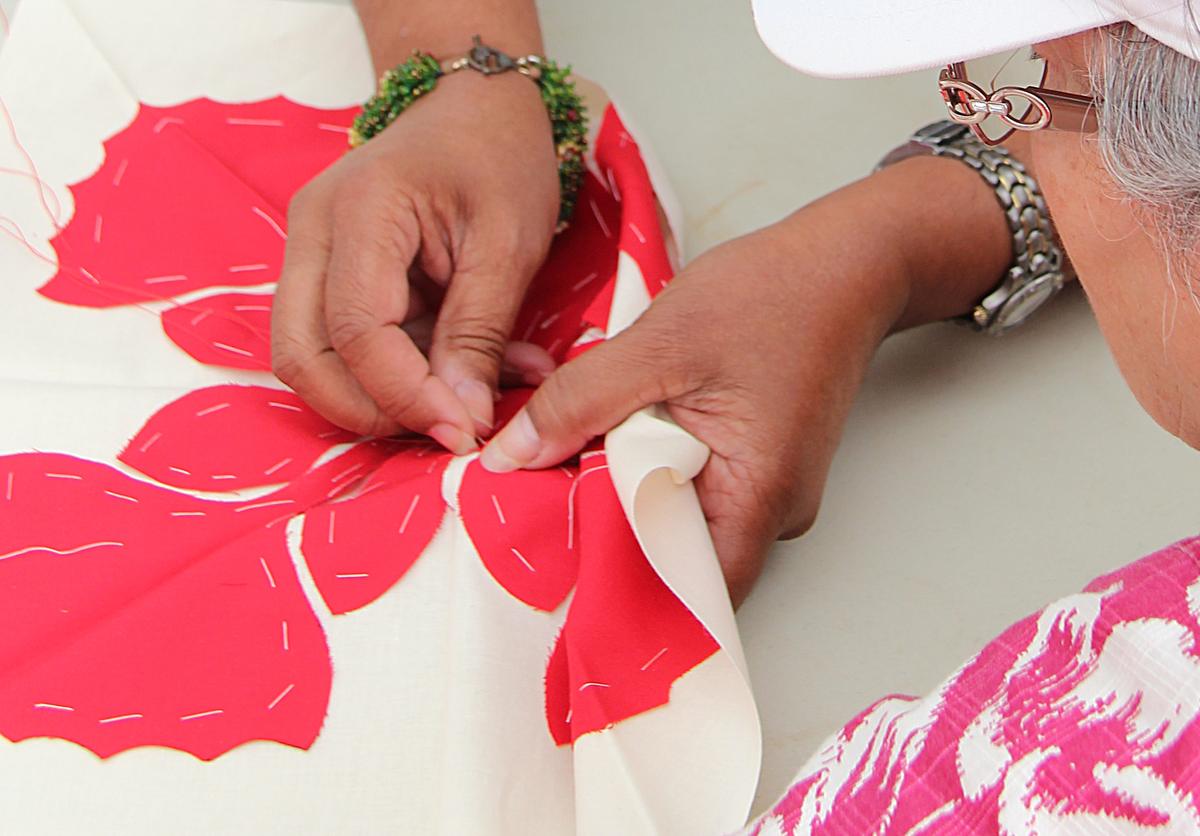
Hands quilting around a red appliqué leaf on white cloth
Kapa kuiki, Hawaiian quilting, at Hawaiʻi Volcanoes National Park's cultural festival, 2013. National Park Service, Jay Robinson · Public domain

Hawaiian quilt myths and legends

Hawaiian quilts carry some lovely stories. Here is which ones the record supports, and which are told as legends.

Partly wrong

Missionaries taught Hawaiians the Hawaiian appliqué quilt in 1820.

In 1820 the missionary women gave high-ranking Hawaiian women calico patchwork to sew. Fold-and-cut appliqué appears by the 1870s and was developed by Hawaiian women; no firm evidence shows missionaries introduced the cutting.

Legend

The first design came from the shadow of a breadfruit tree on cloth laid out to dry.

Hawaiian Mission Houses tells it as a story from master quilter Patricia Lei Murray. It's a lovely legend, but there's no documentary evidence for it.

A real custom

A quilter's first Hawaiian quilt should be an ʻulu (breadfruit).

Linda B. Arthur records the belief that a woman whose first quilt was an ʻulu would always have food, and the quilter Deborah Kakalia said it means you will always make another.

Unproven

Flag quilts were first made in 1843, when Lord George Paulet seized the islands.

The story is often repeated, but no surviving flag quilt is securely dated to 1843. The Honolulu Museum of Art says flag quilts began sometime before 1870.

No evidence

Hawaiian quilts were burned or buried with their makers so their spirits would not wander.

We found it in no museum or scholarly source. What is documented is that patterns were guarded and shared only with permission.

Myth

Queen Liliʻuokalani's quilt is a Hawaiian appliqué quilt she made alone.

It is crazy patchwork with embroidered blocks, made with her companions during and after her 1895 imprisonment.

Design a Hawaiian-style quilt of your own

Hawaiian tradition asks quilters to make their own designs, or to ask before copying one. These pages help you start from a blank sheet.

Hawaiian quilt questions

When did Hawaiians start quilting?

In 1820. On April 3 the chiefess Kalākua gathered the newly arrived missionary women on the deck of the Thaddeus, and four high-ranking Hawaiian women were given calico patchwork to sew. The earliest Hawaiian quilts were pieced; the fold-and-cut appliqué style appears by the 1870s.

What is kapa kuiki?

It is the Hawaiian name for a quilt and for quilting. Kapa was Hawaiian bark cloth, and bedding was kapa moe; kuiki means quilting, or to quilt. Pukui and Elbert's Hawaiian Dictionary spells it kuiki, with no ʻokina, as do Hawaiian Mission Houses and the state arts foundation.

How are Hawaiian quilts made?

The quilter folds one large piece of colored cloth and cuts the design through all the layers, like a paper snowflake, so it repeats symmetrically around the center. She sews it whole onto a plain ground, then quilts it in rows that follow the design. That single cut-cloth design is the big difference from a pieced quilt of many blocks.

What is echo quilting on a Hawaiian quilt?

It is quilting that follows the outline of the appliqué in row after row, so ripples spread across the whole surface. The Hawaiian name, in Pukui and Elbert's dictionary, is kuiki lau, "a kind of quilting that follows the design."

Why should your first Hawaiian quilt be a breadfruit?

It's a widely told custom. Linda B. Arthur records the belief that a woman whose first quilt was an ʻulu (breadfruit) would always have food in her household, and the quilter Deborah U. Kakalia said that to make an ʻulu means you will always make another. The story that the first design came from a breadfruit tree's shadow is a legend.

What does a Hawaiian flag quilt mean?

Flag quilts are called Kuʻu Hae Aloha, "My Beloved Flag": four Hawaiian flags around the kingdom's coat of arms or a crown. The type began before 1870, and demand rose after the 1893 overthrow of Queen Liliʻuokalani. Many were statements of love for the lost kingdom, but each quilt's meaning was its maker's own.

Can I copy a Hawaiian quilt pattern?

By Hawaiian tradition, a pattern was given to you, or you were allowed to copy it, before you made it, and copying another quilter's design without permission was frowned on. In 2021 two fashion labels apologized for copying Hawaiian quilters' designs. Buy a pattern from its designer, ask permission, or draw your own.

More quilt history

Sources and image credits

  1. Lucy G. Thurston, Life and Times of Mrs. Lucy G. Thurston (1882; Internet Archive)
  2. Isabella L. Bird, Six Months in the Sandwich Islands (letters of 1873; Internet Archive)
  3. Liliʻuokalani, Hawaii's Story by Hawaii's Queen (1898; Internet Archive)
  4. Pukui & Elbert, Hawaiian Dictionary: kapa moe (Wehewehe Wikiwiki, University of Hawaiʻi at Hilo)
  5. Pukui & Elbert, Hawaiian Dictionary: kuiki and kuiki lau
  6. Pukui & Elbert, Hawaiian Dictionary: kapa lau
  7. International Quilt Museum: Beauty of Hilo Bay (Quilt of the Month, December 2013)
  8. Hawaiian Mission Houses: Amy Schwab, The Story Behind the Stitch
  9. Linda B. Arthur, Na Pua o' Hawaiʻi exhibition text, University of Hawaiʻi at Mānoa
  10. Honolulu Museum of Art: Kuʻu Hae Aloha (My Beloved Flag), 5783.1
  11. Joyce D. Hammond, Hawaiian Flag Quilts: Multivalent Symbols of a Hawaiian Quilt Tradition, Hawaiian Journal of History 27 (1993)
  12. Wikimedia Commons: Hawaiian quilts in the Honolulu Museum of Art
  13. Reiko Mochinaga Brandon & Loretta G. H. Woodard, Hawaiian Quilts: Tradition and Transition (2004), review
  14. ʻIolani Palace: the Imprisonment Room
  15. Peter T. Young, Queen's Quilt, Images of Old Hawaiʻi
  16. National Archives: Hawaiian petition against annexation
  17. National Archives: Joint Resolution for Annexing the Hawaiian Islands (1898)
  18. National Endowment for the Arts: Meali'i Kalama, 1985 National Heritage Fellow
  19. Hawaiʻi State Foundation on Culture and the Arts: Hawaiʻi's National Heritage Fellows
  20. Alexis Cheung, Unthreading a Quilting Controversy, FLUX Hawaii (2021)

Every picture is in the public domain or released under CC0: quilts in the Honolulu Museum of Art (most photographed by Wikimedia contributor Hiart, who released the photographs under CC0), bark cloth from LACMA, prints and photographs from the Library of Congress and other public-domain publications, and a National Park Service photograph. Each caption names the object and links to its record. No public-domain photograph of Queen Liliʻuokalani's quilt exists, so her portrait is shown instead.