Quilting history · Block names

How Quilt Blocks Got Their Names

From honeycomb patchwork to Drunkard's Path and Double Wedding Ring

Drunkard's Path, Bear's Paw, Burgoyne Surrounded: quilt blocks carry some of the most colorful names in American folk art. Many of them are younger than the quilts they're used for, and some of the stories behind them are just that, stories. Here is how the names really arose, block by block, from the first printed pattern in 1831 to the newspaper columns of the 1930s, with quilts from the Met, the Smithsonian, the Art Institute of Chicago, LACMA, the National Gallery of Art and the Library of Congress.

  • 15 moments
  • 1831 to today
  • 20 museum photographs
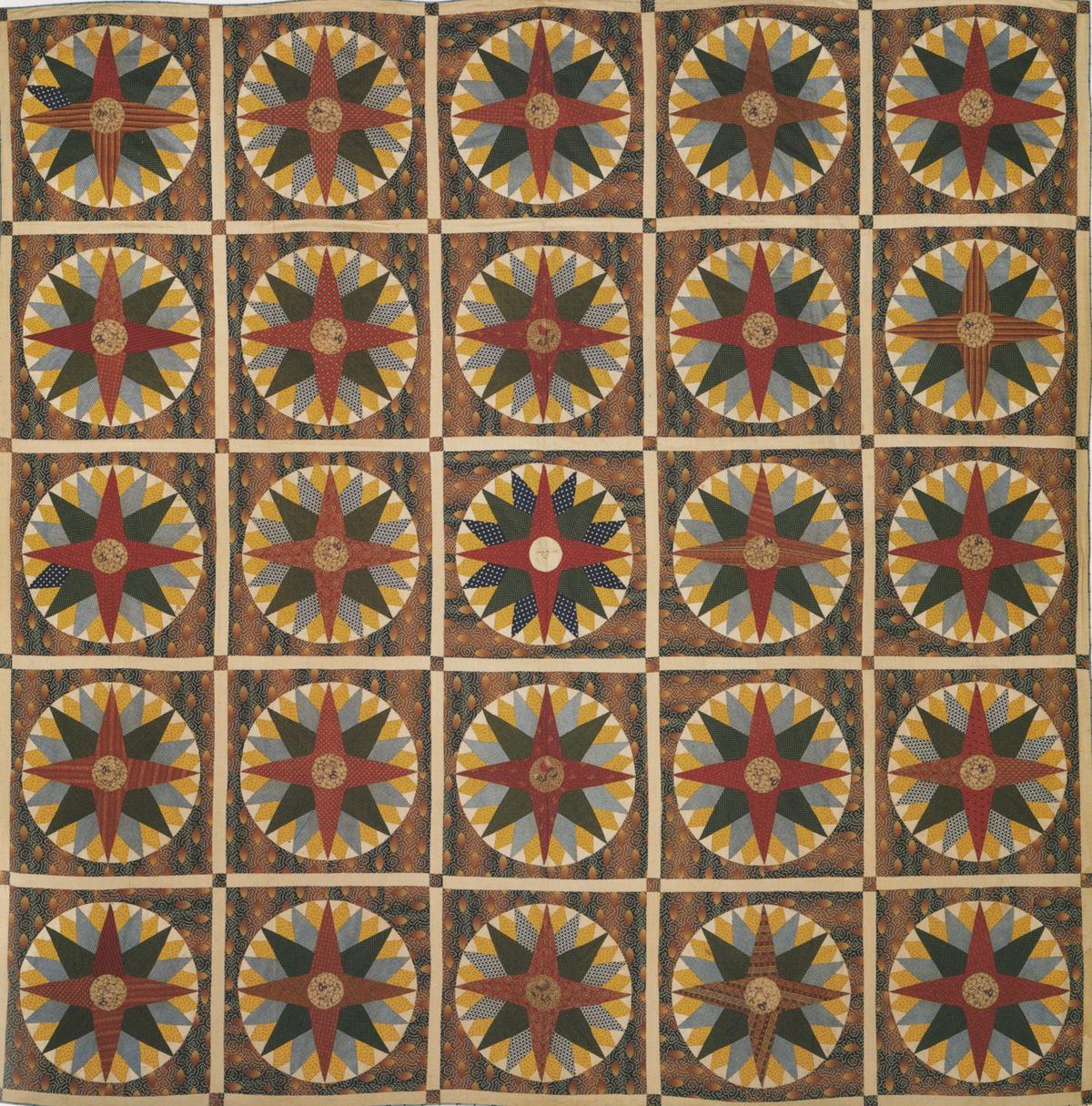
  • Twenty-five sharp-pointed compass stars in red, green, yellow and blue, each in a circle on a brown ground
  • Pieced blocks of small triangles set in green sashing, with the words SUSAN REED AGED 11 YR and 1851 along the bottom border
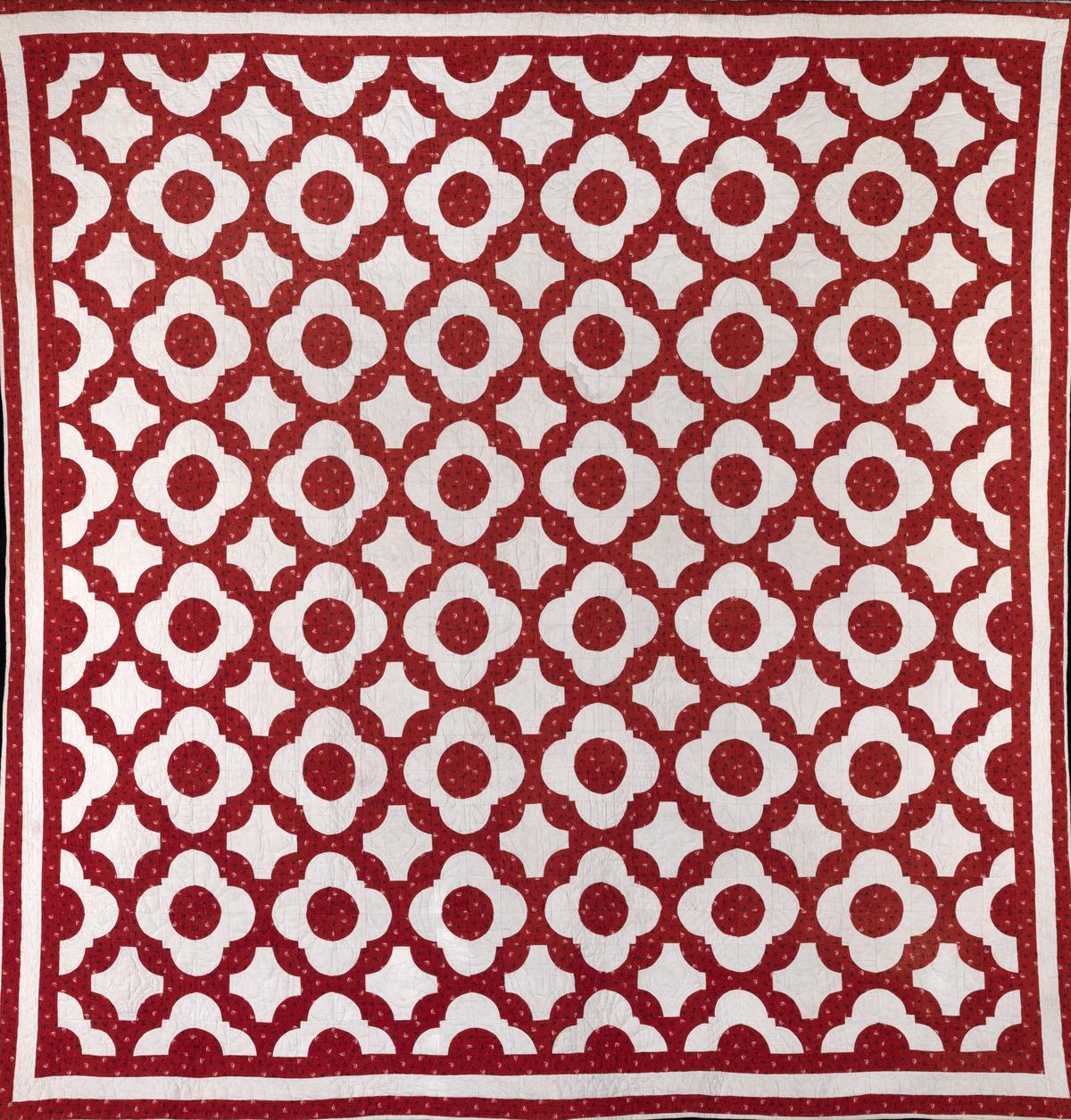
  • A red and white quilt of curved pieces forming circles and rings
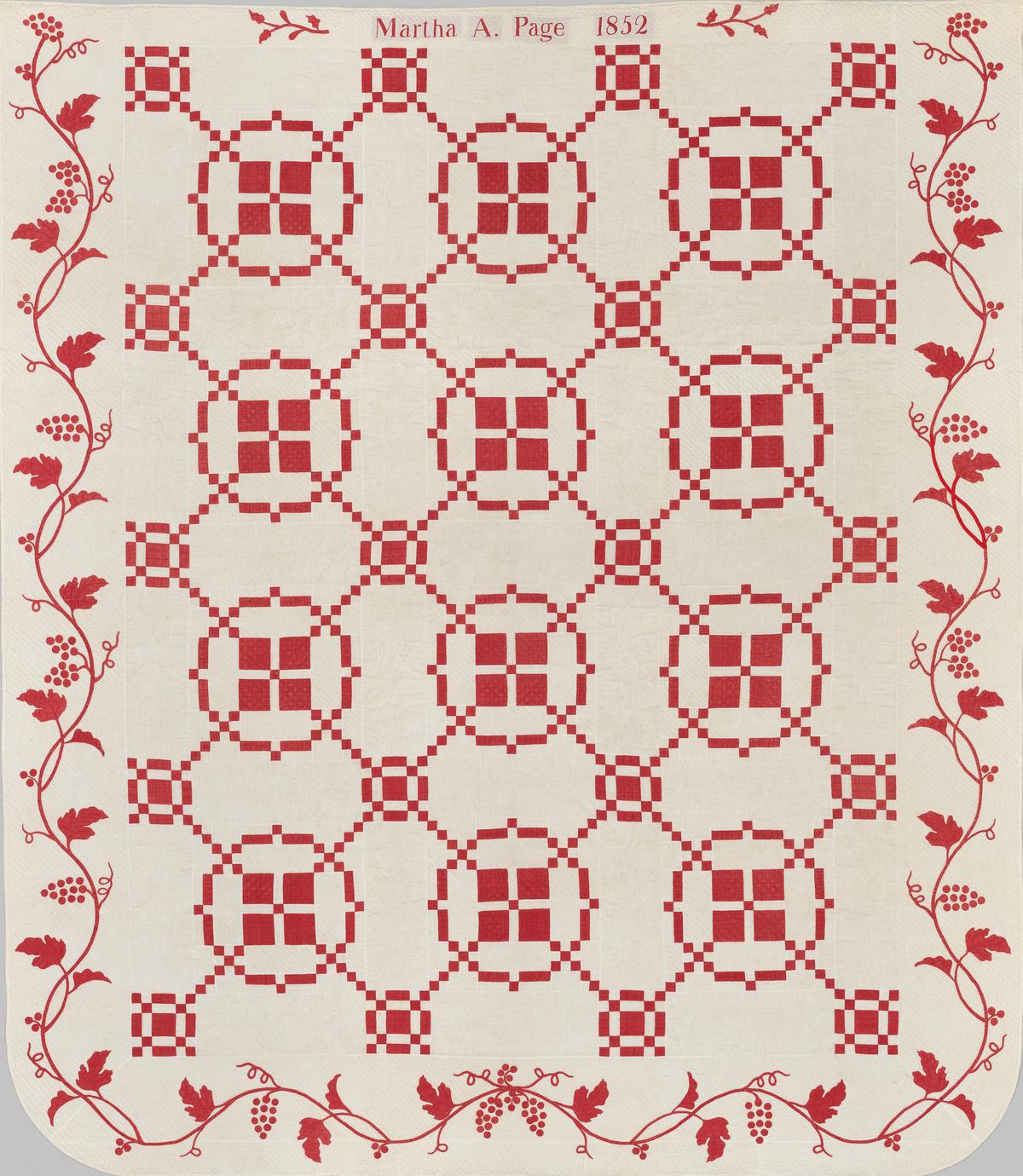
  • A red and white quilt of small squares in rings and crosses, framed by a grapevine border, signed Martha A. Page 1852 at the top
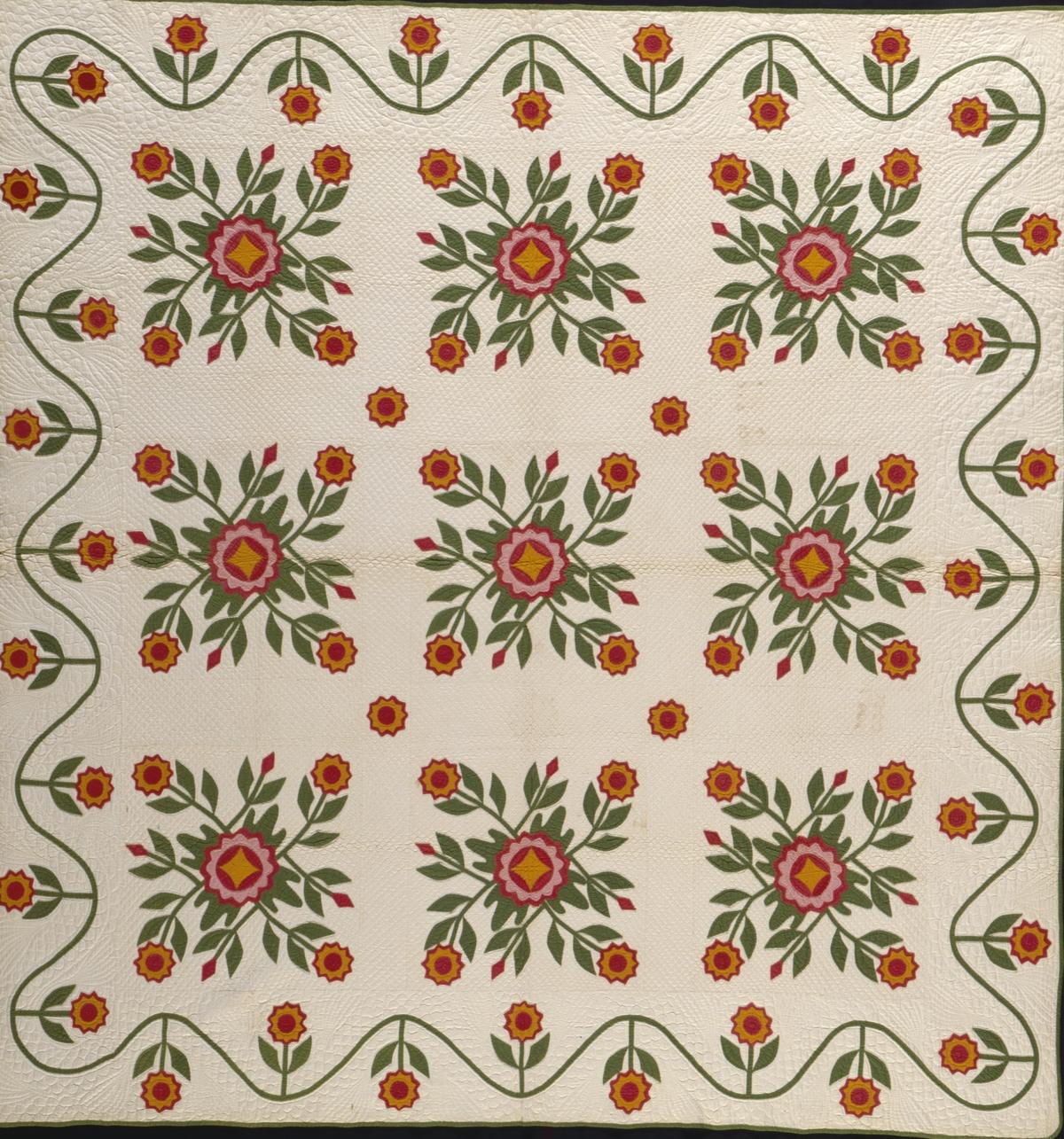
  • Nine appliquéd roses with green leaves on a white quilt inside a running green vine border of orange flowers
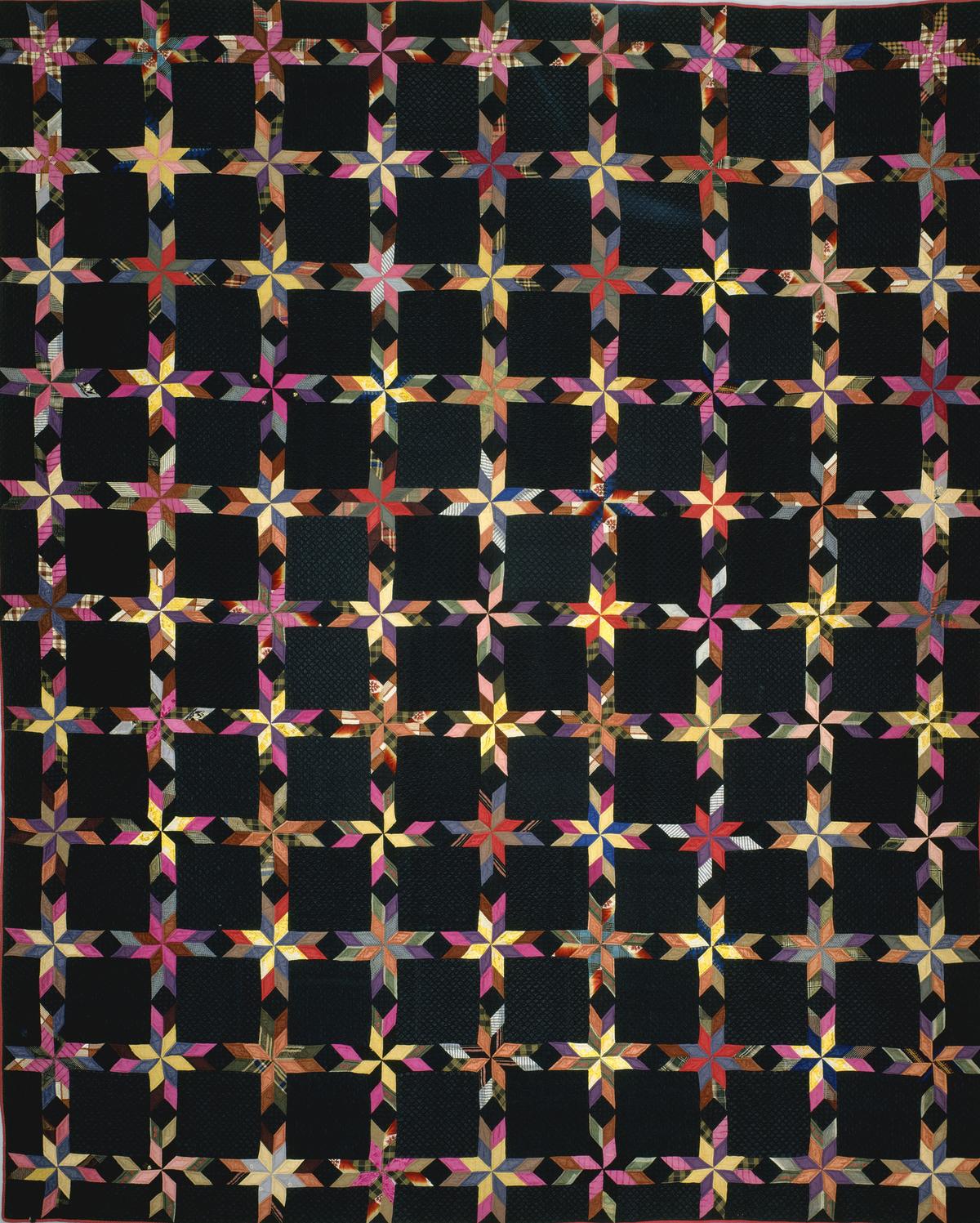
  • Rows of bright eight-pointed silk stars in pinks, yellows and reds on a black ground

How did quilt blocks get their names?

Mostly from everyday life, reading, the Bible, history and politics, and often long after the quilts themselves were made. Early quilters rarely recorded names: the first printed American pattern, in 1831, was simply "hexagon, six-sided or honey-comb patch-work." Names multiplied in print from the 1880s, as farm papers, the Ladies Art Company catalog and later newspaper columns gave every design a name, and different papers often gave the same block different ones.

1780–1851

Before the names

For half a century, American patchwork patterns traveled hand to hand, and most of them had no recorded name at all.

c. 1780 – 1840

Quilts first, names later

Most surviving early American patchwork has no name recorded by its maker. Women described their work by technique or shape, such as "hexagon," "honeycomb" or "six-sided patchwork," rather than by a catchy title, and patterns spread by copying a neighbor's quilt or a sample block, not from print. Quilt historian Wilene Smith's interviews show that sample blocks were still traded as patterns well into the 20th century.

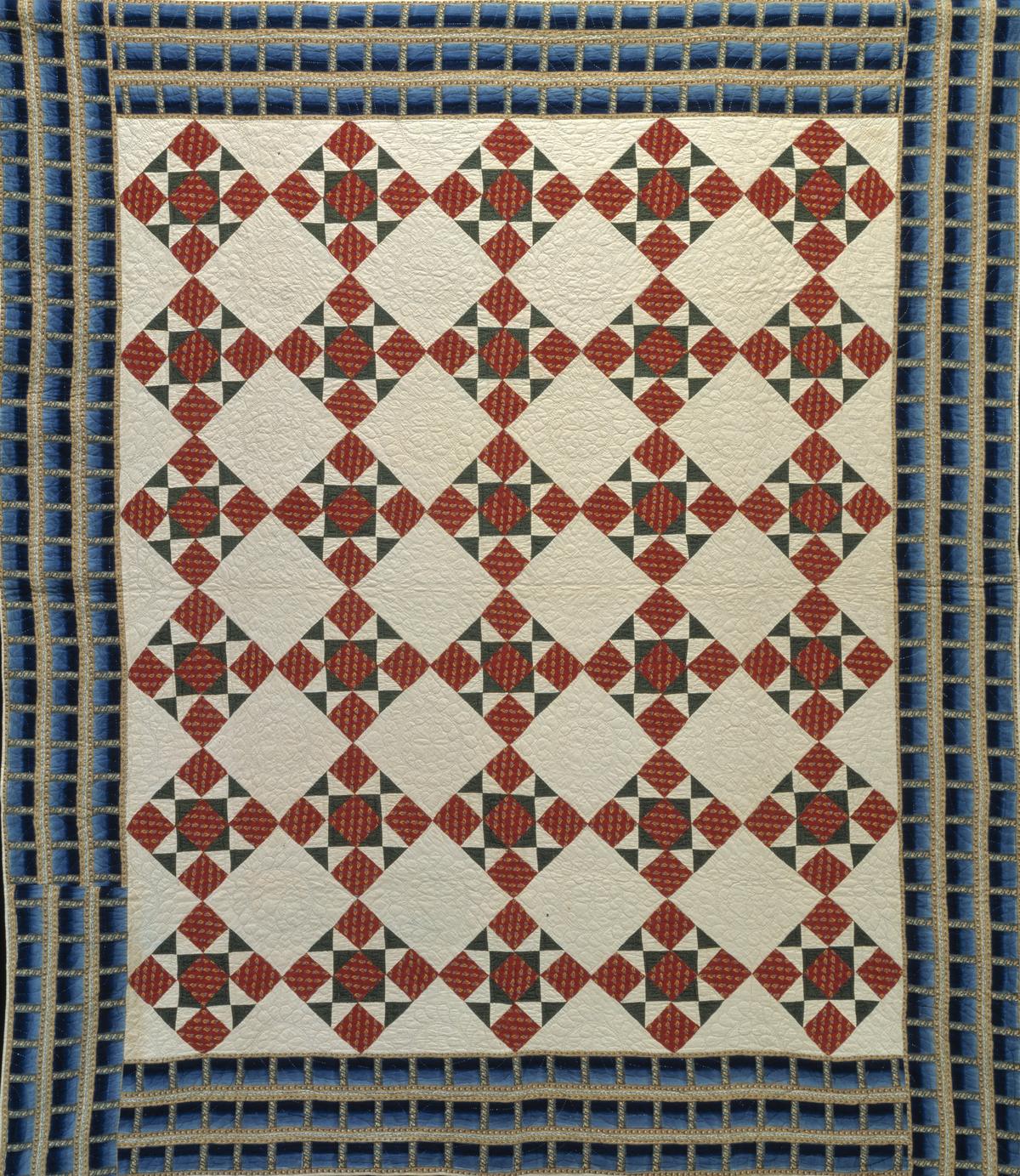
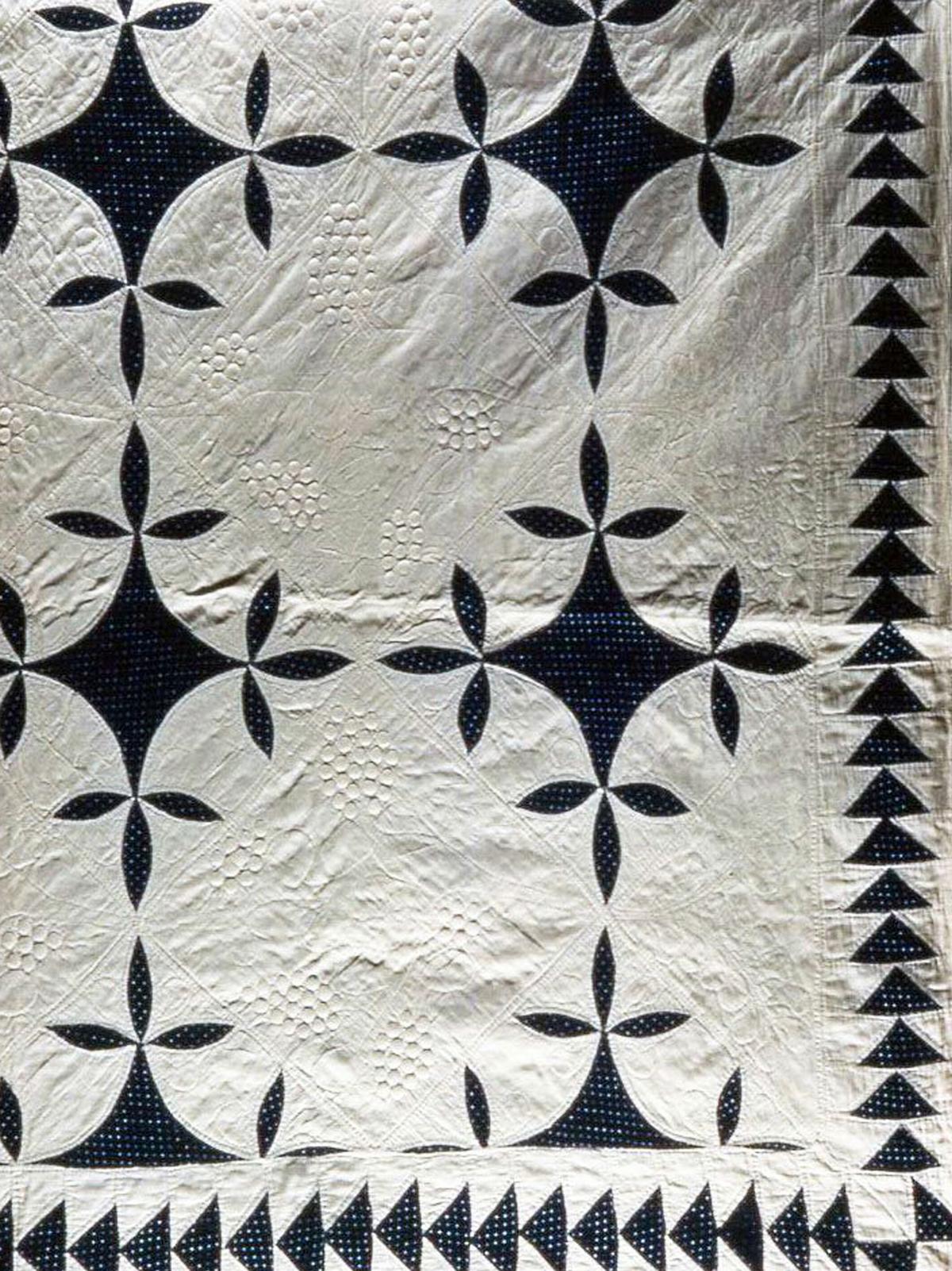
Many names museums use today were attached long after the quilts were made. The Smithsonian catalogs this quilt of about 1845 as Ohio Star, but what its maker called it is unknown. The Art Institute of Chicago lists another, of about 1830, as "Pincushion and Burrs" or "Square and Swallows": one design, two names at once.

Red and green eight-pointed stars set on point across a white quilt with a striped blue border
Ohio Star quilt, United States, about 1845. Smithsonian American Art Museum · CC0
Part of a white quilt with dark blue curved four-pointed shapes and a border of blue triangles
"Pincushion and Burrs" or "Square and Swallows" quilt, United States, about 1830 (detail). Art Institute of Chicago · Public domain

1831 – 1835

The first printed pattern: "honey-comb patch-work"

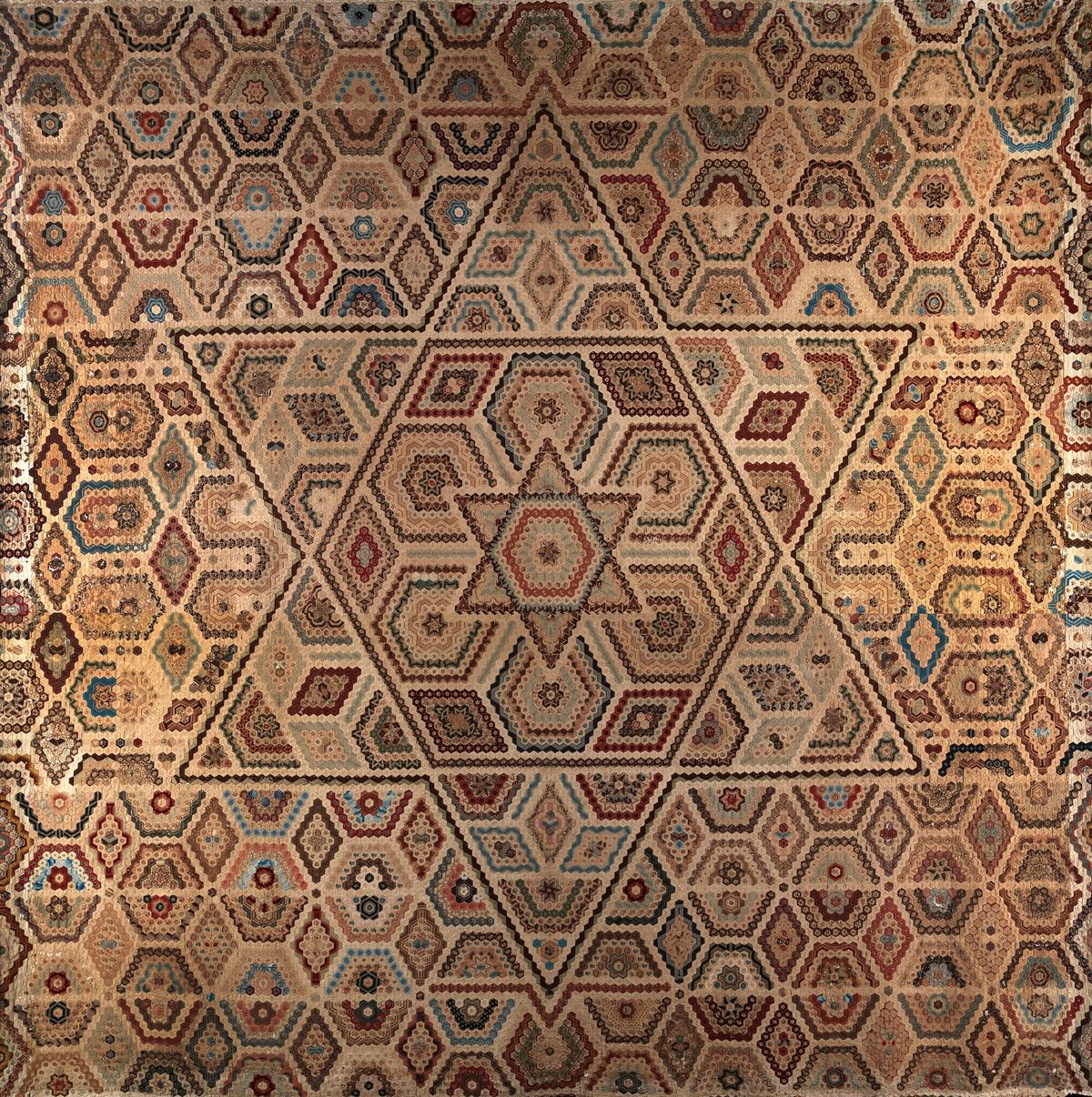
The standard citation for the first published American quilt pattern is Eliza Leslie's The American Girl's Book (1831), which describes "hexagon, six-sided or honey-comb patch-work." Godey's Lady's Book, the widely read Philadelphia women's magazine, reprinted the design and text in 1835. By then Americans had been making hexagon quilts like this one, of about 1815, for decades, so print recorded a pattern rather than inventing it.

The same design later picked up other names: "Job's troubles" in an 1856 story, "Mosaic," and in the 1930s Grandmother's Flower Garden. To try one, Quiltler can design on a hexagon grid.

A brown and tan quilt of tiny hexagons arranged in rosettes inside a large six-pointed star
Pieced bedcover in honeycomb hexagons, United States, about 1815. Smithsonian American Art Museum · CC0

1851

Wild Goose Chase, signed at eleven

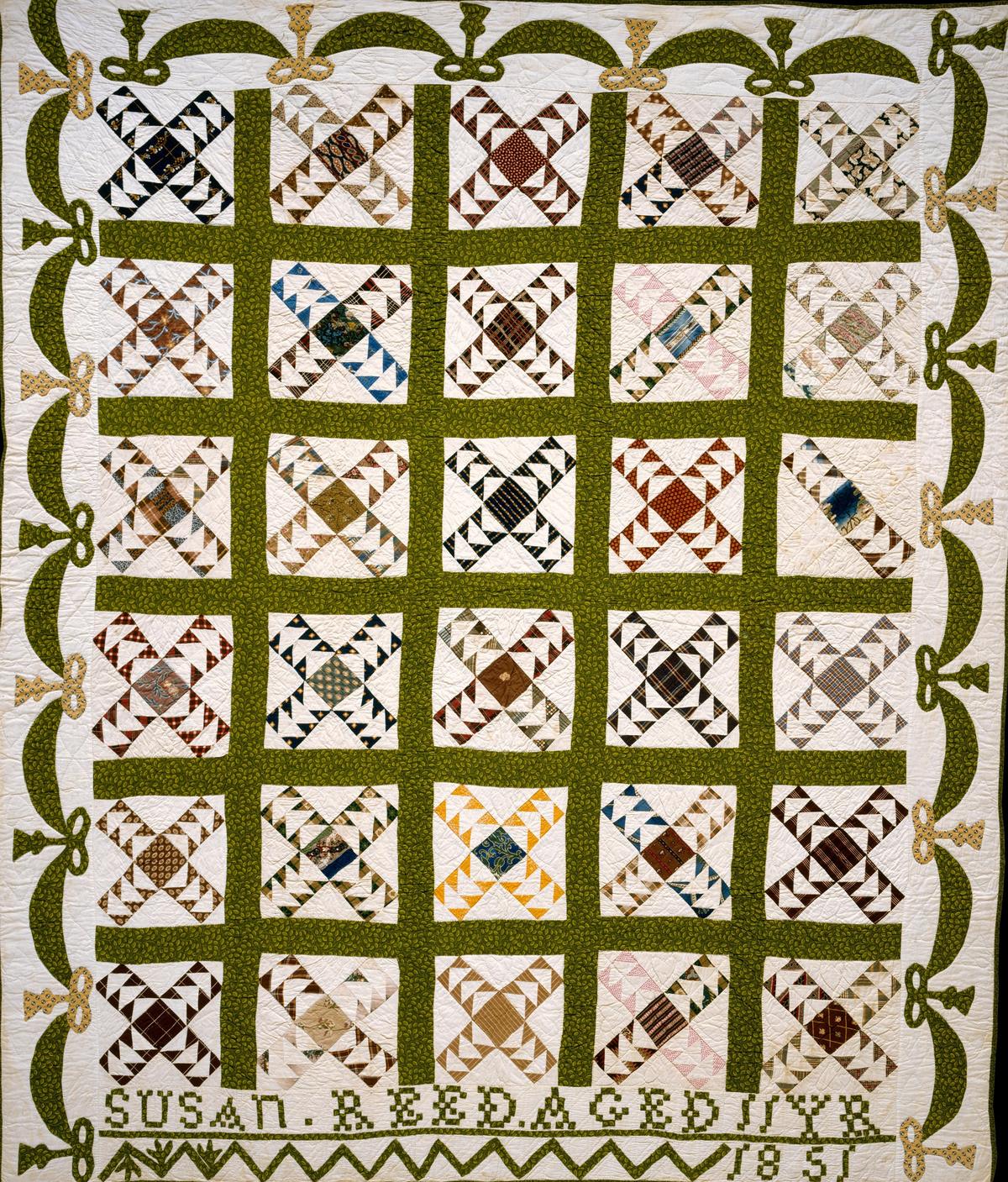
Where early names do survive, they come from everyday life. This quilt at the Met carries its maker's name in the bottom border, "SUSAN REED AGED 11 YR," and the year 1851. Susan Reed, later Ruddick, lived in Forestburgh, New York, and the Met catalogs her quilt as a Wild Goose Chase.

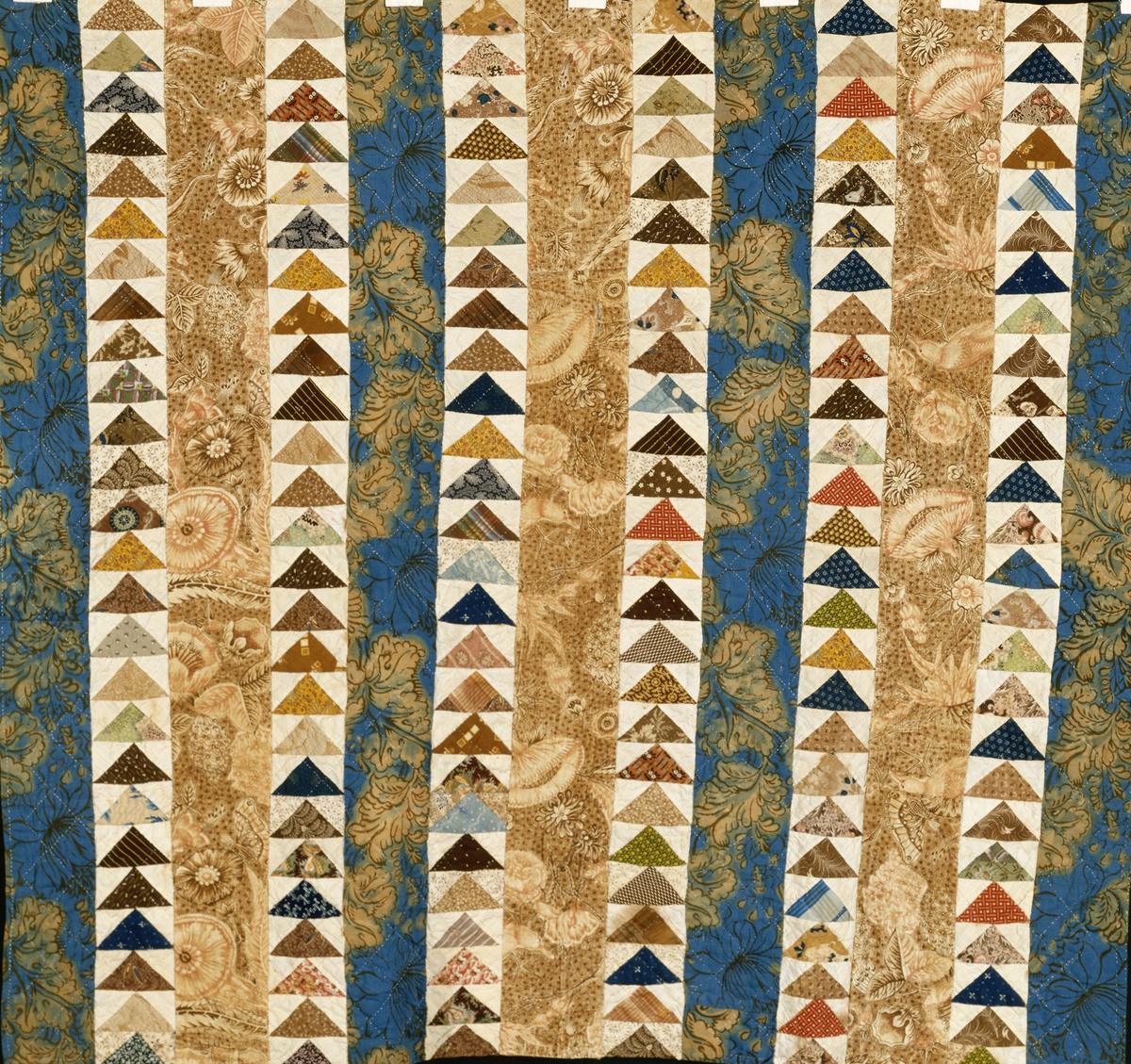
Rows of triangles were called a goose chase long before Flying Geese became the usual name; "goose-chase" is still on Fanny Bergen's list of 1892. A Smithsonian quilt of about 1840 runs the same triangles in strips between panels of printed chintz.

Pieced blocks of small triangles set in green sashing, with the words SUSAN REED AGED 11 YR and 1851 along the bottom border
Susan Reed Ruddick, Wild Goose Chase quilt, Forestburgh, New York, 1851, inscribed "SUSAN REED AGED 11 YR." The Metropolitan Museum of Art · Public domain
Vertical strips of small pieced triangles, all pointing up, between wide strips of blue and brown printed chintz
Flying Geese quilt, United States, about 1840. Smithsonian American Art Museum · CC0

c. 1840 – 1847

Names from books and the sea

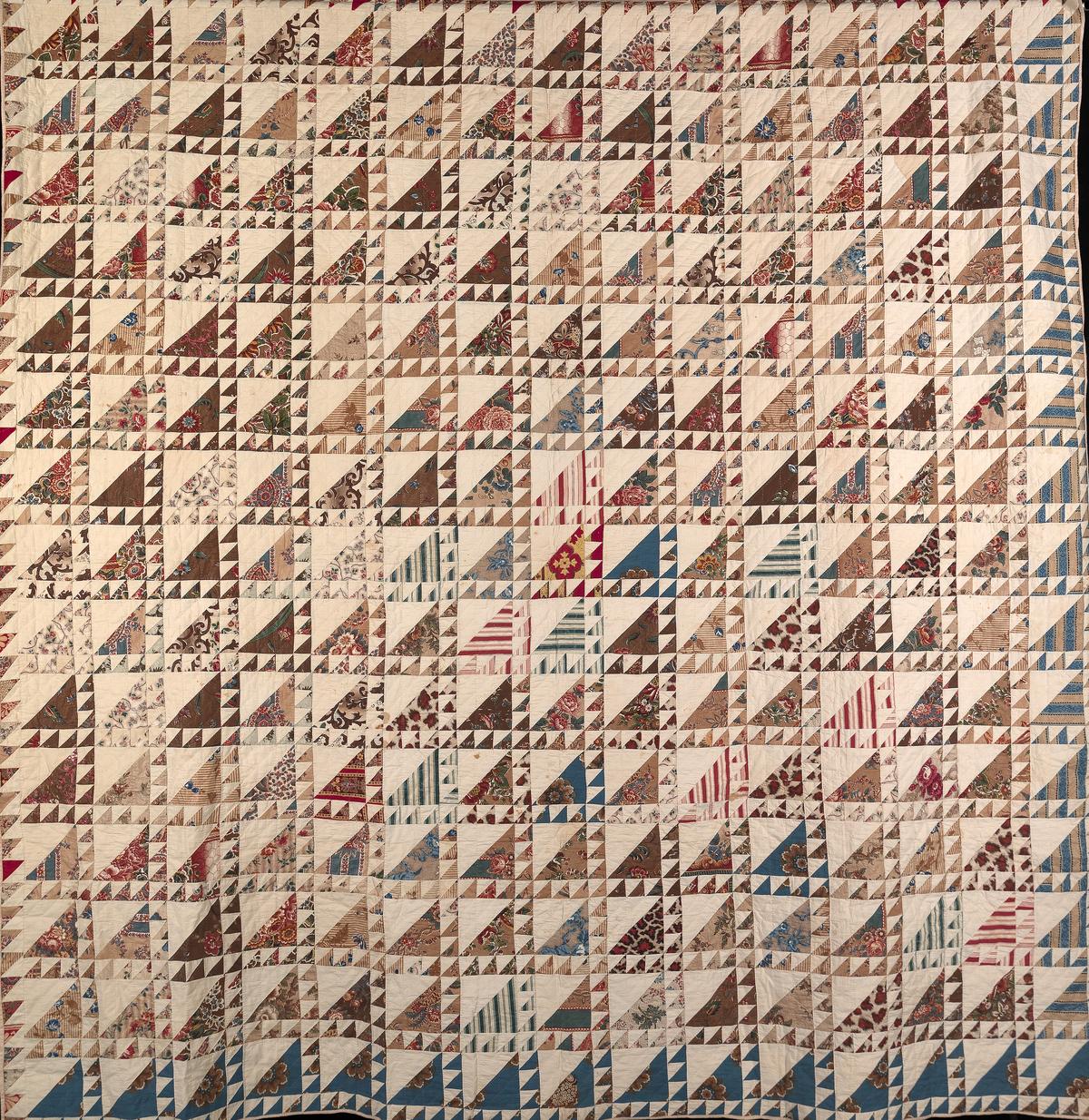
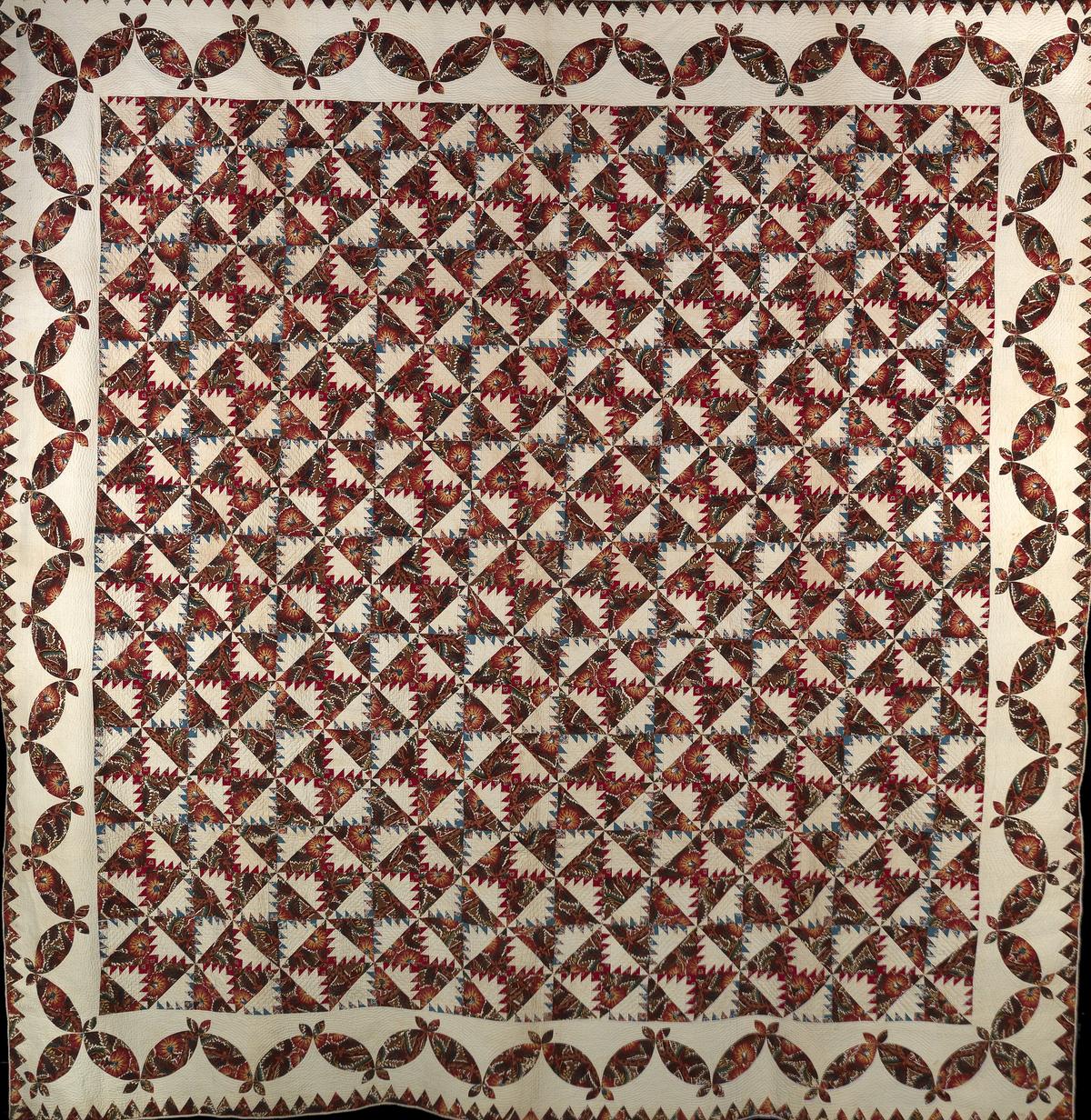
Museums catalog other early quilts under literary names. Lady of the Lake is the title of Walter Scott's best-selling 1810 poem, and Delectable Mountains is a place in Bunyan's Pilgrim's Progress. Whether the makers of these quilts used those names is not recorded.

Mariner's Compass takes its name from the compass rose on sea charts. Barbara Ann Miller pieced twenty-five of them in Pennsylvania in 1847.

A scrappy quilt of small brown, blue and red triangles around larger triangles in rows of blocks
Lady of the Lake quilt, United States, about 1840. Smithsonian American Art Museum · CC0
Rows of red sawtooth triangles forming peaks on a white quilt, inside a border of red leaf shapes
Delectable Mountains variation quilt, United States, about 1845. Smithsonian American Art Museum · CC0
Twenty-five sharp-pointed compass stars in red, green, yellow and blue, each in a circle on a brown ground
Barbara Ann Miller, Mariner's Compass quilt, Pennsylvania, 1847. The Metropolitan Museum of Art · Public domain

1852–1865

Battles and ballots

Some of the most dramatic names recall wars and elections, though most reached print long after the events they name.

1852

Burgoyne Surrounded

The Met owns a red-and-white quilt signed "Martha A. Page 1852" and catalogs it as Burgoyne Surrenders or Burgoyne Surrounded. The name recalls the 1777 surrender of British General John Burgoyne's army near Saratoga, New York, a turning point of the Revolution.

The International Quilt Museum notes that the design looks like the two-color woven coverlets common in early America. The quilt doesn't record what Martha Page called it, and the dramatic name is best documented in 20th-century pattern sources, when patriotic "colonial" names were fashionable.

A red and white quilt of small squares in rings and crosses, framed by a grapevine border, signed Martha A. Page 1852 at the top
Martha A. Page, Burgoyne Surrounded quilt, United States, 1852. The Metropolitan Museum of Art · Public domain

c. 1840 – 1865

Whig Rose, Democrat Rose, Lincoln's Platform

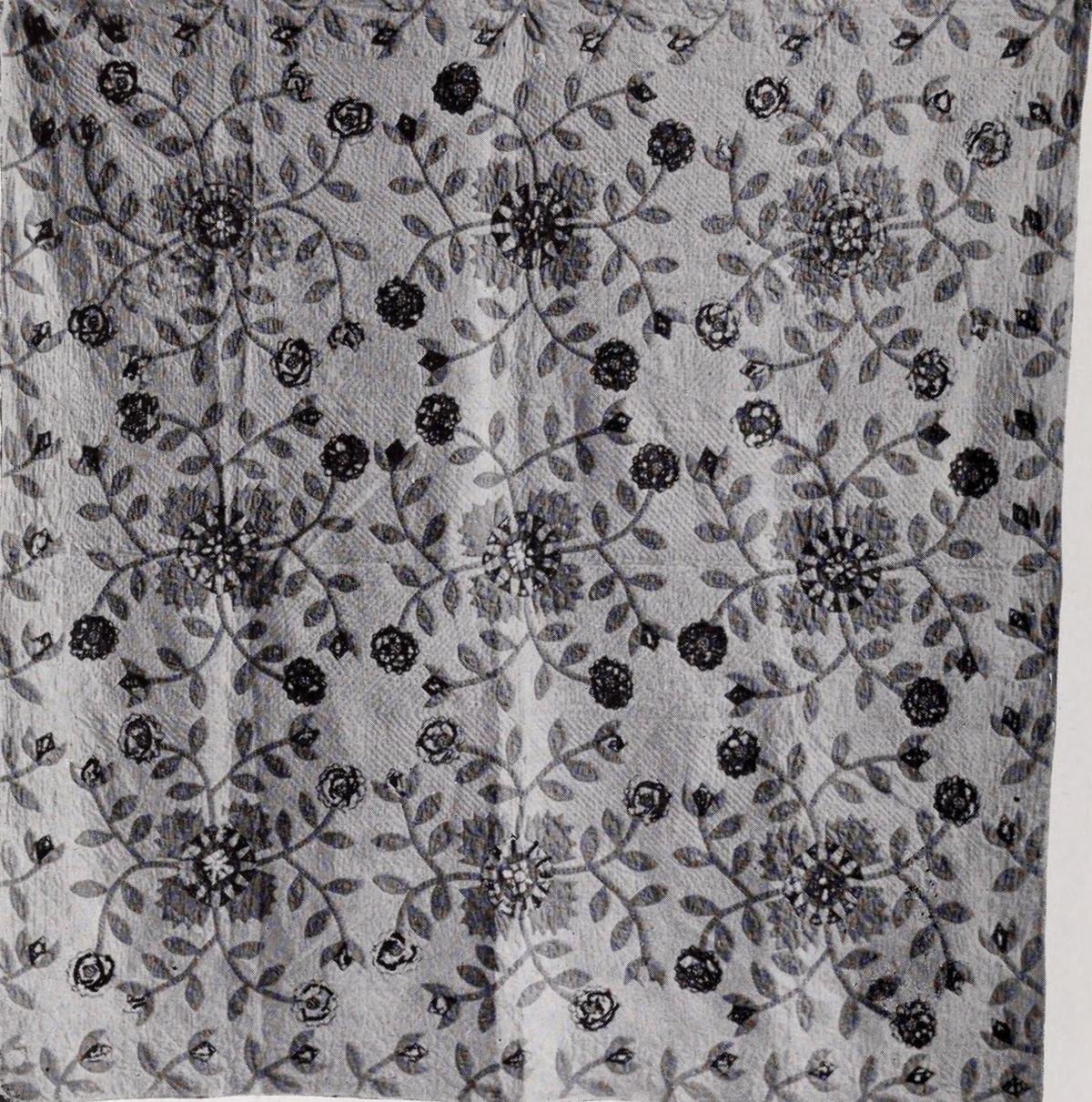
By the time Marie Webster wrote in 1915, many floral appliqué designs carried political names: Whig Rose, Democrat Rose, Harrison Rose, Old Tippecanoe and Lincoln's Platform. Webster read them as proof that women followed the politics of their day, and she published a Democrat Rose she dated to about 1845 in Pennsylvania.

Sarah Watkins Compton made this Whig Rose variation in Kentucky around 1860. Because these names reached print decades after the elections they recall, it is often impossible to say whether the original makers used them.

Nine appliquéd roses with green leaves on a white quilt inside a running green vine border of orange flowers
Sarah Watkins Compton, Whig Rose variation quilt with running vine border, Kentucky, about 1860. Los Angeles County Museum of Art · Public domain
A black and white photograph of an appliqué quilt of roses linked by curling vines
Democrat Rose, made in Pennsylvania about 1845, from Marie D. Webster's Quilts: Their Story and How to Make Them, 1915. Marie D. Webster, Quilts: Their Story and How to Make Them (1915) · Public domain

1888–1915

In less than thirty years, farm papers, a folklorist, a St. Louis pattern company and the first book on quilts turned a handful of names into hundreds.

1888 – 1891

Farm papers print readers' blocks

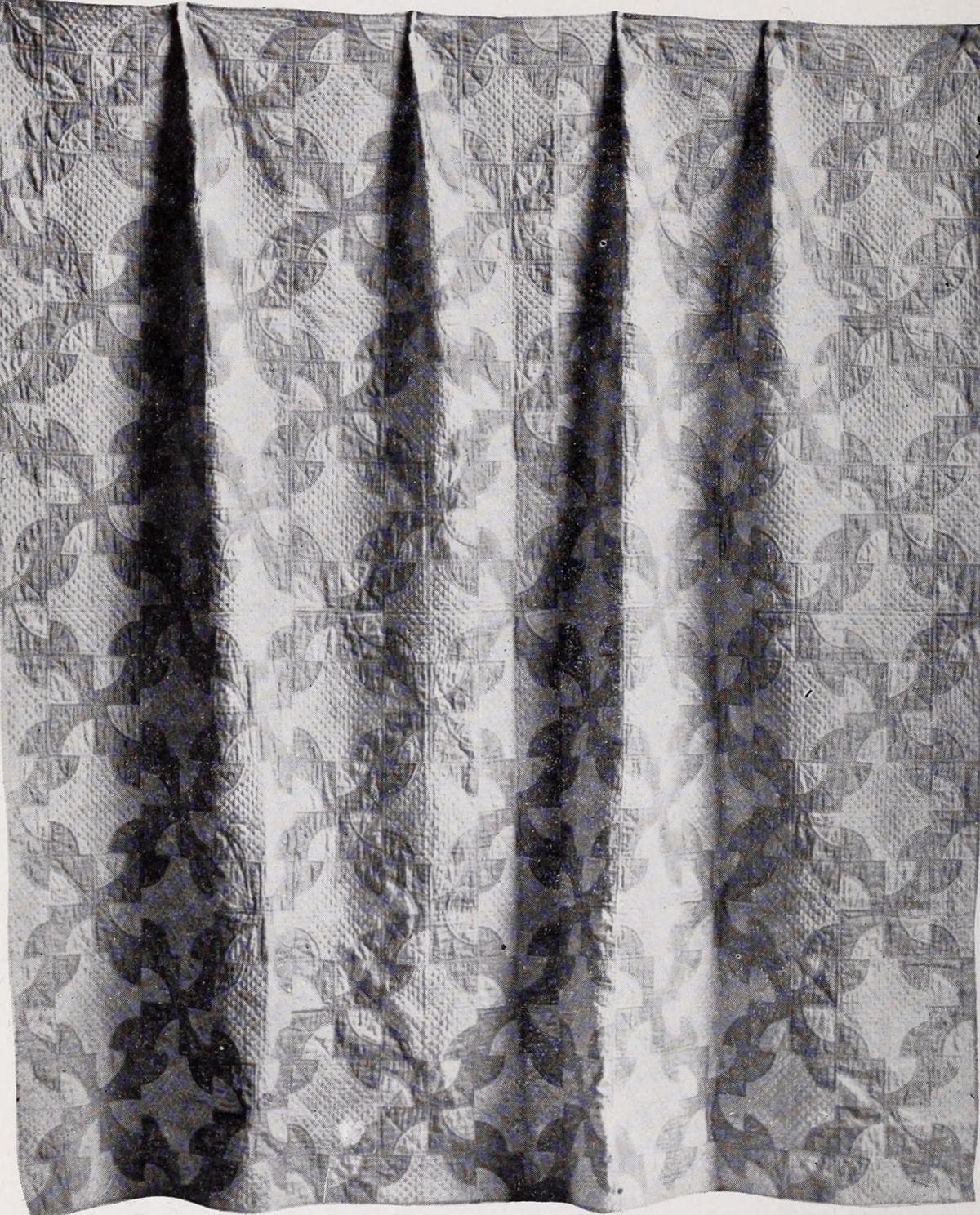
In the 1880s and 1890s farm and family papers began printing quilt blocks sent in by readers, often two or three at a time and sometimes without names. Farm and Home of Springfield, Massachusetts, printed the curved design we call Drunkard's Path as "Wanderer's Path in the Wilderness" in June 1888 and as "Robbing Peter to Pay Paul" in March 1890. Farm & Fireside ran the same curved combination with no name in 1891.

Names can even date a quilt. Barbara Brackman points to a New England quilt with names such as "Old Log Cabin, Spruce, Two Stumps" written on its blocks; because they match names published around 1890, she dates it about 1890–1910 rather than the 1820 once claimed.

A red and white quilt of curved pieces forming circles and rings
Drunkard's Path variation quilt, United States, about 1880–1900. Smithsonian American Art Museum · CC0

1892

A folklorist starts collecting the names

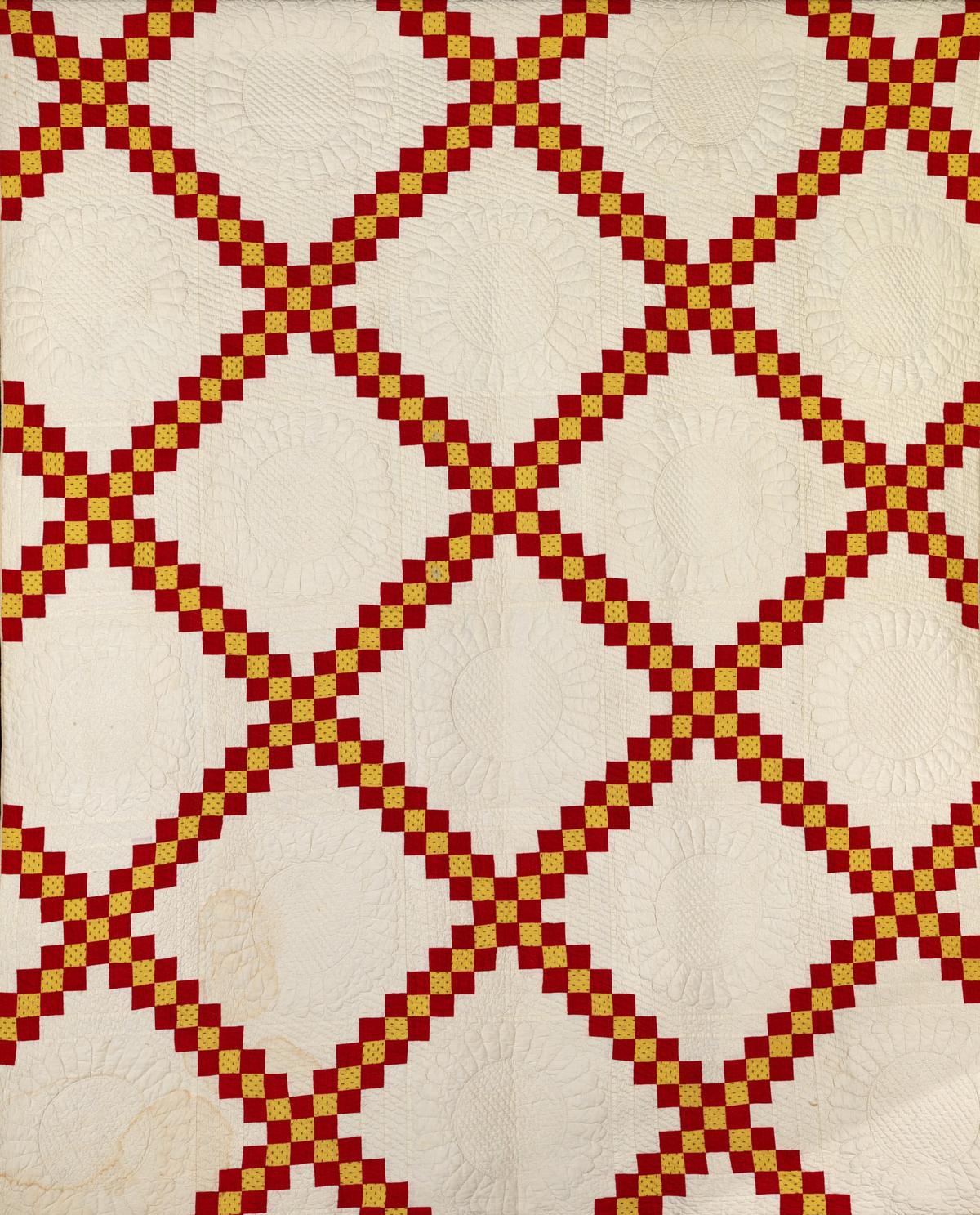
In 1892 Fanny D. Bergen asked readers of the Journal of American Folklore to help her collect quilt pattern names before the old craft disappeared. Her short list is one of the earliest printed snapshots of names in everyday use: album quilt, nine-patch, log cabin, star, tea-leaf, tumbler, state-house steps, goose-chase, pineapple, Irish chain, double Irish chain, brick work and rising sun.

Several of those names are still used today, and "state-house steps" is an early form of what is now called Courthouse Steps. For the story of that family of blocks, see Log Cabin quilts.

Red and yellow chains of small squares crossing a white quilt on the diagonal
Double Irish Chain quilt, Mississippi, about 1850–75. Smithsonian American Art Museum · CC0

1889 – 1928

The Ladies Art Company: the great namer

The Ladies Art Company, founded in St. Louis in 1889 by a German immigrant family, added quilt patterns to its needlework catalog in the mid-1890s. The catalog, first titled Diagrams of Quilt, Sofa and Pin Cushion Patterns, numbered every design and gave each a name: 420 quilt patterns in the 1898 edition, 450 in 1907 and 530 by 1928.

Its No. 220, Drunkard's Path, is the earliest known printed use of that name with a picture of the design, and it printed Bear's Paw as Bear's Foot. Quilt historian Cuesta Benberry called it the first major collection of quilt patterns in print, and noted that Marie Webster, Carrie Hall, Nancy Page, Nancy Cabot and the Kansas City Star all drew on it.

1915

Marie Webster's "Quilt Names"

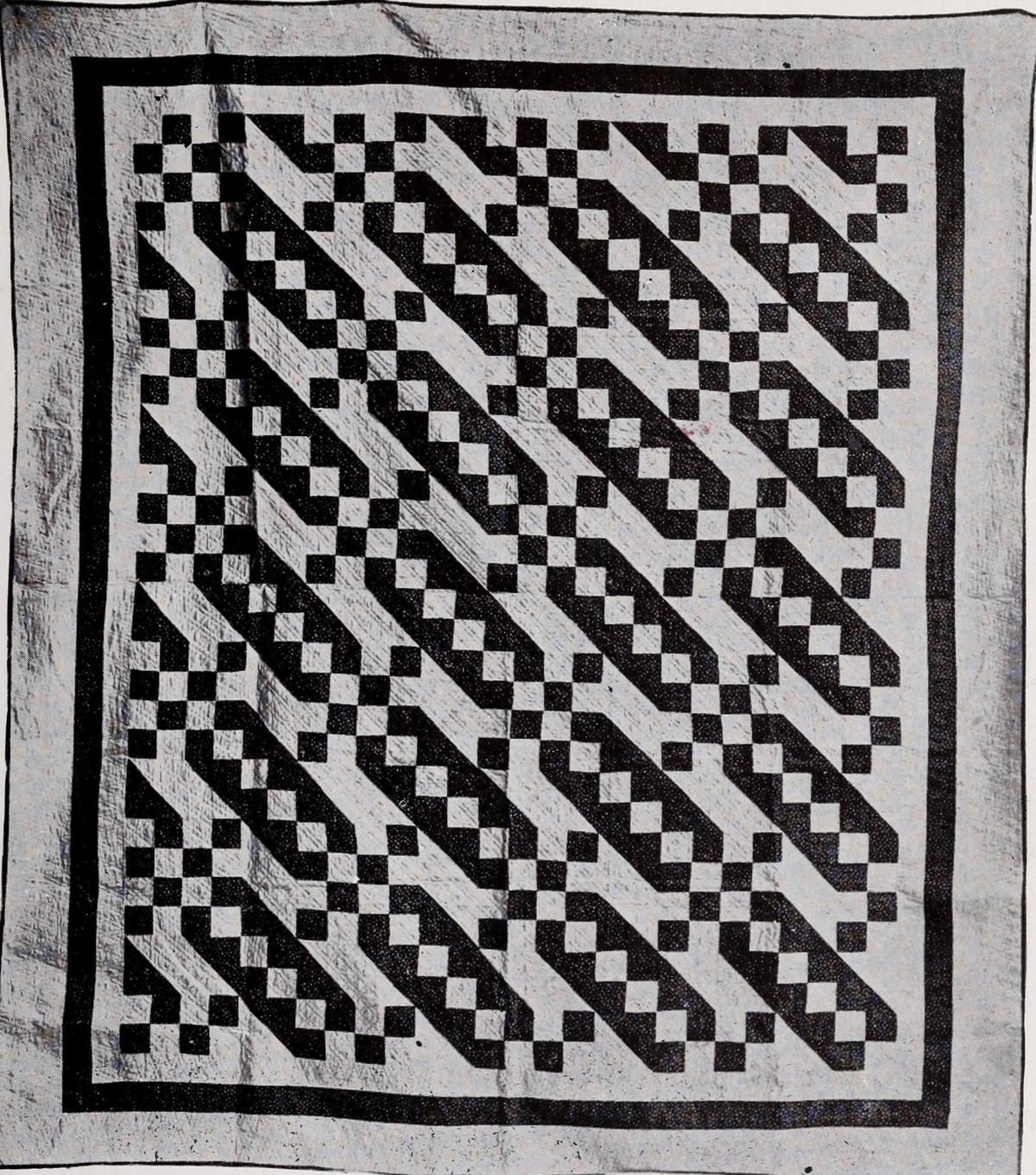
Marie Webster's Quilts: Their Story and How to Make Them (1915) was the first full book on American quilts, and it gave a whole chapter to names. Nature, religion, history, politics and humor all fed them, she wrote, and a small change to a block often earned a new one, as when a Nine Patch with a bigger center became Puss in the Corner.

She guessed that the family wag thought up names like Drunkard's Path and Old Bachelor's Puzzle, and she called Jacob's Ladder one of the most striking quilts with a Biblical name. Her list of pattern names closely follows the Ladies Art Company catalog.

A black and white photograph of a Jacob's Ladder quilt of dark and light squares running in diagonal steps
Jacob's Ladder, "one of the most striking of the quilts having Biblical names," from Marie D. Webster's Quilts: Their Story and How to Make Them, 1915. Marie D. Webster, Quilts: Their Story and How to Make Them (1915) · Public domain
A black and white photograph of a Drunkard's Path quilt hanging in folds
Drunkard's Path, "a modern quilt after an old pattern," from Marie D. Webster's Quilts: Their Story and How to Make Them, 1915. Marie D. Webster, Quilts: Their Story and How to Make Them (1915) · Public domain

1917–1942

The pattern boom

Newspaper columns, pattern books and a Depression art project spread the old names, and coined plenty of new ones.

1917 – 1961

Newspaper columns name a thousand blocks

From the late 1910s, newspapers hired quilt columnists who printed patterns weekly, both old designs and new ones sent in by readers. Ruby Short McKim's Mother Goose Quiltie series for the Omaha Daily News in 1917 is the earliest known syndicated newspaper quilt series. Florence LaGanke wrote as Nancy Page, and Loretta Leitner Rising as Nancy Cabot in the Chicago Tribune.

The Kansas City Star printed its first block in 1928 and more than 1,000 patterns by 1961. Columnists renamed old designs and coined new ones, so the same block could appear under different names in different papers.

1928 – 1940

New "old" favorites

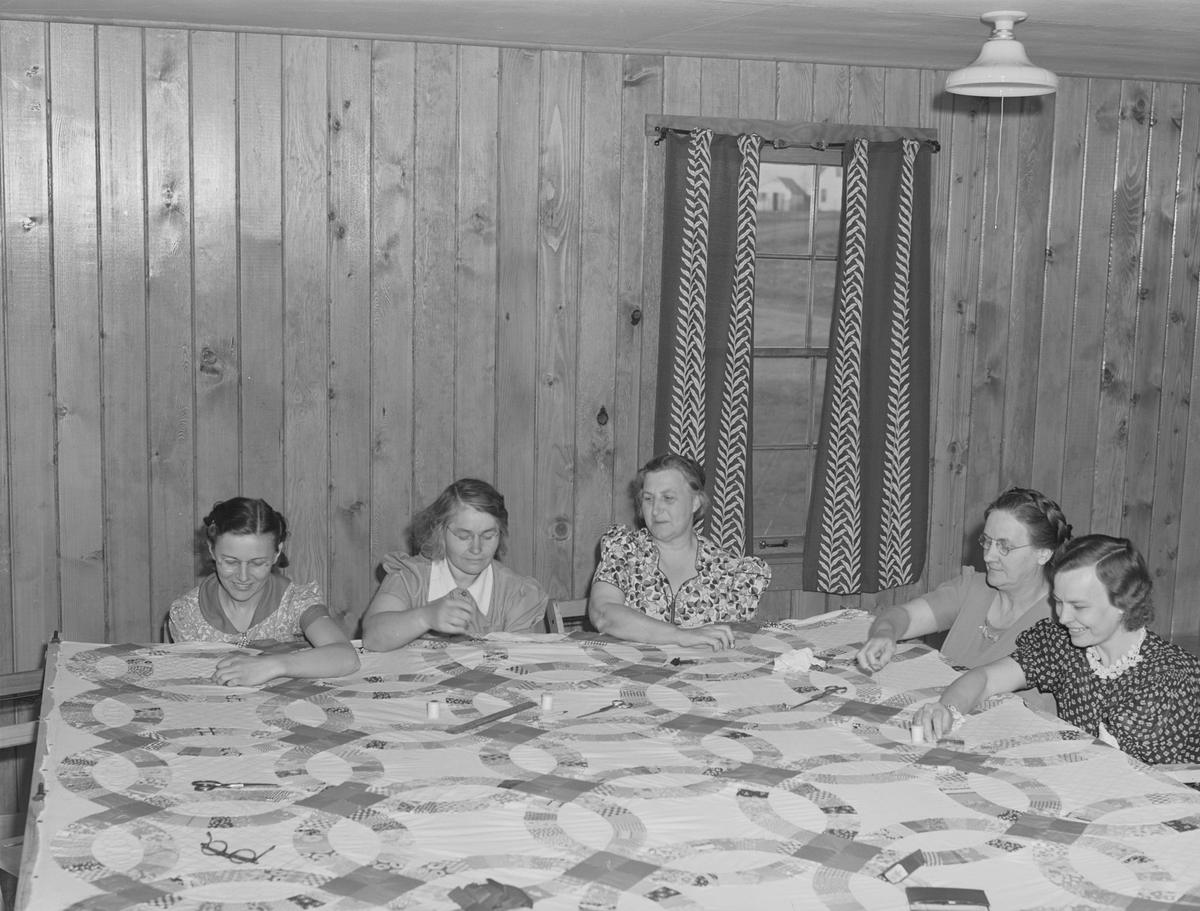
Some of the best-loved "traditional" names are younger than people think. Wilene Smith found the Double Wedding Ring first illustrated in Capper's Weekly on October 20, 1928, with the name itself in print by 1931, and Barbara Brackman's earliest date-inscribed example is from 1932. Don't confuse it with the Single Wedding Ring, a pieced block of squares and triangles.

Dresden Plate and the garden names for hexagon quilts, such as Grandmother's Flower Garden, also belong to the pattern boom of the 1920s and 1930s. In 1940 a Farm Security Administration photographer found a women's club in Granger, Iowa, quilting a Double Wedding Ring together; there's more on that in quilting bees.

Five women at a quilting frame in a wood-paneled room, quilting a Double Wedding Ring quilt
John Vachon, members of the women's club quilting a Double Wedding Ring, Granger Homesteads, Iowa, 1940. Library of Congress, FSA/OWI · Public domain

1929 – 1935

Storytellers: Finley, Hall and Kretsinger

Ruth Finley's Old Patchwork Quilts and the Women Who Made Them (1929) and Carrie Hall and Rose Kretsinger's The Romance of the Patchwork Quilt in America (1935) spread many of the colorful naming stories still repeated today. Finley wrote that the block called Bear's Paw in Ohio was Duck's Foot in the Mud on Long Island and Hand of Friendship among Philadelphia Quakers.

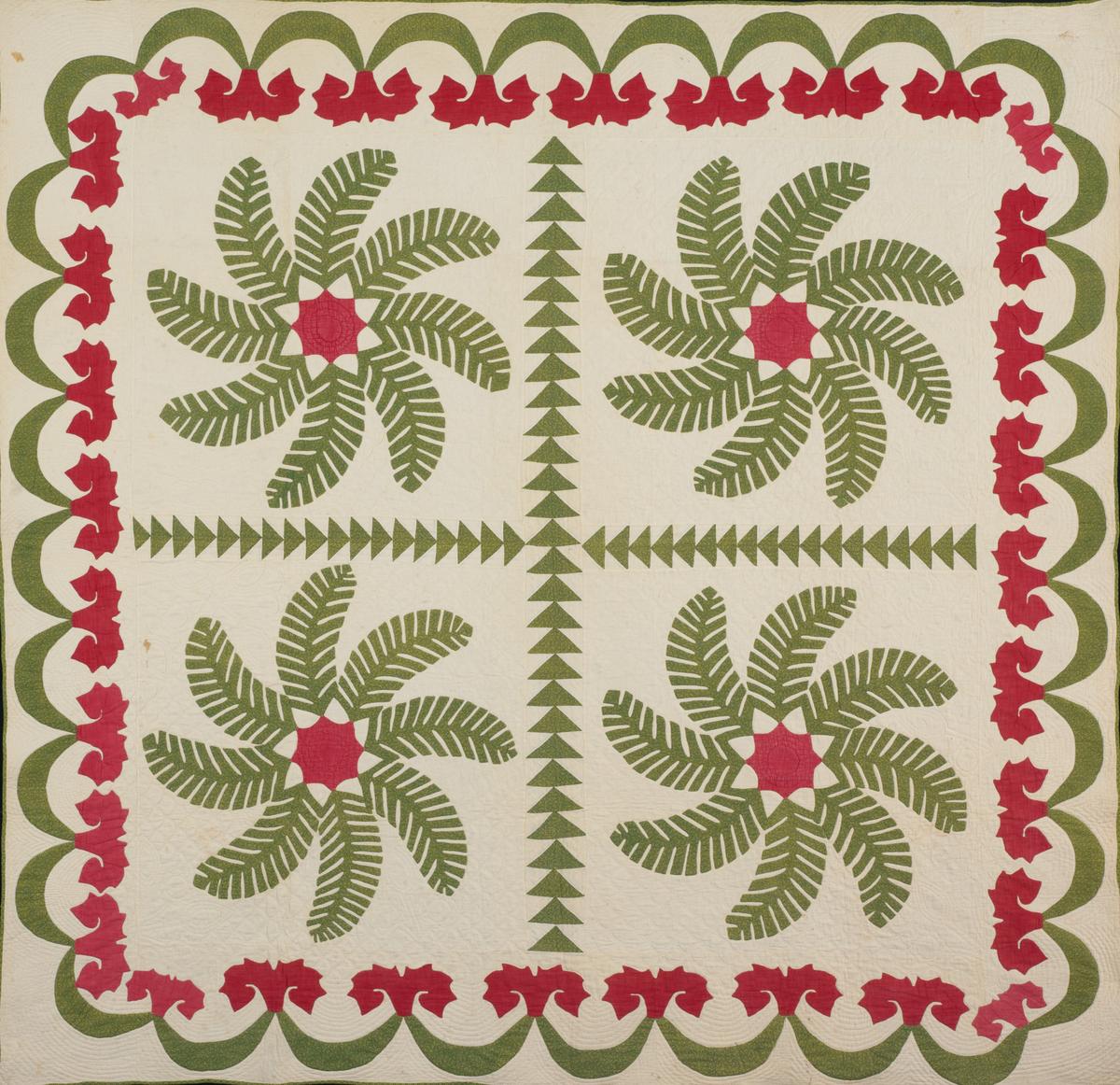
Hall acknowledged using the Ladies Art Company catalog. These books drew on interviews and family lore, so their origin stories are valuable folklore but not proof of when or why a name began. Museums keep the double names too: the Art Institute of Chicago lists this appliqué of about 1850 as "Princess Feather" or "Ostrich Plume."

Four green appliquéd whirls of feathers around red stars, with a border of green swags and red tulips
"Princess Feather" or "Ostrich Plume" quilt, United States, about 1850. Art Institute of Chicago · Public domain

1935 – 1942

The Index of American Design records the names

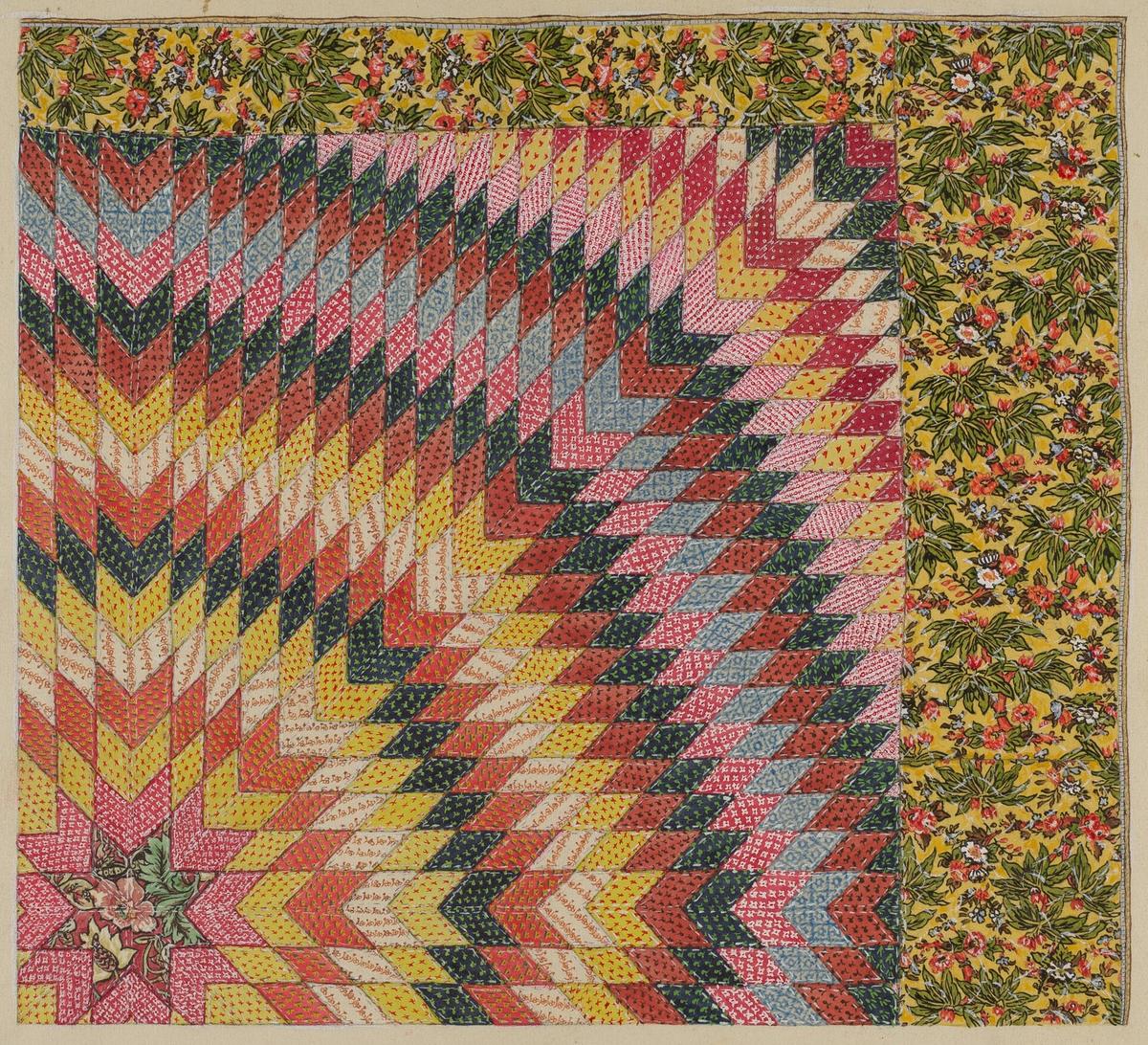
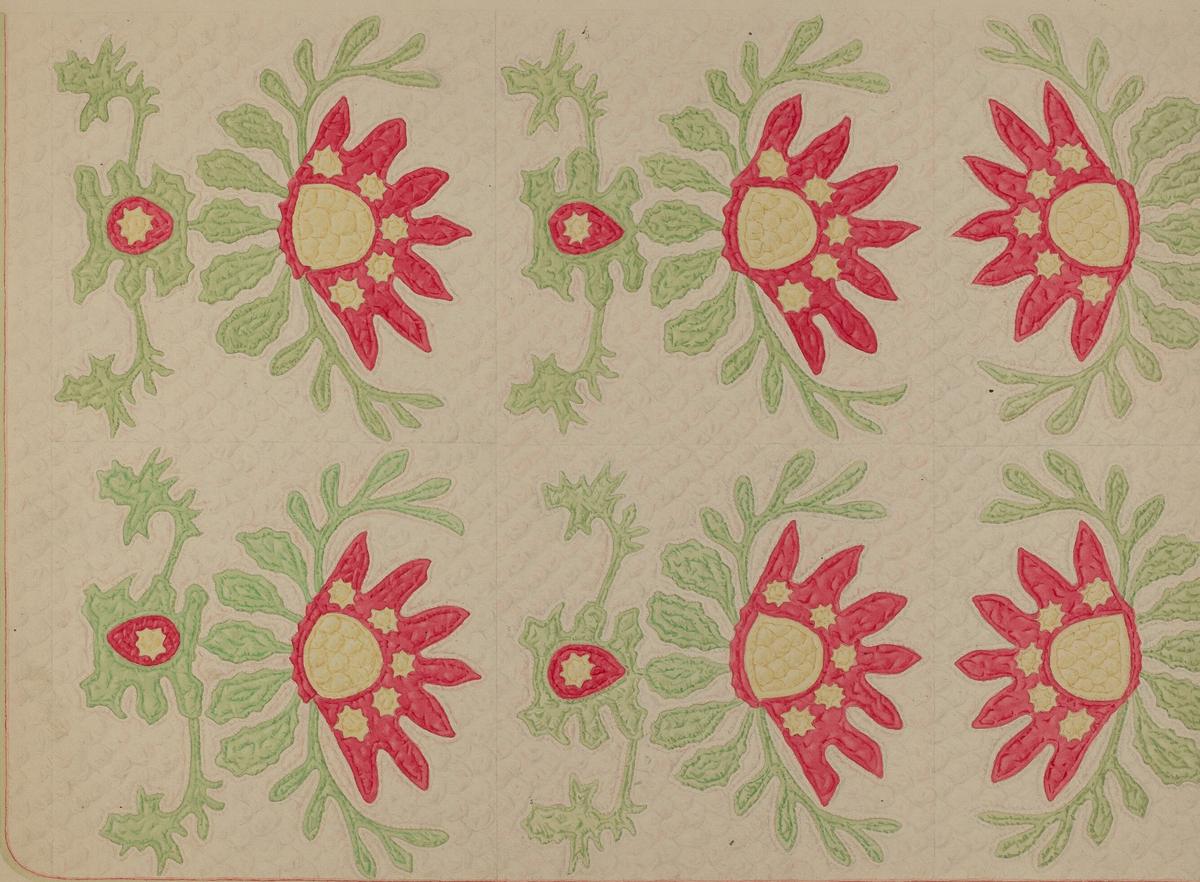
During the Depression, the Works Progress Administration's Index of American Design paid artists to paint exact watercolors of American folk objects, including hundreds of quilts. Their titles record the pattern names in use in the 1930s, such as "Rising Sun," from Westchester County, New York, and "King David's Crown."

The roughly 18,000 renderings are now at the National Gallery of Art, which has released its images of them as open access.

A watercolor of one corner of a quilt with rings of colored diamonds radiating from a star, inside a yellow floral border
Maud Schmid, Quilt – "Rising Sun," watercolor for the Index of American Design, about 1936 (quilt from Westchester County, New York). National Gallery of Art, Index of American Design · CC0
A watercolor of an appliqué quilt with red and yellow crown-like flowers and pale green leaves on white
Elbert S. Mowery, Appliqué Quilt – "King David's Crown," watercolor for the Index of American Design, about 1938. National Gallery of Art, Index of American Design · CC0

1979 – today

Sorting out the names

1979 – today

Brackman's encyclopedia

Quilt historian Barbara Brackman began indexing printed patterns in 1979, and her Encyclopedia of Pieced Quilt Patterns (1993) catalogs more than 4,000 pieced designs from sources printed between about 1830 and 1970. Each design gets a number, with every published name and source listed under it, which is why quilters cite "Brackman numbers" such as 1461 for Drunkard's Path. The database lives on as BlockBase software.

The index shows both problems at once: one block with a dozen names, and one name used for several different blocks. The eight-pointed LeMoyne Star here, made about 1860, carries a name whose origin story nobody can prove (see the myths below).

The old names live on in every pattern book. Quiltler's block guides, from Churn Dash and Shoofly to Ohio Star, give each block's cutting sizes, and in Quiltler you can add a classic block to a design of your own.

Rows of bright eight-pointed silk stars in pinks, yellows and reds on a black ground
Star of LeMoyne variation quilt, United States, about 1860. The Metropolitan Museum of Art · Public domain

Block name myths

Block names attract good stories. Here is what printed sources and quilt historians actually show.

Unproven

Drunkard's Path was a temperance pattern, made to protest alcohol.

No 19th-century document links it to the Woman's Christian Temperance Union, and quilt historians have found few quilts that support the idea. The design was printed earlier as "Wanderer's Path in the Wilderness" (1888) and "Robbing Peter to Pay Paul" (1890), and Marie Webster (1915) thought the name was simply a family joke.

Myth

Bear's Paw, Drunkard's Path, Flying Geese and Log Cabin were a secret Underground Railroad code.

The "quilt code" comes from one family's oral account published in Hidden in Plain View (1999). Historians have found no mention of it in 19th-century slave narratives, abolitionist records or the 1930s interviews with formerly enslaved people, and several of the "code" names aren't found in print until the 1880s to 1920s. See the quilt code.

Often false

The names we use today are the names the original makers used.

Museums catalog old quilts under modern pattern names. A hexagon quilt of about 1815–40 was "honeycomb" or "mosaic" to its maker, not Grandmother's Flower Garden, a 20th-century name, and Drunkard's Path was printed under other names first.

Unproven

Burgoyne Surrounded is a map of the troops surrounding Burgoyne at Saratoga.

The name recalls the 1777 surrender, but there's no record of the design being drawn from the battle. It looks like early two-color woven coverlets, and the earliest dated example, from 1852, doesn't record its maker's name for it.

Unproven

The LeMoyne Star is named for the Le Moyne brothers who founded New Orleans, and "Lemon Star" is a mispronunciation.

Museum records repeat the story, but no early document ties the eight-pointed star to the brothers. The design was in use by the 1840s to 1860s; the name appears in print much later.

Myth

The Double Wedding Ring is an old colonial pattern.

It's a 20th-century favorite: first illustrated in 1928, named in print by 1931, with the earliest date-inscribed example from 1932.

Sew the blocks behind the names

Each guide shows the block, its cutting sizes and how to design a whole quilt with it.

Questions about block names

How did quilt blocks get their names?

From everyday life, reading, the Bible, history, politics and humor, and often long after the quilts were made. Early quilters mostly described patterns by shape. Names multiplied in print from the 1880s, when farm papers, the Ladies Art Company catalog and later newspaper columns gave every design a name.

Why is it called Drunkard's Path?

No one knows. Marie Webster guessed in 1915 that a family joker named it. The design was printed first as "Wanderer's Path in the Wilderness" (1888) and "Robbing Peter to Pay Paul" (1890), and the Ladies Art Company's No. 220 is the earliest known printed Drunkard's Path with a picture. The popular link to the temperance movement has never been documented.

Why do quilt blocks have so many different names?

Patterns spread by hand and then through many papers and catalogs, and columnists renamed old designs and coined new ones. Ruth Finley wrote in 1929 that the block called Bear's Paw in Ohio was Duck's Foot in the Mud on Long Island and Hand of Friendship among Philadelphia Quakers, while the Ladies Art Company printed it as Bear's Foot.

What was the first published quilt pattern?

The usual answer is the hexagon "honey-comb patch-work" in Eliza Leslie's The American Girl's Book (1831), reprinted in Godey's Lady's Book in 1835. It recorded a design Americans had been sewing for decades.

What were the Ladies Art Company and Kansas City Star patterns?

The Ladies Art Company of St. Louis published a catalog of numbered, named quilt patterns from the mid-1890s, with 420 in 1898 and 530 by 1928; later writers and columnists drew on it. The Kansas City Star printed its first quilt block in 1928 and more than 1,000 patterns by 1961, renaming old designs and coining new ones along the way.

Were quilt block names used as Underground Railroad codes?

There's no evidence they were. The quilt code story comes from one family's account published in 1999, and historians have found no trace of it in 19th-century sources. Several of the block names in it weren't in print until the 1880s or later. See Underground Railroad quilts.

What is a Brackman number?

The number a design has in Barbara Brackman's Encyclopedia of Pieced Quilt Patterns (1993), which indexes more than 4,000 pieced patterns printed between about 1830 and 1970, with every published name listed under each. Drunkard's Path, for example, is 1461.

More quilt history

Sources and image credits

  1. Barbara Brackman, Hexagon Quilts: Miscellaneous Info (2021)
  2. Barbara Brackman, Pattern Blocks (2020), citing Wilene Smith, "Quilt Blocks—or—Quilt Patterns," Uncoverings 1986
  3. International Quilt Museum, World Quilts: The American Story — Publishing Explosion
  4. TRC Leiden, Grandmother's Flower Garden
  5. The Met: Susan Reed Ruddick, Wild Goose Chase Quilt, 1851
  6. The Met: Martha A. Page, Burgoyne Surrenders or Burgoyne Surrounded Quilt, 1852
  7. International Quilt Museum, Burgoyne Surrounded
  8. Art Institute of Chicago: "Pincushion and Burrs" or "Square and Swallows" Quilt, about 1830
  9. Marie D. Webster, Quilts: Their Story and How to Make Them (1915), Internet Archive
  10. Fanny D. Bergen, "Quilt Patterns," Journal of American Folklore 5, no. 16 (1892): 69
  11. Wilene Smith, "Drunkard's Path Quilts, T Quilts, and the W.C.T.U." (Quilt History Tidbits)
  12. Barbara Brackman, Drunkard's Path Variations 1 (2022)
  13. Barbara Brackman, Temperance Quilts 1: T Blocks (2016)
  14. Barbara Brackman, "Old Log Cabin, Spruce, Two Stumps": pattern names on a quilt (2017)
  15. Cuesta Benberry, "An Historic Quilt Document: The Ladies Art Company Catalog," Quilters' Journal (Quilt Index)
  16. International Quilt Museum, Ladies Art Company Alphabet Patterns
  17. Barbara Brackman, Kansas City Star Quilt Patterns List (2020)
  18. Wilene Smith, Wedding Ring designs (Quilt History Tidbits)
  19. Barbara Brackman, Double Wedding Rings (2010)
  20. Library of Congress: John Vachon, Members of the women's club making quilt, Granger Homesteads, Iowa, 1940
  21. Barbara Brackman, Turkeys, Hens & Bears (2019)
  22. National Gallery of Art, Index of American Design
  23. Barbara Brackman, Encyclopedia of Pieced Quilt Patterns ebook (2013)
  24. International Quilt Museum: Underground Railroad Quilts?
  25. Smithsonian Folklife: Underground Railroad Quilt Codes
  26. Spencer Museum of Art: Eight-Point Star or Le Moyne Star crib quilt

Every picture is in the public domain or released under CC0: quilts from the Metropolitan Museum of Art, the Smithsonian American Art Museum, the Art Institute of Chicago and the Los Angeles County Museum of Art, watercolors from the National Gallery of Art's Index of American Design, plates from Marie Webster's 1915 book and a Farm Security Administration photograph from the Library of Congress. Each caption names the object and links to its record.